As I wrote a few weeks ago, there are some serious contenders for Tyrannosaurus’ crown as the biggest, fiercest land carnivore of all time. Giganotosaurus and Megaraptor could certainly give Tyrannosaurus a battle, but this week’s contenders, from Africa, are even more powerful.
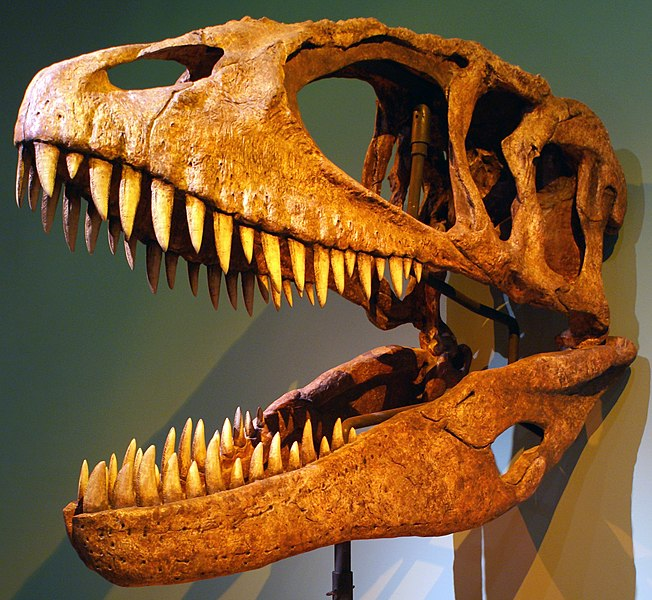
Carcharodontosaurus (Kar-KAR-oh-don-toe-SAWR-us) lived in Northern Africa during the late Cretaceous Period 99 to 94 million years ago. Its name means “shark-toothed lizard,” and its long jagged-edged teeth are much like those of a shark.
Most estimates rank Carcharodontosaurus as about three or four feet longer than Tyrannosaurus. It’s hard to tell because scientists have found only some tens of bones and a number of teeth from it.
Even if Carcharodontosaurus is slightly larger, Tyrannosaurus still has a number of advantages. Smithsonian Magazine reported that Tyrannosaurus’ bite force was almost 12,800 pounds, stronger than any other animal that ever walked on land. (Megalodon, an enormous extinct shark, does have it beat at 41,000 pounds. There was also an extinct crocodile named Purussaurus which had a bite of 15,500 pounds of force.) Tyrannosaurus’ bite was stronger than the force of an average-sized African elephant dropping on you. (I don’t want to even think what that means about Megalodon’s bite.) Tyrannosaurus’ teeth are shaped like bananas. The rounded shape is very effective at breaking bones. Carcharodontosaurus’ teeth were shaped differently. They were thinner, more like the blade of a knife. They were meant for shearing meat from bones. They might have broken if Carcharodontosaurus bit directly into thick bones.
Tyrannosaurus also had an advantage in eyesight. Its eyes were more forward looking than Carcharodontosaurus’. This gave Tyrannosaurus a wider range of sight, enabling it to see more of what was in front of it. Because of the shape of Carcharodontosaurus’ skull, it would have had to drop its head toward its chest to see any distance ahead. This likely meant it hunted its prey by ambushing them, rather than chasing after them. Regardless, if the two had ever met, it would have been a titanic battle.
Franko Fonseca from Redondo Beach, USA, CC BY-SA 2.0,via Wikimedia Commons
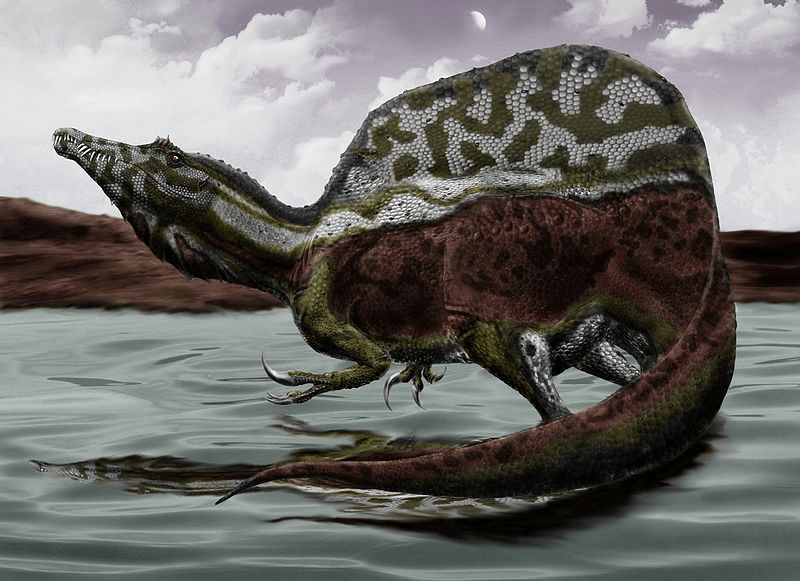
And then there’s the biggest of the top five, Spinosaurus. It also lived during the late Cretaceous Period and was found in North Africa. This creature was about 49 feet long and weighed just over eight tons. However, its back legs were much shorter than Tyrannosaurus’, making it about 9 feet tall at the hip compared to Tyrannosaurus’ 12-15 feet in height. However, if the sail on Spinosaurus’ back is included, then it was 15-16 feet tall.
Durbed, CC BY-SA 3.0, via Wikimedia Commons
It’s difficult to compare its power to the other three because it was shaped differently and lived a different kind of life. It was a little thinner, with a large sail on its back, a paddle-shaped tail and its jaws were long and narrow like a crocodiles’. Its teeth were like overturned ice cream cones instead of curved with jagged edges. Scientists think that it hunted at least part of the time in the water and that on land it stayed near the coast and ambushed its prey, rather than running it down. Its likely that, despite its huge size, its shorter legs would have made it less agile than Tyrannosaurus. Its tail would have been a formidable weapon for knocking other dinosaurs around, but that might not be enough.
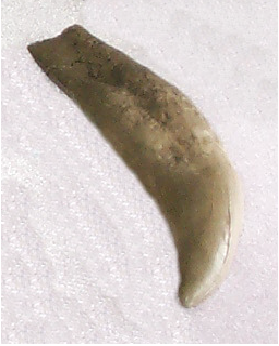
Figure 1 (left) Spinosaurus tooth – 1 Jiří X. Doležal (about me), CC BY-SA 3.0, via via Wikimedia Commons. Figure 2 (right) Tyrannosaurus tooth
Scientists don’t know which of these dinosaurs was most powerful. Even though it’s been many years since Giganotosaurus, Megaraptor, Carcharodonotosaurus, and Spinosaurus were discovered, scientists still know very little about them. It takes a long time for fossil bones to be excavated and studied. For me, however, Tyrannosaurus still holds its crown by virtue of its long teeth, large brain, and powerful bite. But never forget that there is another alternative: any day a paleontologist might dig up a new dinosaur that could take on all of them.
What do you think?
Sources (Click Me!)
Aureliano Tito, Aline M. Ghilardi, Edson Guilherme, Jonas P. Souza-Filho, Mauro Cavalcanti, and Douglas Riff . “Morphometry, Bite-Force, and Paleobiology of the Late Miocene Caiman Purussaurus brasiliensis.” PLOS ONE. 17 Feb. 2015. https://journals.plos.org/plosone/article?id=10.1371/journal.pone.0117944.
Novas, Fernando, E., Diego Pol Juan I. Canale; Juan D. Porfiri; Jorge O. Calvo. “A bizarre Cretaceous theropod dinosaur from patagonia and theevolution of Gondwanan deomaeosaurids. Proceedings: Biological Sciences, Mar2009, Vol. 276 Issue 1659, p1101-1107, 7p.
Richardson, Hazel. Smithsonian Handbooks: Dinosaurs and Prehistoric Life. New York: Dorling Kindersley, 2003.
Sereno PC, Myhrvold N, Henderson DM, Fish FE, Vidal D, Baumgart SL, Keillor TM, Formoso KK, Conroy LL. “Spinosaurus is Not an Aquatic Dinosaur.” Elife. 2022 Nov 30;11:e80092. doi: 10.7554/eLife.80092. PMID: 36448670; PMCID: PMC9711522.
Smith, Nathan D., Peter J. Makovicky1, Federico L. Agnolin, Martin D. Ezcurra, Diego F. Pais3 and Steven W. Salisbury. “A Megaraptor -like theropod (Dinosauria: Tetanurae) in Australia: support for faunal exchange across eastern and western Gondwana in the Mid-Cretaceous.” Proceedings of the Royal Society. 20 May 2008.
“Sue at the Field Museum.” The Field Museum, Chicago, IL. 2007. 15 July 2009.
University of Queensland. “Australian Dinosaur Found To Have South American Heritage.” ScienceDaily 15 June 2008. 10 September 2009 <http://www.sciencedaily.com /releases/2008/06/080613111410.htm>.
Tyrannosaurus rex, long considered the largest carnivorous dinosaur, faces competition from newer discoveries.
The name Tyrannosaurus rex means “king of the tyrant lizards,” but a number of other giant carnivores would like to steal its crown. Recently some pretty big, fierce dinosaurs have been found.
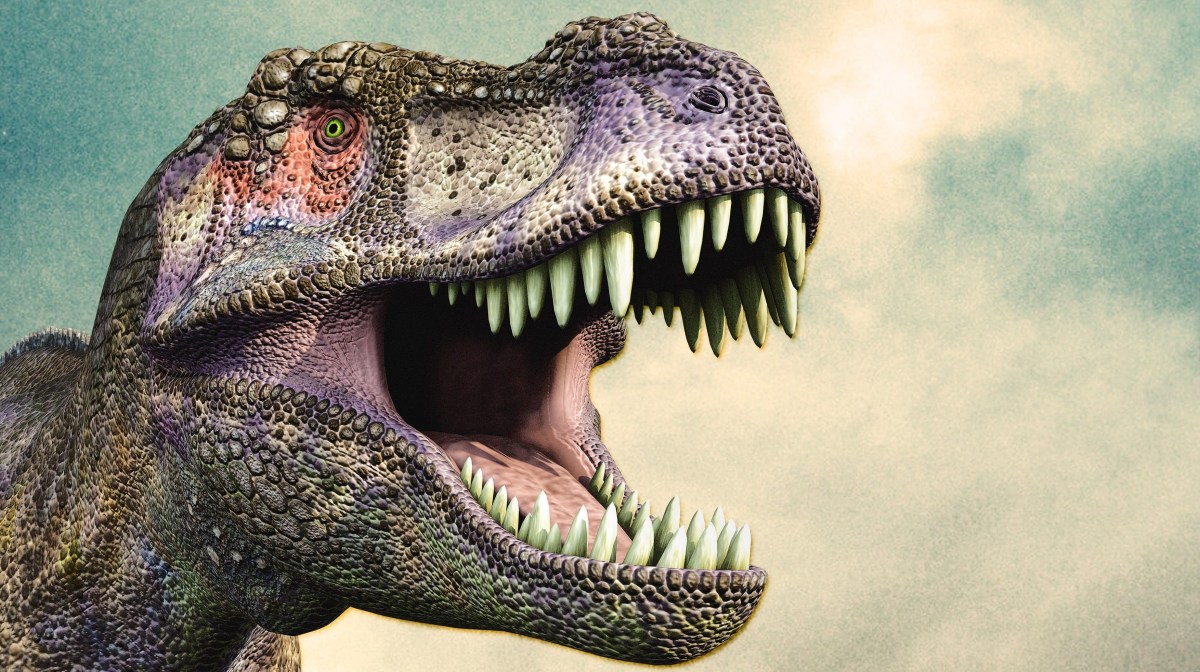
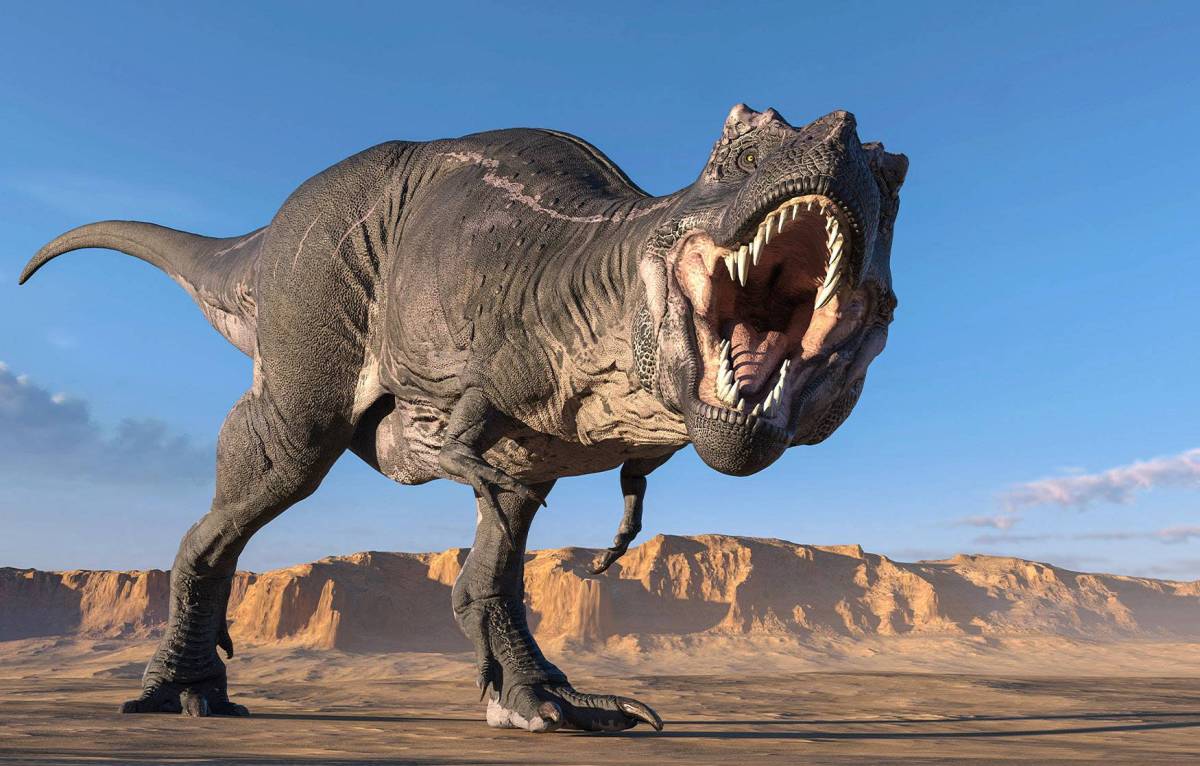
Tyrannosaurus Nobu Tamura, CC BY-SA 4.0, via Wikimedia Commons
From its discovery in 1902 until the 1990s, Tyrannosaurus rex was regarded as the biggest, most powerful carnivorous dinosaur of all. It was about 40-42 feet long, stood about 12-15 feet tall at the hip, and weighed about 9.7 tons. These days, however, there are at least four other contenders for that crown. Two are from Argentina and two are from Africa. Today, I’m going to write about the two from Argentina, and in two weeks, the two from Africa.
Giganotosaurus (GIG-ah-noh-ta-SAWR-us). was found in Argentina in 1993. Its name comes from Greek words meaning “giant southern lizard.” There’s a lot of confusion about how to pronounce its name. It is definitely not said like gigantic. That leaves out the first “o” in its name. In Greek, the “g” is a hard sound, like get. So that’s what I go with. Lots of Internet sources use a “j” sound, making it JIG-ah-noh-ta-SAWR-us. But I have to go with the Greek sound: GIG-ah-noh-ta-SAWR-us.
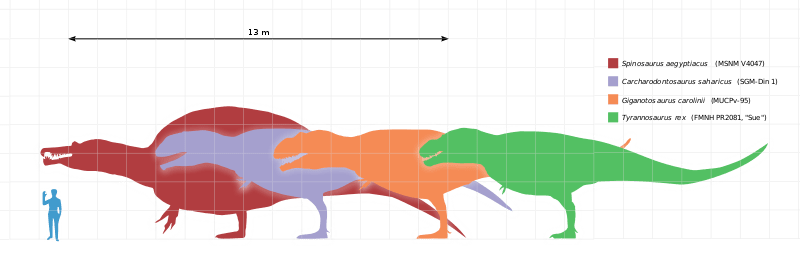
When it was first discovered, paleontologists thought Giganotosaurus was an impressive eight feet bigger than T-rex. Now most think they were similar in size, though Giganotosaurus was probably a little longer, about 40-423 feet long. Their heights and weights also seem to have been similar, with Giganotosaurus having just a slight edge.
T-rex did have some advantages. Its teeth, which were likely used as weapons, could reach 12 inches long, but those of Giganotosaurus were only 8 inches (as if eight-inch teeth were small!). Even more importantly, T-rex had a bigger brain, with well-developed optical lobes, helping it see better. Giganotosaurus had smaller optical lobes, but bigger lobes devoted to smell. Which do you think is more important to a hunter: sight or smell?
These two certainly would have had a huge battle if they ever met. But that never happened. Giganotosaurus lived about 99.5 to 95 million years ago in the area that is now Argentina in South America. Tyrannosaurus lived 72.7 to 66 million years ago in what is now the western United States.
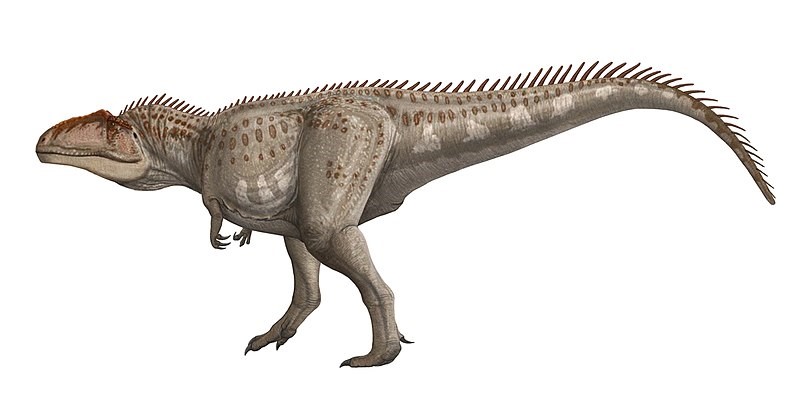
Giganotosaurus ДиБгд, Public domain, via Wikimedia Commons
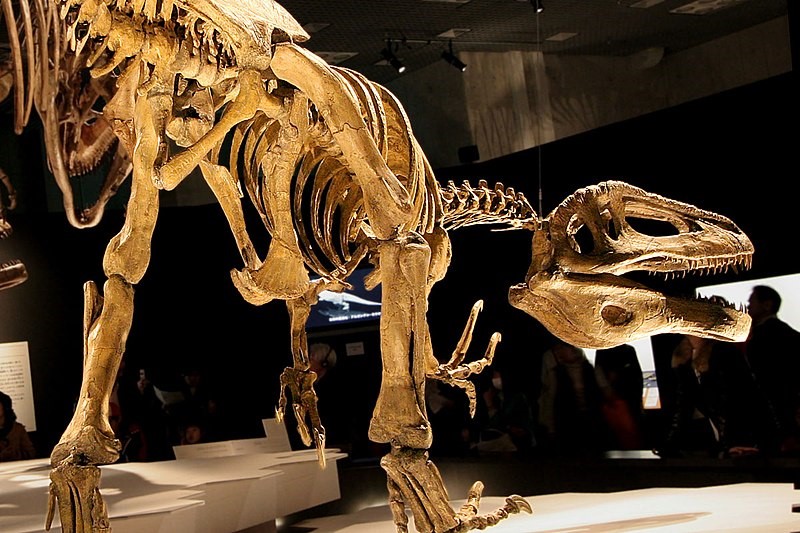
The other contender from Argentina is Megaraptor (MEG-uh-rap-tor). Its name means “large thief.” Megaraptor is known from just a few partial skeletons found in Argentina and Australia in 1997. It lived about 75 to 92 million years ago. Scientists think it might have been about the same height as T-rex. Megaraptor was about 13 feet tall at the hip, but it was not nearly as long, only about 25 to 33 feet, 7-9 feet shorter than Tyrannosaurus.
Megaraptor skeleton Kabacchi, CC BY 2.0, via Wikimedia Commons
It would seem that Tyrannosaurus’ larger size and probably greater strength would scare Megaraptor off before the fight even began, but that’s not the whole story. What Megaraptor did have was a 15-inch claw on the first finger of each of its hands – and its other claws were pretty big, too. That first claw, though, is almost twice the length of the longest T-rex claw. Tyrannosaurus’s tiny arms were pretty useless in a fight. Megaraptor could use its longer, muscular arms and huge hands to reach in and slash its prey. Also, Megaraptor’s lighter build probably made it faster than T-rex and more agile. It could dart in and out quickly to avoid Tyrannosaurus.
So, it would be an epic battle. Who do you think would win? Could either of these two take Tyrannosaurus’ crown? Or does that crown belong to a dinosaur from Africa? Come back in two weeks to find out.
Sources (Click Me!)
Calvo, Jorge Orlando and Rodolfo Coria. “New Specimen of GiganotosaurusCarolini (Coria & Salgado, 1995), Supports it as the Largest Theropod Ever Found.” GAIA, Lisbon, December 1998.
Currie, Philip J and Colleayn O. Mastin. The Newest and Coolest Dinosaurs. Grasshopper Books Publishing, 1998.
Frachtenberg, Fabio, and Jorge Calvo, Oscar A. Frachtenberg. Dinosaurios Argentinos: Giants of Patagonia. Aurora, IL: SciTech Hands-On Museum, 2006.
Gasparini, Zulma, Leonardo Salgado, and Rodolfo A. Coria (eds.). Patagonian Mesozoic Reptiles. Indiana University Press, 2007.
Larson, Peter and Kenneth Carpenter. Tyrannosaurus Rex: The Tyrant King. Indianapolis: Indiana University Press, 2008.
Mazzetta, Gerardo V., Per Christiansen, and Richard Farina. “Giants and Bizarres: Body Size of Some Southern South American Cretaceous Dinosaurs.” Historical Biology, June – December 2004, Vol. 16 (2-4) pp. 71-83.
Miller, Erin. “T-Rex’s older, tougher cousin – Giganotosaurus skeleton will go on national tour.”Daily Telegraph, The (Sydney) (n.d.). Newspaper Source_. EBSCO. Judson University Library, Elgin, IL 15 JJuly 2009. <http://www.judsonu.edu:2048/login? url=http://<http://www.judsonu.edu:2048/login?url=http://search.ebscohost.com/login.aspx?direct=true&db=nfh&AN=200312221022639124&site=ehost-live>.
Novas, Fernando, E., Diego Pol Juan I. Canale; Juan D. Porfiri; Jorge O. Calvo. “A Bizarre Cretaceous Theropod Dinosaur from Patagonia and the Evolution of Gondwanan Deomaeosaurids. Proceedings: Biological Sciences, Mar2009, Vol. 276, Issue 1659, p1101-1107.
Porfiri, Juan D., Domenica Dos Santos, and Jorge O. Calvo. “New Information on Megaraptornamunhuaiquii (Theropoda: Tetanurae), Patagonia: Considerations on Paleoecological Aspects.” Arquivos do Museu Nacional, Rio de Janeiro, 2007, Vol. 65, n. 4, pp. 545-550.
Richardson, Hazel. Smithsonian Handbooks: Dinosaurs and Prehistoric Life. Dorling Kindersley, 2003.
Smith, Nathan D., Peter J. Makovicky1, Federico L. Agnolin, Martin D. Ezcurra, Diego F. Pais3 and Steven W. Salisbury. “A Megaraptor-like theropod (Dinosauria: Tetanurae) in Australia: Support for Faunal Exchange across Eastern and Western Gondwana in the Mid-Cretaceous.” Proceedings of the Royal Society. 20 May 2008.
Spotts, Peter N. “Giant Dinosaur Fossil Forces Scientists to Question Theories.” Christian Science Monitor 03 Dec. 1997: 3. Academic Search Premier. EBSCO. Judson University Library, Elgin, IL. 15 July 2009. <http://www.judsonu.edu:2048/login?url=http://search. ebscohost. com/login.aspx?direct=true&db=aph&AN=9712050418&site=ehost-live>.
University of Queensland. “Australian Dinosaur Found to Have South American Heritage.” ScienceDaily. 15 June 2008. <http://www.sciencedaily.com/releases/ 2008/06/080613111410.htm>.
I know the ‘Facts Tier List’ is something that has been done to death in pop-culture. But I thought it would be fun to make a short list of the most obscure facts I could find about the king lizard, Tyrannosaurus Rex. If this is something you find interesting, I may make this a series where we cover less recognizable dinos!
1/3 |T-Rex wasn’t Always The Most Popular
Taking a look at the countless pictures, books, movies, and exhibits on the world of paleontology, it is self-evident that the Tyrannosaurus Rex is one of, if not the most popular dinosaur. Many would assume that this has always been the case, but what if I told you that wasn’t.
My older readers may recognize the name or shape of the Brontosaurus. A sauropod with a complicated history, this dinosaur was the symbol for Sinclair Oil and at one time was considered the face of the dinosaur world. The Brontosaurs will be the topic of a future post, so subscribe so you don’t miss out!
2/3 | Usable Arms
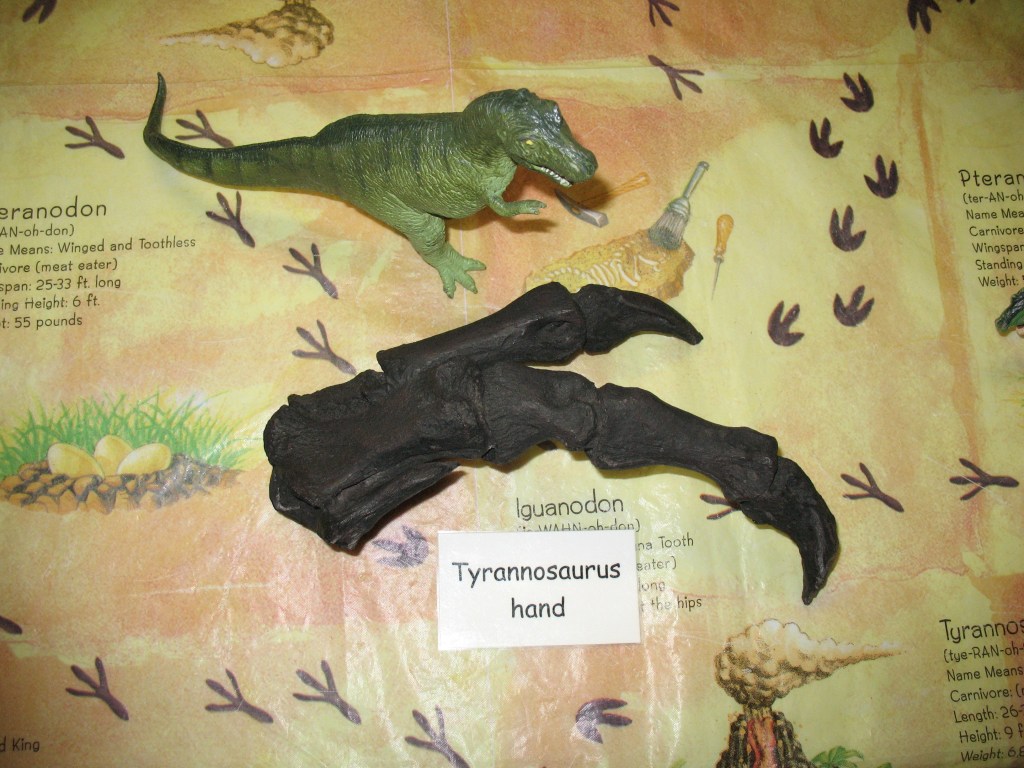
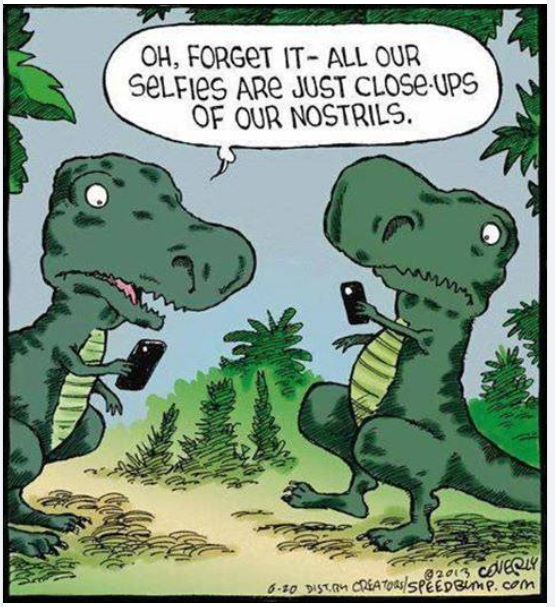
The T-Rex is often made fun of for it’s tiny arms. They were quite small in proportion to the rest of its body, measuring in at only 2-3 feet. The T-Rex’s head alone was 5 feet long. However, just because they were tiny, doesn’t mean they were useless. Their arms were incredibly capable despite the size and were able to support over 400 pounds in weight.
There is still speculation as to what purpose their arms served. Many believe they were used to help T-Rex lift itself off of the floor or for holding on to recently killed prey.
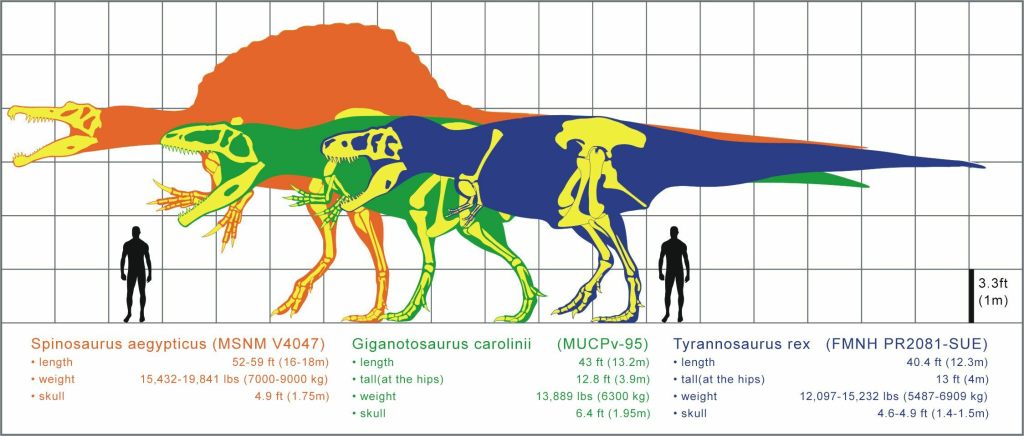
Although the T-Rex has earned the moniker: ‘King of the Dinosaurs’, that doesn’t mean that T-Rex was the largest Carnivore of them all. T-Rex was estimated to be about 40 feet long and weighed between 7 and 9 tons. The Giganotosaurus and the Spinosaurus both outclassed the king lizard, with the former weighing 9 tons and the latter weighing over 10 tons. Giganotosaurus barely beats out T-Rex in length, as it was recorded to be 43 feet long. But the Spinosaurus takes the cake at almost 60 feet long from head to tail! I may take a deeper look into the unique features of these 3 species…
I hope you found these facts interesting; I surely did! If there are any facts you would like to share, feel free to do so in the comments below.









 Dinosaur Lady


