Dinosaurs left behind skeletons, eggs, footprints, even fossilized poop. All these things help us imagine what the world of the dinosaurs looked like. But we really don’t have much of an idea what it sounded like. We can be pretty sure that the dinosaurs’ world echoed with the thud of gigantic feet, the splash of water, and the buzz of insects. But did dinosaurs bark, howl, grunt or growl? We don’t know.
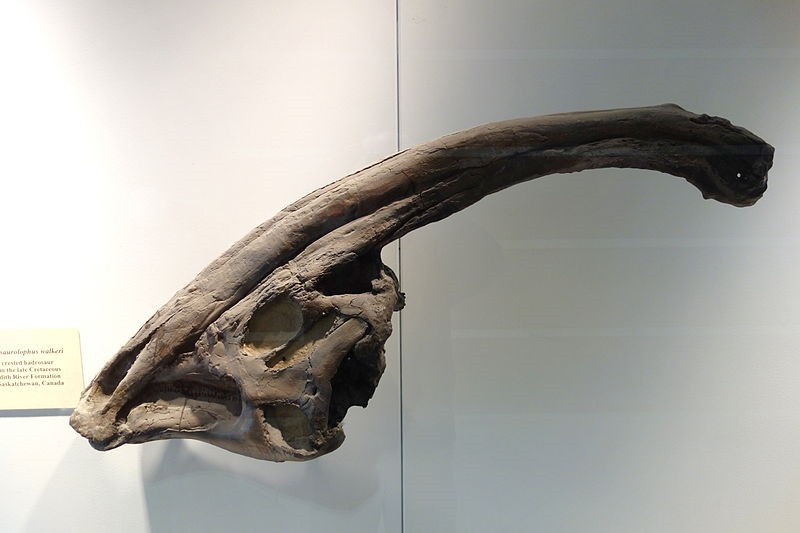
However, scientists do think that one dinosaur “played a horn.” That dinosaur was Parasaurolophus (par-uh-sore-oh-loaf-us). Scientists have made models of the long, hollow crest on its head, and when they blew air through it, it made a deep, low tone, like a musical instrument.
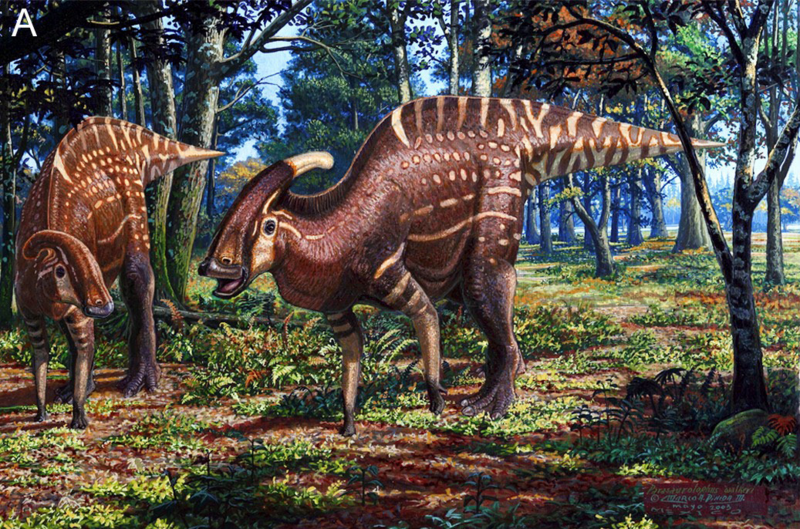
The crest of Parasaurolophus was a very long, thin tube of bone. It began at the dinosaur’s nose and stretched up way above its head. On some Parasaurolophus the crest reached six feet long – longer than most people! This crest was hollow inside. A tube for air went up from each nostril to the tip of the crest and then curved back down like a trombone. All the air it breathed had to make that long journey. Not even Pinocchio had a nose that long!
In every other way Parasaurolophus was ordinary. It was one of the plant eaters nicknamed “duckbilled” because its mouth was long and flat like a duck’s bill. It stood on two strong back legs, with shorter front legs that it could also walk on or use as arms. It was about 30 feet long and 16 feet tall, and it probably weighed 3 or 4 tons. This was about the size of a bus – or an average dinosaur.
Size comparison of person and Parasaurolophuswalkeri
Parasaurolophus might have used the sounds it could make with its crest to communicate different messages, such as danger or food ahead. A herd might have honked at a Tyrannosaurus to go away. A special kind of honk might have attracted a mate.
Parasaurolophus also might have used its crest to push away branches in a thick forest. The cassowary, a large flightless Australian bird, uses its crest for that today. Another idea is that the crest brought cool air close to the Parasaurolophus’ brain to keep it from getting too hot. And it might have been able to smell through it, so it could seek out its favorite plants or tell when a meat eater was close by.
Scientists don’t know for sure if the Parasaurolophus used its crest in any of these ways. They continue to look for clues and ideas.
Scientists do know that Parasaurolophus had strong jaws which would be good for eating tough plants, such as pine needles, leaves, and different fruits and seeds. Its cheeks were loaded with good teeth for grinding things up. It even had three or four extra teeth above the ones that showed. That way if any of its teeth broke or wore out, new ones moved down. A Parasaurolophus may have grown more than 10,000 teeth during its lifetime.
Parasaurolophus lived right up to the end of the age of dinosaurs, outliving the other known duckbilled dinosaurs. But sixty-six million years ago, the last dinosaurs on earth died, including Parasaurolophus. Never again will the world echo with the sound of those gigantic feet or the honk of a Parasaurolophus calling to its friends.
Sources (Click Me!)
Norman, David. The Illustrated Encyclopedia of Dinosaurs. Crescent Books, 1985.
When the dinosaurs lived, they often had just one thing on their minds – FOOD! Whether a dinosaur ate plants or meat, getting food was a full-time job. Scientists have found evidence that at least one type of dinosaur went fishing for its food. That dinosaur was Baryonyx (BAR-ee-ON-ix).
Scientists know Baryonyx was a meat eater because it had the sharp curved teeth needed to cut through meat. But in many ways, it was different from other meat-eating dinosaurs.
Most meat-eating dinosaurs had strong jaws, heavy skulls, and enormous teeth, so they could slice through tough skin and bone. But Baryonyx’s jaws were not very strong, and its head was long and flat, like a crocodile’s. Its teeth were much smaller than most meat eaters’ – and it had almost twice as many of them. Baryonyx was not made for attacking other dinosaurs. It was made for catching fish.
A lot of animals like the taste of fish, but it takes a very special kind of animal to catch them. Fish dart about very quickly in the water. To catch them, an animal has to be even quicker. Fish are also very slippery. Holding onto them takes special claws or teeth.
So, how could Baryonyx catch fish? Scientists have suggested several ways. It might have stood by the edge of a shallow lake, waiting as patiently as a heron. When an unsuspecting fish swam by, it might have snapped it up. Its long mouth and many sharp teeth could have grabbed a quick-moving fish and held onto it no matter how much it wiggled.
Or the Baryonyx might have played crocodile. Some scientists picture it floating in the water, watching carefully. If a fish swam by, it was scooped up in the long mouth of Baryonyx.
Artwork by Jim Conaway
Another way it might have fished was with its front feet. It could use its front feet as hands. It had long, slender fingers which may have been used to grab fish. Or if it didn’t feel like grabbing, it might have gone “spear fishing.” The name Baryonyx means “heavy claw.” It got this name because it had a huge claw, one of the biggest dinosaur claws that has ever been found – 12 inches long! Scientists think Baryonyx had one of the super claws on each front foot. It could stand in shallow water, waiting. Then, when a fish swam past, it could stab quickly into the water and catch it.
Artwork by Jim Conaway
What makes scientists so sure Baryonyx ate fish? The first skeleton found had fish scales where its stomach would have been. They also found a few bones of a plant-eating dinosaur. How did Baryonyx hunt large plant eaters when it wasn’t a very big or strong dinosaur? Well, many scientists think it let a powerful meat eater like Megalosaurus do all the work. Megalosaurus might kill a plant eater too big for it to eat. Baryonyx could come by when it was done and eat the leftovers. So, the life of Baryonyx was like a vacation – lots of fishing and somebody else prepares the food!
Scientists don’t know much about how Baryonyx lived. They don’t know if it traveled in a pack or alone, they don’t know if it took care of its babies or left them on their own, and they don’t know if it had feathers or scaly skin. They can describe its size because the first skeleton found of it was 85% complete. It grew about 30-33 feet long and was about twice as tall as an average person. Its legs were short compared to some dinosaurs and lacked strong muscles, so it wasn’t a runner. It was not very strong in general, but its large claw would have made a great weapon to defend itself. Only a very big and very hungry meat eater would have bothered it.
Scientists are fascinated by this dinosaur because it’s so different from other dinosaurs. The wide variety of dinosaurs makes them very interesting to study, and each new discovery adds to our picture of what they were like.
Most of the dinosaurs that lived millions of years ago were peaceful plant eaters. But, every now and then, into this peaceful life came meat eaters!
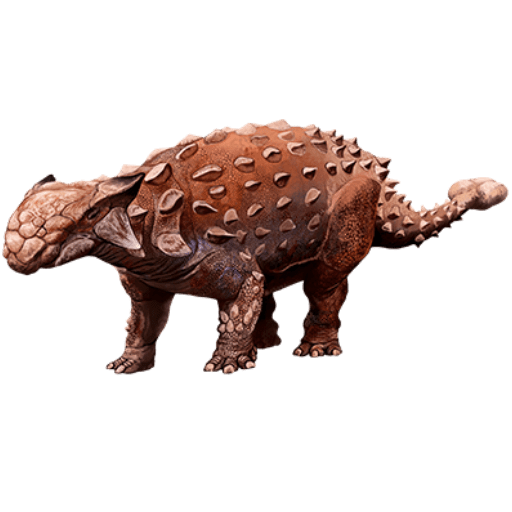
If a plant eater didn’t want to become dinner, it had to be able to defend itself. Some plant eaters were very good at this. They had sharp claws or horns of their own. But one type of dinosaur didn’t need to fight back. All it had to do was squat down. This was the Ankylosaurus (an-KI-luh-sawr-us). The Ankylosaurus had thick, bony armor over almost all of its body.
The Ankylosaurus was a huge dinosaur. That alone would have been enough to discourage most meat eaters. It was just a little smaller than a bus – about 26 feet long and 7 feet tall, weighing as much as five tons. But it didn’t look like a bus – it looked like a tank.
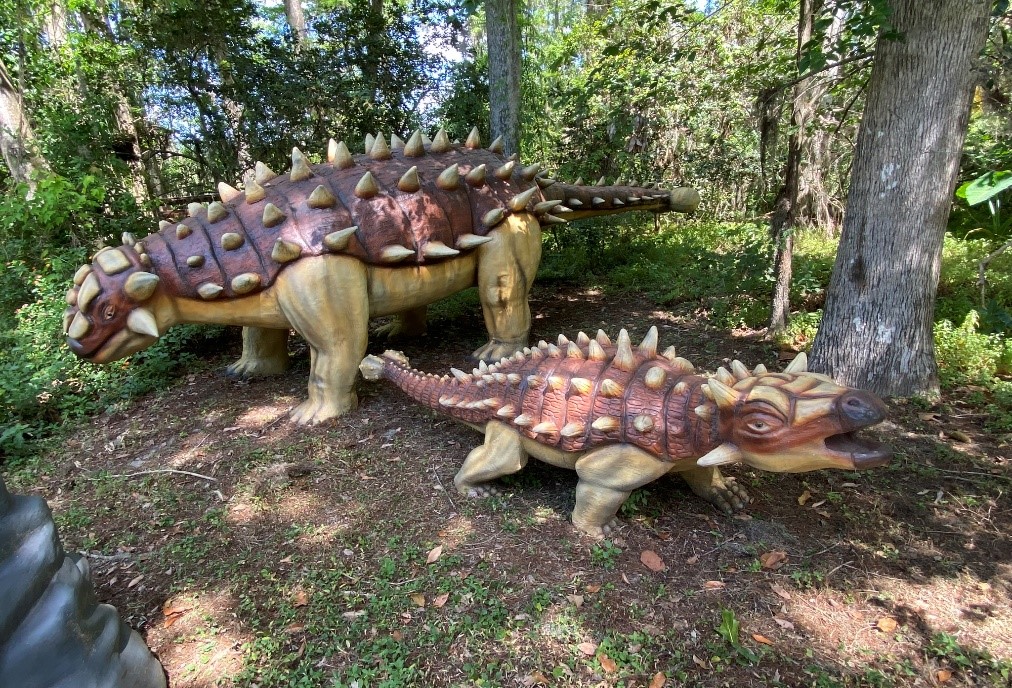
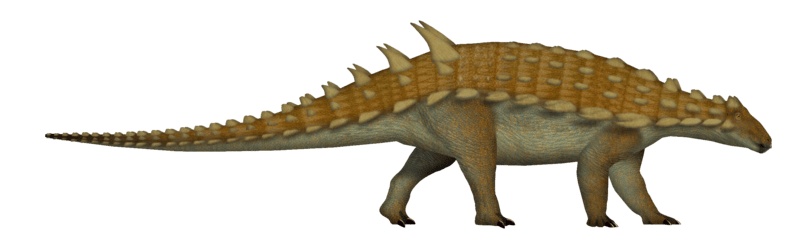
Tanks are covered with metal armor. The Ankylosaurus’ armor was made from thick bands or plates of bone. Spikes and knobs were scattered across the back and over the head. The armor covered its back, neck, and head – even its eyelids!
Ankylosaurus head cast Tim Evanson, CC BY-SA 2.0, via Wikimedia Commons
The armor was probably very frustrating to a hungry meat eater. Even if a meat eater could dodge the knobs and spikes, all it would get was a mouthful of bony armor – and maybe a few broken teeth.
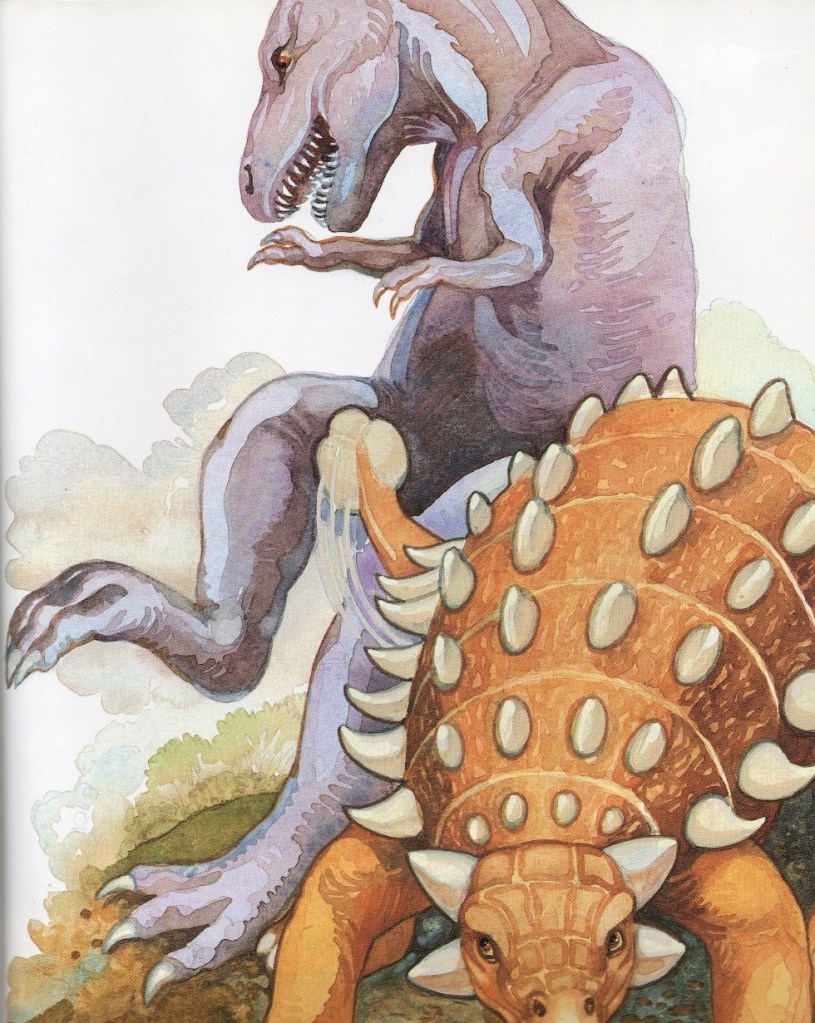
A meat eater had only one chance. The belly of the Ankylosaurus didn’t have any armor. If the meat eater could get to that soft spot, it could still have an Ankylosaurus snack. But all the Ankylosaurus had to do was crouch to the ground, folding its legs underneath. That way the only parts a meat eater could get to were covered with armor.
Illustration by Diana Magnuson
Some meat eaters probably tried to flip it on it back. If it were flipped over, the weight of its armor would prevent it from flipping back, much like a turtle. It would be completely helpless. However, trying to flip an Ankylosaurus was like trying to flip a tank. Most ankylosaurs were much too heavy for even the strongest meat eater to budge. And, of course, it was hard to find a place to grab on, with all those spikes and knobs in the way.
If a meat eater kept on bothering an Ankylosaurus, it ran the risk of provoking the creature into an attack. At the end of its tail, the Ankylosaurus had a huge, bony club. The club was about 16 inches wide and made of solid bone. The muscles in the tail were very strong. If an Ankylosaurus swung its club hard enough, it could probably have knocked down any other dinosaur, even a Tyrannosaurus. It might have been able to break a meat eater’s leg – or its skull – with that club. It certainly would have made that meat eater very sorry it ever wanted an Ankylosaurus for dinner!
Illustration by Diana Magnuson
Ankylosaurus had some trouble finding its own dinner. It was hard for it to move its head and neck because of all that armor. And it certainly couldn’t rear up on its back legs with all that heavy bone to lift. That meant that it could only feed on plants that grew close to the ground. Maybe that wasn’t all bad, though. Every now and then it might scoop up some ants or a few beetles for a tasty dessert.
You might think that the Ankylosaurus with its heavy armor was a slow-moving dinosaur, but it was more like a rhinoceros than a turtle. A rhinoceros is very large and heavy, but it can run fast. Ankylosaurus wasn’t as fast as a rhino, but it could run as fast as 6 mph, which is about as fast as most people can run. The powerful leg muscles of Ankylosaurus helped it to move quickly if it needed to.
Ankylosaurus was the biggest armored dinosaur that we know, but it was not the only one. It had many relatives. Some had more spikes. Some had few or none at all. Some had tail clubs. Some did not.
Hylaeosaurus UnexpectedDinoLesson, CC BY-SA 4.0, via Wikimedia CommonsYuxisaurus Xi Yao, Paul M Barrett, Lei Yang, Xing Xu, Shundong Bi, CC BY 4.0, via Wikimedia Commons
But most of them were good at surviving. Many of the armored dinosaurs lived until the very end of the age of dinosaurs. It wasn’t easy living in the same world as Tyrannosaurus, but it could be done – by a walking tank!
Sources (Click Me!)
“Ankylosaurus.” Natural History Museum of London. n.d. https://www.nhm.ac.uk/ discover/dino-directory/ankylosaurus.html
“Cretaceous Insects.” Western Australian Museum. n.d. https://museum.wa.gov.au/ explore/dinosaur-discovery/cretaceous-insects
Norman, David. The Illustrated Encyclopedia of Dinosaurs. Crescent Books, 1985.
Rasmussen, Patty and Talon Homer. “Ankylosaurus: A Tank-like Herbivore With a Killer Club Tail.” How Stuff Works. 10 July 2024. https://animals.howstuffworks.com/ dinosaurs/ankylosaurus.htm?utm_source=facebook&utm_medium=social&utm_campaign=hsw-owned&utm_content=animals&fbclid=IwY2xjawFYdItleHRuA2Flb QIxMQABHSJZrzMY8s_ckpGF7a0h_hX_66x-bgLwyX_Zqb-4gJSO4DdqauNWL6RUmA_aem_vUroiI23KZyLQ6TE2xysxw
Riehecky, Janet. Ankylosaurus. The Child’s World, 1991.
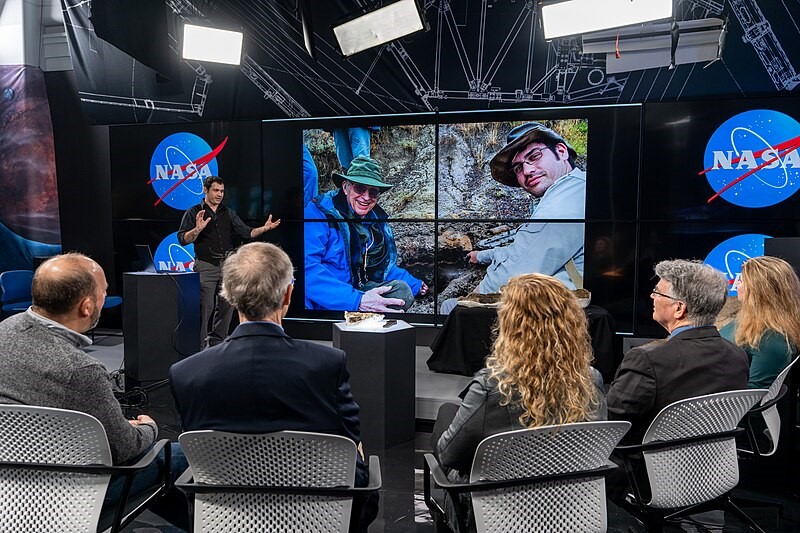
We finally conclude our deep dive into the extinction event that killed the dinosaurs. We end with Robert dePalma, whose findings shaped our understanding of the asteroid.
At first it was just disappointment. Thirty-year-old graduate student, Robert dePalma, was excavating a fossil site on a ranch in North Dakota. When he began digging in 2021, he had hoped to find layers of sediment that would show the years leading up to the end of the Cretaceous Time Period. The site was a large area, covering about two acres and measuring about three-feet deep, but it was clear the entire layer had been laid down all at once by some kind of flood. There were fish fossils, but they broke apart into tiny flakes when he tried to dig them out.
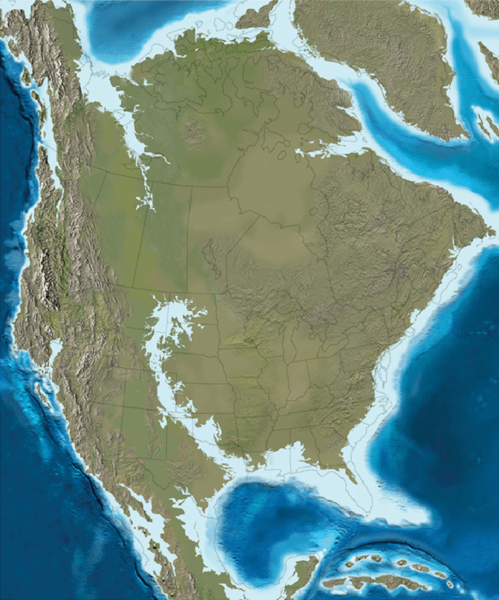
North America at the End of the Cretaceous Period Ron Blakely, Colorado Plateau Geosystems is credited for the maps, in the paper, and Terry A. Gates et al are stated to be the copyright holders for the paper and its contents, CC BY 1.0, via Wikimedia Commons
He continued to dig, though, and he found tiny, white/gray bits that looked like sand. When he looked at them under a magnifying glass, he recognized their tear-drop shape as belonging to microtektites. Tektites, as mentioned in last week’s blog, are created when rock becomes so hot that it turns to liquid. They can be formed by volcanos or by an asteroid hitting the earth. The liquid rock is flung into the air in small bits until it goes high enough the air cools them. As they fall to Earth, they form tear-shaped, glass fragments. Over millions of years, they turn to clay. The tektites he found were so small they were classified as microtektites. DePalma found millions of them. He knew the bed he was digging in was from the end of the Cretaceous Time Period. It dawned on him that the microtektites might be from the asteroid that hit the Earth then.
DePalma continued his excavation. He found an amazing number of fossils. Most of the time fossils are flat, crushed by layers and layers of rock, laid down over time. But many of these fossils were three-dimensional because they had been deposited and covered immediately, and the sediment around them acted as support.
He found new species of fish and a variety of plants, including tree trunks smeared in amber. The amber contained what appeared to be asteroid debris. He suspected that the site he was working on had been formed the very day the asteroid hit! If that was true, it was an incredible find!
As a child and young adult, dePalma had collected bones and fossils. He lent them to a nearby museum where he also reconstructed some dinosaur skeletons. But when the museum went bankrupt, they refused to return his collection. After that he was very careful about the fossils he excavated. In the United States, fossils belong to whoever’s property they are found on and can be sold to anyone. It is not unusual for a paleontologist or commercial fossil collector to sign a contract with a private land owner for an excavation. They usually agree to split the profit on any fossils that are found and sold. Museums and universities don’t like this arrangement because important finds can disappear into private collections.
Realizing that this site was potentially one of the most important ever found, he entered a long-term agreement with the ranch owner. The details of the agreement have been kept private.
Over the next several years, dePalma continued to excavate. He confided in only three other people what he had found, including Walter Alvarez, the man who had originally proposed the asteroid theory. DePalma did publish a paper that described a hadrosaur bone he’d found with a tyrannosaur tooth embedded in it. The bone had healed, indicating that the hadrosaur had gotten away after the attack, which dePalma said proved Tyrannosaurus hunted live prey. Scientists have long debated whether Tyrannosaurus was just a scavenger who lived by finding meals that were already dead or if it hunted live prey. DePalma’s evidence was not taken very seriously because he was just a student and a commercial fossil collector.
Continued excavation at the site revealed a paddlefish, but underneath it was a mosasaur tooth. A paddlefish is a freshwater fish, but a mosasaur is a giant, saltwater reptile. How could fossils of both be in the same site? DePalma and the others tried to come up with a theory to explain this, but they couldn’t.
Then he found small impact craters, about three inches across. At the bottom of each crater was a normal-sized tektite. DePalma was sure they had to be from the asteroid that ended the Cretaceous Period, even though the impact site was about 2000 miles away. He arranged to have a laboratory compare the tektites to material from the Chicxulub (CHICKS-ih-lube) Crater. They matched! The asteroid impact was so explosive that debris was thrown 2000 miles away!
For years dePalma had worked on the site in secret, sharing it with just a few others. But in 2019, he invited a reporter from New Yorker magazine to see the site and tell the world its story. When the story was published, the scientific community was skeptical. The normal procedure for announcing a significant discovery would be to submit a paper to a peer-reviewed journal where experts would evaluate the evidence before it was published, not submit it to a literary magazine. Many scientists disparaged his theories because dePalma was just a student only working on a PhD, a nobody who dug up fossils to sell rather than to study. But they sold dePalma short, as evidence he was right continued to pour in. (And he did eventually publish papers in peer-reviewed journals.)
Depiction of a Cretaceous forest of what is today the Tanis site, in North Dakota, hours after the K-Pg impact. Notice a burnt carcass of a Thescelosaurus, an impaled turtle, a small mammal and a small ornithuran avialan. YellowPanda2001, CC0, via Wikimedia Commons
DePalma has named the site Tanis, after an ancient Egyptian city. In the late Cretaceous, a large inland sea stretched from the Gulf of Mexico to what is now the U.S./Canadian border. What is now North Dakota was subtropical. DePalma and the people he has now working with him on the site have determined that Tanis was a sandbar located between a river and a forest. They think that when the asteroid hit in the Gulf of Mexico, it created a gigantic earthquake. It took maybe ten minutes for the shock waves to reach Tanis. The disturbance caused giant waves to form on the inland sea shown in the map above. They flung sea creatures, such as the mosasaur, at Tanis, many miles away. In addition, waves were formed in the nearby river, flinging freshwater creatures onto the site. DePalma found a turtle that was flung so hard that a tree branch went right through its body.
Continued excavation has also revealed
Fish with asteroid debris clogging their gills,
Ant nests with the ants still in them and asteroid debris in their tunnels,
Large feathers that likely came from a large dinosaur,
Broken bits from almost all the dinosaurs known to have lived in that area during the late Cretaceous,
A small burrow inhabited by a small mammal,
Dinosaur eggs and hatchlings,
Pterosaur bones,
A partial mummified Thescelosaurus with its skin still intact,
And pieces of the actual asteroid preserved in amber.
DePalma and his crew continue to work on the site. It will take years to explore it thoroughly. Right now, though, it’s an amazing picture of what happened the day the dinosaurs died.
Everyone knows an asteroid killed the dinosaurs. But is that all we know? Join me as we go down the rabbit hole of how the dinosaurs went extinct…
Sixty-six million years ago, life on Earth was very different from today. Trees, ferns, and flowering plants covered the land. There wasn’t any grass (despite what the picture below shows. I couldn’t find a free Cretaceous scene anywhere without green ground). Grass hadn’t evolved yet.
User:Debivort, CC BY-SA 3.0, via Wikimedia Commons
The only mammals were small creatures, no bigger than about three feet long. Dinosaurs dominated the planet. There were small dinosaurs, medium-sized dinosaurs and BIG dinosaurs. They lived in every part of the world. They lived in valleys and on mountains. They lived in dry places and wet places. They lived in forests and on open plains. They had ruled the Earth for 180 million years, and it seemed they would continue to do so indefinitely.
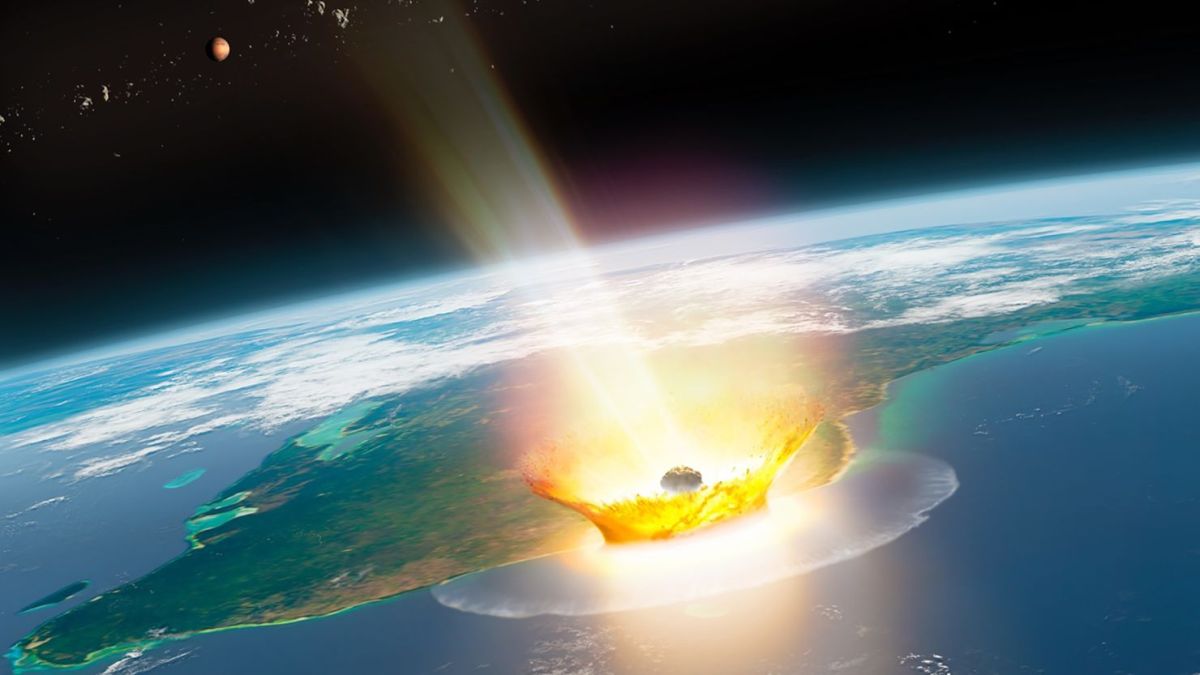
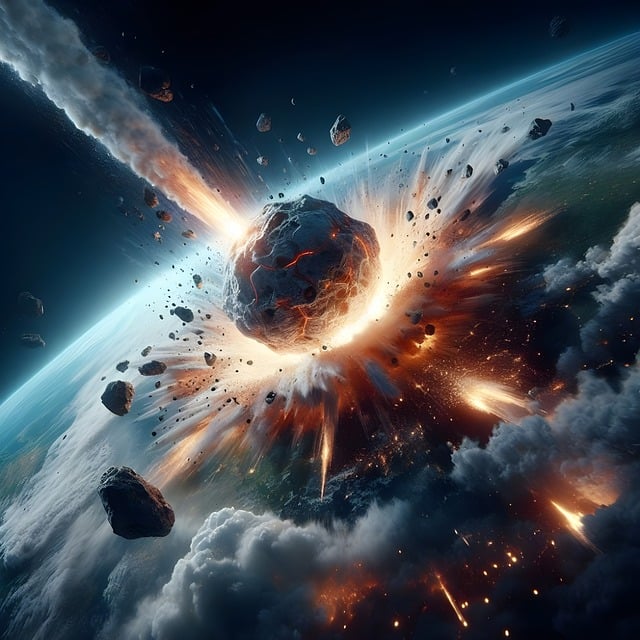
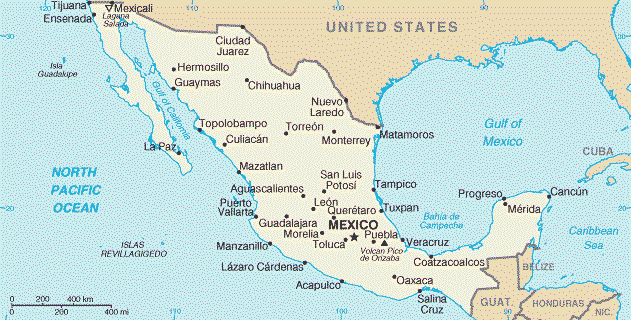
But out in space an asteroid was plunging toward Earth. It was about six miles wide and the height of Mt. Everest. When it reached the Earth’s atmosphere, it would have looked like a fireball brighter than the sun. It was seen, though, for only a few seconds before it hit the Earth because it was hurtling through the air at about 45,000 mph! It hit in the Yucatan Peninsula in Mexico, forming a crater that covers a large portion of the Gulf of Mexico. The crater has been named Chicxulub (CHICKS-ih-lube) Crater.
NASA/JPL-Caltech, modified b, Public domain, via Wikimedia Commons
The asteroid hit with a force 10 billion times larger than the atomic bomb detonated on Hiroshima, blowing a hole in the ground 120 miles wide and 18 miles deep. Imagine how loud that explosion must have been! In an instant, the intense heat of the explosion vaporized the asteroid and turned thousands of cubic miles of rock into liquid and spewed it into the air, like a colossal volcano erupting. Anything within 600 miles or more would have been instantly incinerated by the fireball. A combination of soot, sulfuric gases, and extremely fine dust was flung into the atmosphere. For the next several hours, titanic winds blew this debris around the whole Earth. They ignited a world-wide firestorm that probably killed most of life on Earth. In addition, a mega-earthquake shook all of Mexico and Central America, the southern United States, and as far south as far as Argentina. The earthquake (magnitude 13 – likely the biggest earthquake the Earth has ever felt) triggered giant tsunamis and mudslides. One-thousand-foot-high waves of water hit the coast where now Texas, Alabama, Mississippi, northern Mexico, and Cuba lie. Secondary waves traveled as far as what is now North Dakota.
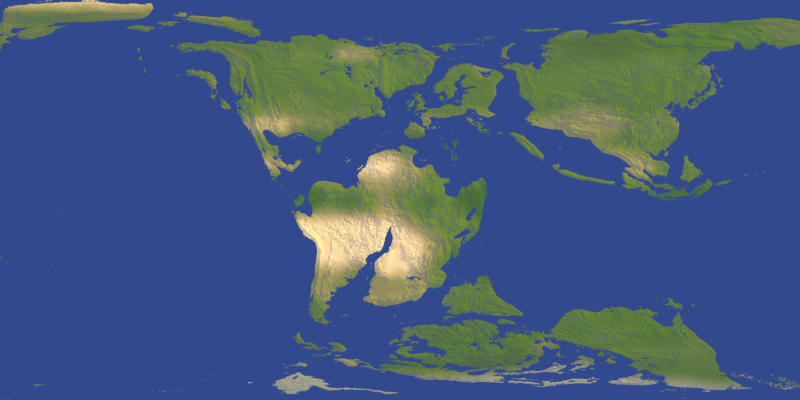
Continent placement at the end of the Cretaceous Era Merikanto, CC BY-SA 4.0, via Wikimedia Commons
Life that somehow survived this, now faced another horror. Dust and soot lingered in the atmosphere blocking most of the sunlight for at least a year. Without sunlight plants couldn’t grow and thrive. Plant eaters lost their food source and died. Meat eaters lost their food source and died. In addition, the lack of sunlight lowered the temperature on Earth by about 80° Fahrenheit.
As if this weren’t bad enough, volcanos in India had been erupting at this same time, with lava flows covering 190,000 square miles of land, killing all life in that area. The eruptions also added more toxic fumes and debris to the atmosphere.
Scientists disagree about how long it took, but about 75% of all life on earth, plant and animal, died because of the asteroid hit and the volcanos, including all the dinosaurs (except birds which most scientists believe are direct descendants of dinosaurs). Some small animals survived, including the ancestors of today’s frogs, snakes, lizards, alligators, crocodiles, a variety of insects, birds, and mammals.
How do we know all this happened? I’ll explain in my next blog.
This blog is the first in a series that will explore the timeline of Earth’s history, from the formation of the planet to the dominance and eventual extinction of dinosaurs.
This blog is about dinosaurs in time; that is, dinosaurs in the timeline of Earth’s history. Not dinosaurs on time, because dinosaurs were hardly ever on time seeing they didn’t have clocks.
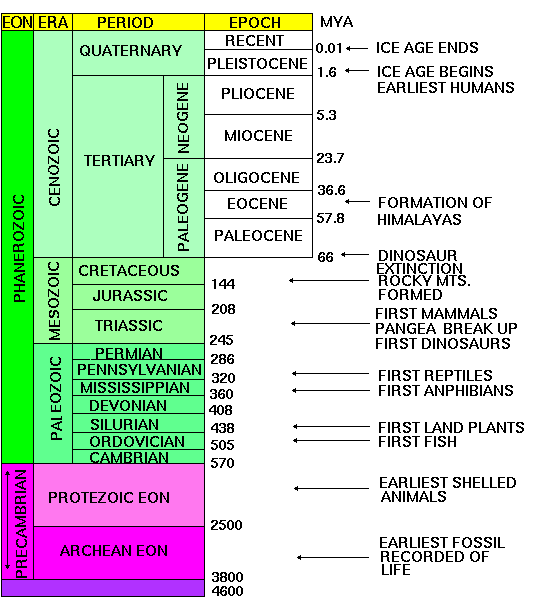
Scientists say the Earth was formed 4.6 billion years ago. At first it was just molten lava, hundreds of miles deep. Over millions of years the Earth cooled and a crust appeared.
The first lifeform that existed was a sort of blue-green algae. Then other lifeforms appeared, including shellfish. That whole time period of more than four billion years is called the Precambrian Eon. From 542 million years ago to the present age is the Phanerozoic Eon. It’s divided into three eras, the Paleozoic, the Mesozoic, and the Cenozoic. During the Paleozoic (from 541 to 252 million years ago) life began to bloom. The first fish, first amphibians, and the first reptiles appeared. The first plants also began to grow. But then a massive extinction wiped out 90% of life on Earth. Its cause is not known, but it ended the Paleozoic Era making way for the Mesozoic Era (from 252 to 66 million years ago).
That’s when we get to the good stuff: Dinosaurs! The Mesozoic is divided into three time periods: the Triassic, the Jurassic, and the Cretaceous. And about halfway through the Triassic Period a new kind of animal evolved: a dinosaur.
Timeline of Earth (MYA means millions years ago)) Thanaben, CC BY-SA 3.0, via Wikimedia Commons
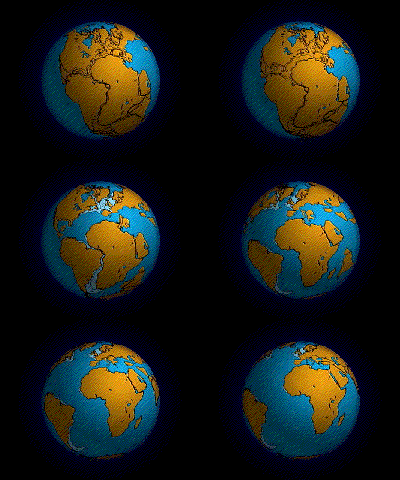
During the Triassic the Earth was warm and fairly dry, with ice at the north and south poles. (Although Santa Claus hadn’t moved in yet.) Most of the large island masses gathered together in a supercontinent called Pangaea. Conifers, cycads (which looked like mutant pineapples), and ferns were the most common plants, and reptiles ruled the planet. It was about 240 million years ago that the first dinosaurs appeared. They were small and walked on two legs. Over millions of years, they began to change, and many varieties of dinosaurs appeared. Some were meat eaters; others, plant eaters. Some grew to large sizes. These included Riojasaurus and Lessemsaurus. But then 201 million years ago, another mass extinction took place, probably caused by volcanic action in the Atlantic Ocean, rising sea levels, and climate change.
Pangaea breaking up Public Domain U.S. Dept. of the Interior
Some dinosaurs survived and moved into the Jurassic Period. Pangaea broke apart and, over millions of years, formed the continents we know today. Their environment ranged from arid deserts to lush tropical forests. Conifers and ferns were the main plants. Most importantly, dinosaurs dominated each new continent. Some of the largest of all dinosaurs evolved during this time, including Alamosaurus, Argentinosaurus, and Dreadnaughtus. The fierce predator Allosaurus also lived in this time period. And the earliest known bird, Archaeopteryx, emerged in the late Jurassic.
About 140 million years ago, life on Earth began to change dramatically. Many new life forms emerged while others went extinct. There doesn’t seem to have been any big extinction event, but scientists date this as the beginning of the Cretaceous Period (my favorite time period!). Flowering plants appeared, but there were still a lot of the familiar conifers and ferns. Many new, strange-looking dinosaurs dominated the environment. Tyrannosaurus became an apex predator and weird dinosaurs, such as Parasaurolophus, Ankylosaurus, Triceratops and Pachycephalosaurus roamed around.
Dinosaurs were so abundant it seemed they would rule Earth forever – but an asteroid colliding with Earth 66 million years ago brought their world to an end. The Cenozoic Era began, with an opening for mammals to dominate the world. The asteroid collision will be the subject of my next blog.
Stegosaurus is one of the most iconic herbivores, but is also one of the most peculiar…
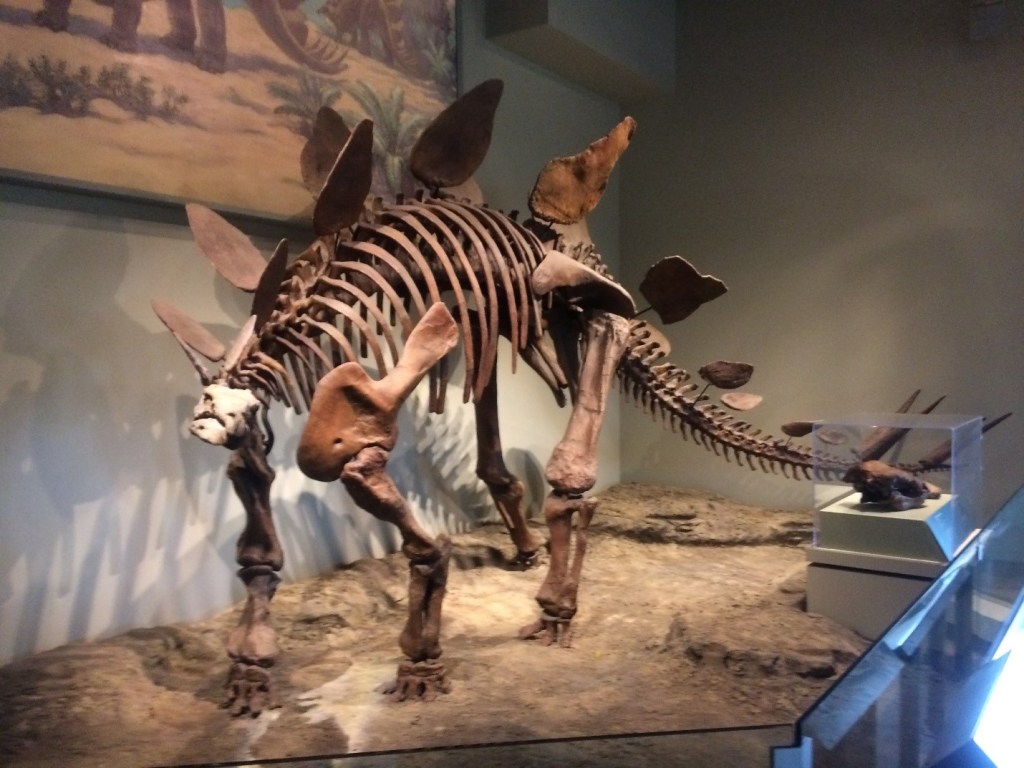
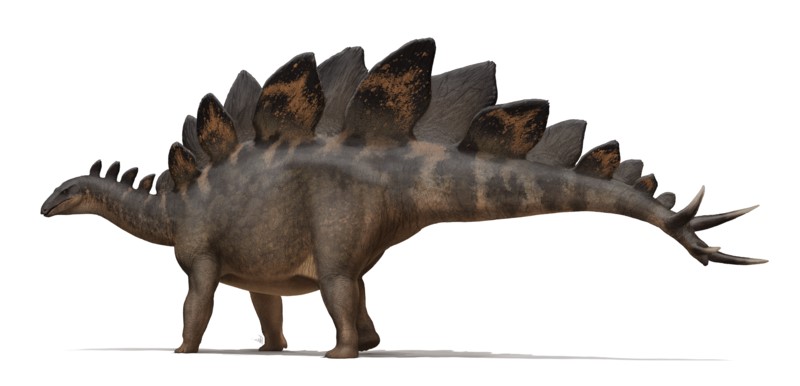
Many dinosaurs are strange. But one of the strangest is Stegosaurus. Imagine what you would look like if you walked on your feet and your elbows! Well, that’s sort of what Stegosaurus looked like. Its back legs were twice as long as its front legs. That meant its hips were stuck way up in the air – 9-13 feet! Its head and shoulders were close to the ground, and its back curved like a slide down to its tail. From front to back it was about 24-30 feet long, and it weighed about 5 ½ tons. In a bowling alley, it would take just two stegosaurs to stretch from the beginning of the alley all the way down to the bowling pins.
Stegosaurus skeleton at the Field Museum of Natural History in Chicago
That was certainly a strange shape, but Stegosaurus had an even stranger mouth. The front of its mouth was a beak, like that of a parrot or turtle. Most plant eaters have strong teeth that can grind up food, but not Stegosaurus. In the back of its mouth, it had rows of small, weak teeth. Its jaws could only move up and down, not to the side, which made chewing hard. As you can imagine, all this made it hard for Stegosaurus to eat. It could break off a mouthful of plants, but it couldn’t really chew them up very well before swallowing them. So, most things went down whole. There’s no evidence to indicate that it ate rocks (called gastroliths) as did other dinosaurs that couldn’t chew. The rocks helped break up the food in a special sac called a gizzard. But Stegosaurus didn’t do this. So, scientists have no idea how this strange creature managed to digest its food.
Stegosaurus not only had trouble eating – it also had trouble thinking. The Stegosaurus had a tiny head and probably the smallest brain compared to its size of any dinosaur. It was only about as big as a golf ball or walnut.
Stegosaurus might not have been very smart, but it knew enough to avoid somebody who tried to take a bite out of it. And there were plenty of creatures that wanted to take a bite out of Stegosaurus.
The Stegosaurus lived at the same time as the fierce Allosaurus and many other meat eaters. It couldn’t run fast, and it couldn’t think fast. It had to have some way to protect itself – so it grew a very strange weapon. Most dinosaurs that needed to defend themselves grew sharp claws on their feet or horns on their heads. But Stegosaurus did things backwards. It grew four, foot-long spikes on the end of its tail!
These spikes were good weapons and helped the Stegosaurus, but they were not good enough to fight off a determined attack. So, Stegosaurus’ best chance for survival was either to hide from meat eaters (and it was too big to do that!) or to stay with a herd of stegosaurs. Like any bully, an Allosaurus would rather attack a Stegosaurus found alone than one with a lot of friends nearby.
Probably the weirdest thing about Stegosaurus was the plates on its back. Scientists have wondered whether there was one row of plates or two, whether they stood up straight or lay down flat, and whether they were arranged in pairs or alternated. They have also wondered what the plates were for.
They weren’t dinner plates – but they may have helped keep Stegosaurus from becoming someone else’s dinner, serving as defense. This isn’t too likely because their whole sides had no covering. Just protecting the top wasn’t very effective.
Or the plates may have worked to keep the Stegosaurus from becoming too hot. Their position and shape seem designed to pull heat from the body of Stegosaurus and let the wind carry it away. But dinosaur species similar to Stegosaurus, such as Kentrosaurus, have spikes instead of plates, which wouldn’t work as heat dispersers. Most likely, the plates may have been just for display, to help Stegosaurus attract a mate. Scientists have considered all of these ideas, but they have not been able to agree. They continue to study the plates, but they may never know for sure why Stegosaurus had them.
Kentrosaurus Connor Ashbridge, CC BY-SA 4.0, via Wikimedia Commons
Scientists also don’t know much about the kind of life Stegosaurus led. Scientists have found Stegosaurus footprints which seem to indicate it traveled in herds, living on flat floodplains and in conifer forests bordering rivers. It is likely it ate plants that grew close to the ground, such as mosses or ferns. They think it laid eggs and that it probably left its babies on their own to take care of themselves because they weren’t smart enough to take care of them. Many reptiles, such as sea turtles and snakes, do this. But scientists don’t know for sure. There will always be things we don’t know about Stegosaurus. But that’s part of the fascination of this strange creature.
Dinosaurs varied in size, most know the giants, but today we are tackling one of the smallest dinos: Compsognathus
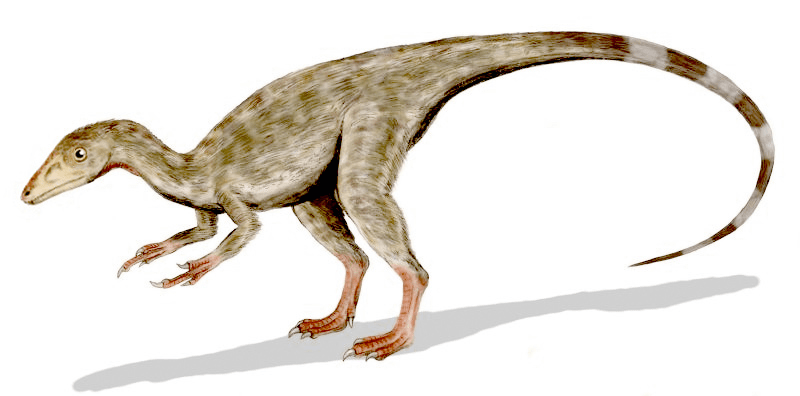
When most people think of dinosaurs, they think of huge creatures. And many of the dinosaurs were enormous. Supersaurus was longer than a basketball court, and Sauroposeidon (SORE-oh- poe- seye-don) was as tall as a five-story building. But not every dinosaur was huge. During the Jurassic Time Period, when many of the biggest dinosaurs lived, there also lived Compsognathus (KOMP-sog-nath-us)). Compsognathus was a tiny dinosaur, not much bigger than a chicken.
My life-size model of Compsognathus compared to my cat.
The largest Compsognathus ever found was not quite four feet long – and most of that was just its tail. It stood about 11 inches high at the hip and weighed about 9-12 pounds. There were some advantages to being a tiny dinosaur in a land of giants. Many big meat eaters were likely to overlook such a small animal. They could feast on hundreds of pounds of tasty plant eaters. Why should they bother with one, stringy, little mouthful?
Of course, it wouldn’t be so great to be caught in the path of one of the giant dinosaurs. Some of the really big ones could step on a Compsognathus and hardly know it – the way you might step on a large bug.
But Compsognathus wasn’t likely to get stepped on often. Scientists say it was built for speed with hollow bones and a slender, streamlined body. It ran on two long, strong, back legs, and its tail helped keep it balanced as it ran. It could zip along dodging giant dinosaurs with ease.
It may not have needed to dodge too many other dinosaurs. Only two skeletons of Compsognathus have been found, and both of them seemed to have lived on atolls, islands that have a lagoon in their center. If all Compsognathus lived on these types of islands, they may have been the biggest predator on them.
Satellite picture of the Atafu atoll in TokelauAtafu.jpg: NASA Johnson Space Center derivative work: Talkstosocks, Public domain, via Wikimedia Commons
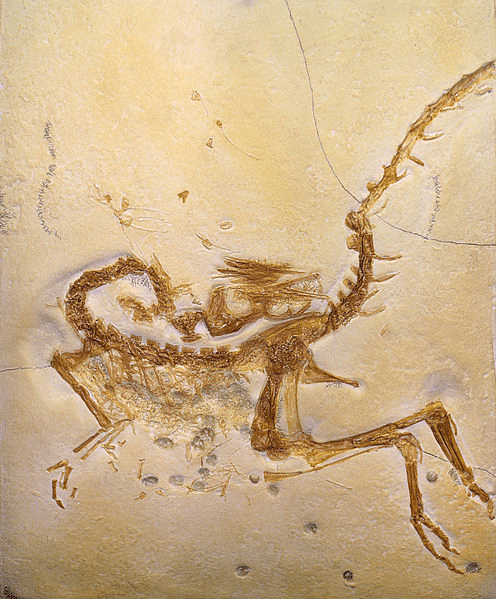
Compsognathus still needed to be speedy – to catch its own food. Scientists think Compsognathus ate such things as insects, frogs, and small lizards. It took speed to catch such quick-moving creatures. One skeleton of a Compsognathus was found with a particularly fast lizard in its stomach. The lizard may have been fast, but Compsognathus was faster.
Compsognathus skeletonH. Zell, CC BY-SA 3.0, via Wikimedia Commons
Compsognathus could grab its lunch with the long fingers on its hands. It had three fingers on each “hand,” but only two of them were usable. Each one of them had a very long claw, good for grabbing food. Once it caught its lunch, Compsognathus could crunch its victim with its many sharp, pointed teeth, though it may have just swallowed it whole. The name Compsognathus means “pretty jaw,” but if you were a pterosaur (TAIR-uh-sore), grounded with a broken wing, you wouldn’t think those jaws were so pretty.
It’s hard for scientists to learn much about Compsognathus and other little dinosaurs because so few of their skeletons are ever found. Many such dinosaurs were probably gulped down whole by big meat eaters. Even if a tiny dinosaur were fossilized, chances are no one would find it. It’s just much easier to find a six-foot bone than a two-inch one.
Rigorius, CC BY-SA 4.0, via Wikimedia Commons
Scientists have found a few dinosaurs that were as small or even smaller than Compsognathus. These include Microraptor which is in the same family as Velociraptor and Utahraptor, except it was only two feet long and weighed about two pounds, and Aquilops, (uh-QUIL-ops) which was a little bigger – 3-5 pounds. Its descendants included the mighty Triceratops. Studying them alongside Compsognathus makes scientists think that any small dinosaur must have been quick and active.
Scientists want to learn all they can about what made small dinosaurs special. They would like to know whether they lived in packs or by themselves. In the Jurassic Park franchise (where they were called “compis”) a pack of Compsognathus were shown working together to attach someone, but we don’t know if that was true or not. Scientists would also like to know whether or not they took care of their babies or left the babies alone to fend for themselves. And they would like to know whether they lived in fear of the big dinosaurs or simply ignored them.
So far, the fossil record hasn’t answered those questions. In the meantime, scientists continue to search for clues. One thing is already known – tiny dinosaurs are just as fascinating as huge ones!
CompsognathusNobu Tamura (http://spinops.blogspot.com), CC BY-SA 3.0, via Wikimedia CommonsSources (Click Me!)
Norman, David. The Illustrated Encyclopedia of Dinosaurs. Crescent Books, 1985.
Riehecky, Janet. Compsognathus. The Child’s World, 1991.
Strauss, Bob. “The 19 Smallest Dinosaurs and Prehistoric Animals.” ThoughtCo. 5 Apr. 2023, thoughtco.com/smallest-dinosaurs-and-prehistoric-animals-1093812.
As I wrote a few weeks ago, there are some serious contenders for Tyrannosaurus’ crown as the biggest, fiercest land carnivore of all time. Giganotosaurus and Megaraptor could certainly give Tyrannosaurus a battle, but this week’s contenders, from Africa, are even more powerful.
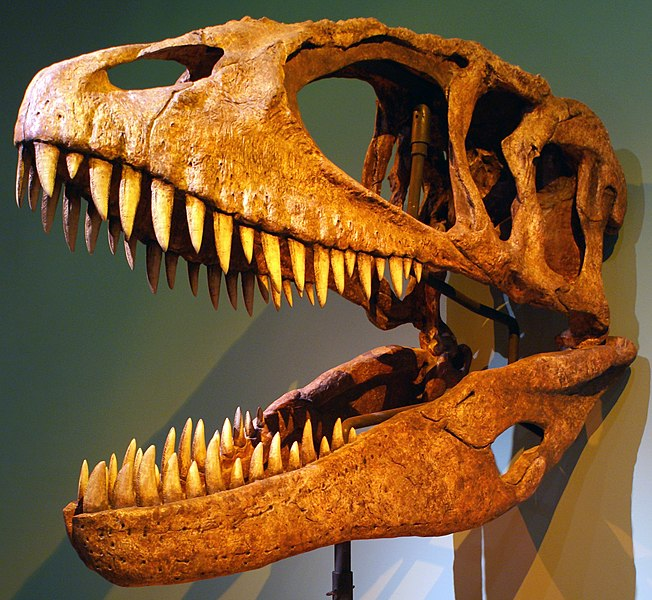
Carcharodontosaurus (Kar-KAR-oh-don-toe-SAWR-us) lived in Northern Africa during the late Cretaceous Period 99 to 94 million years ago. Its name means “shark-toothed lizard,” and its long jagged-edged teeth are much like those of a shark.
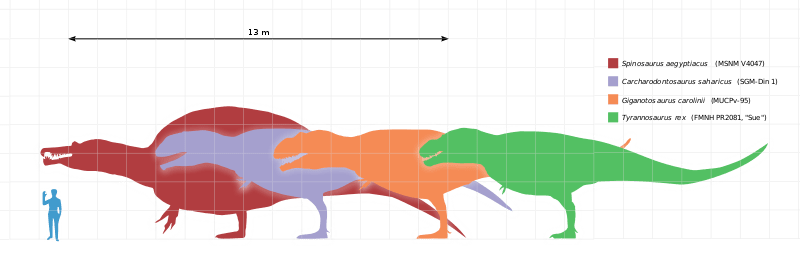
Most estimates rank Carcharodontosaurus as about three or four feet longer than Tyrannosaurus. It’s hard to tell because scientists have found only some tens of bones and a number of teeth from it.
Even if Carcharodontosaurus is slightly larger, Tyrannosaurus still has a number of advantages. Smithsonian Magazine reported that Tyrannosaurus’ bite force was almost 12,800 pounds, stronger than any other animal that ever walked on land. (Megalodon, an enormous extinct shark, does have it beat at 41,000 pounds. There was also an extinct crocodile named Purussaurus which had a bite of 15,500 pounds of force.) Tyrannosaurus’ bite was stronger than the force of an average-sized African elephant dropping on you. (I don’t want to even think what that means about Megalodon’s bite.) Tyrannosaurus’ teeth are shaped like bananas. The rounded shape is very effective at breaking bones. Carcharodontosaurus’ teeth were shaped differently. They were thinner, more like the blade of a knife. They were meant for shearing meat from bones. They might have broken if Carcharodontosaurus bit directly into thick bones.
Tyrannosaurus also had an advantage in eyesight. Its eyes were more forward looking than Carcharodontosaurus’. This gave Tyrannosaurus a wider range of sight, enabling it to see more of what was in front of it. Because of the shape of Carcharodontosaurus’ skull, it would have had to drop its head toward its chest to see any distance ahead. This likely meant it hunted its prey by ambushing them, rather than chasing after them. Regardless, if the two had ever met, it would have been a titanic battle.
Franko Fonseca from Redondo Beach, USA, CC BY-SA 2.0,via Wikimedia Commons
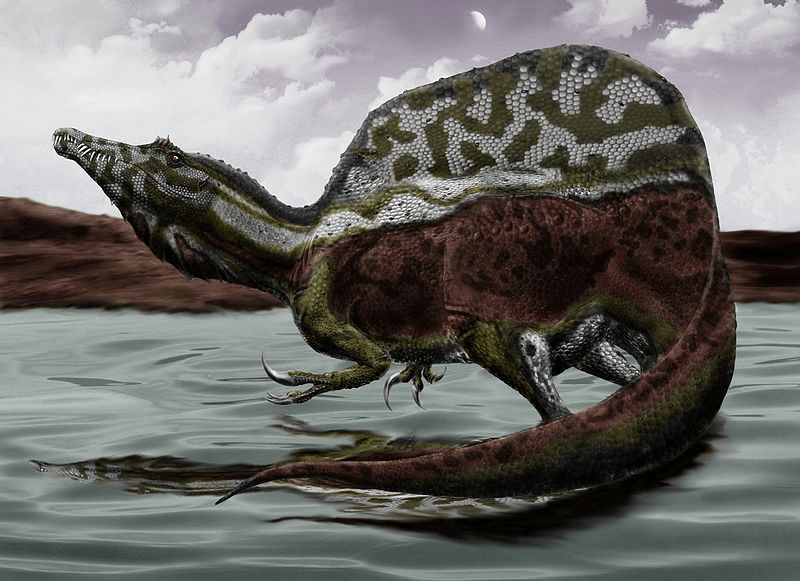
And then there’s the biggest of the top five, Spinosaurus. It also lived during the late Cretaceous Period and was found in North Africa. This creature was about 49 feet long and weighed just over eight tons. However, its back legs were much shorter than Tyrannosaurus’, making it about 9 feet tall at the hip compared to Tyrannosaurus’ 12-15 feet in height. However, if the sail on Spinosaurus’ back is included, then it was 15-16 feet tall.
Durbed, CC BY-SA 3.0, via Wikimedia Commons
It’s difficult to compare its power to the other three because it was shaped differently and lived a different kind of life. It was a little thinner, with a large sail on its back, a paddle-shaped tail and its jaws were long and narrow like a crocodiles’. Its teeth were like overturned ice cream cones instead of curved with jagged edges. Scientists think that it hunted at least part of the time in the water and that on land it stayed near the coast and ambushed its prey, rather than running it down. Its likely that, despite its huge size, its shorter legs would have made it less agile than Tyrannosaurus. Its tail would have been a formidable weapon for knocking other dinosaurs around, but that might not be enough.
Figure 1 (left) Spinosaurus tooth – 1 Jiří X. Doležal (about me), CC BY-SA 3.0, via via Wikimedia Commons. Figure 2 (right) Tyrannosaurus tooth
Scientists don’t know which of these dinosaurs was most powerful. Even though it’s been many years since Giganotosaurus, Megaraptor, Carcharodonotosaurus, and Spinosaurus were discovered, scientists still know very little about them. It takes a long time for fossil bones to be excavated and studied. For me, however, Tyrannosaurus still holds its crown by virtue of its long teeth, large brain, and powerful bite. But never forget that there is another alternative: any day a paleontologist might dig up a new dinosaur that could take on all of them.
What do you think?
Sources (Click Me!)
Aureliano Tito, Aline M. Ghilardi, Edson Guilherme, Jonas P. Souza-Filho, Mauro Cavalcanti, and Douglas Riff . “Morphometry, Bite-Force, and Paleobiology of the Late Miocene Caiman Purussaurus brasiliensis.” PLOS ONE. 17 Feb. 2015. https://journals.plos.org/plosone/article?id=10.1371/journal.pone.0117944.
Novas, Fernando, E., Diego Pol Juan I. Canale; Juan D. Porfiri; Jorge O. Calvo. “A bizarre Cretaceous theropod dinosaur from patagonia and theevolution of Gondwanan deomaeosaurids. Proceedings: Biological Sciences, Mar2009, Vol. 276 Issue 1659, p1101-1107, 7p.
Richardson, Hazel. Smithsonian Handbooks: Dinosaurs and Prehistoric Life. New York: Dorling Kindersley, 2003.
Sereno PC, Myhrvold N, Henderson DM, Fish FE, Vidal D, Baumgart SL, Keillor TM, Formoso KK, Conroy LL. “Spinosaurus is Not an Aquatic Dinosaur.” Elife. 2022 Nov 30;11:e80092. doi: 10.7554/eLife.80092. PMID: 36448670; PMCID: PMC9711522.
Smith, Nathan D., Peter J. Makovicky1, Federico L. Agnolin, Martin D. Ezcurra, Diego F. Pais3 and Steven W. Salisbury. “A Megaraptor -like theropod (Dinosauria: Tetanurae) in Australia: support for faunal exchange across eastern and western Gondwana in the Mid-Cretaceous.” Proceedings of the Royal Society. 20 May 2008.
“Sue at the Field Museum.” The Field Museum, Chicago, IL. 2007. 15 July 2009.
University of Queensland. “Australian Dinosaur Found To Have South American Heritage.” ScienceDaily 15 June 2008. 10 September 2009 <http://www.sciencedaily.com /releases/2008/06/080613111410.htm>.
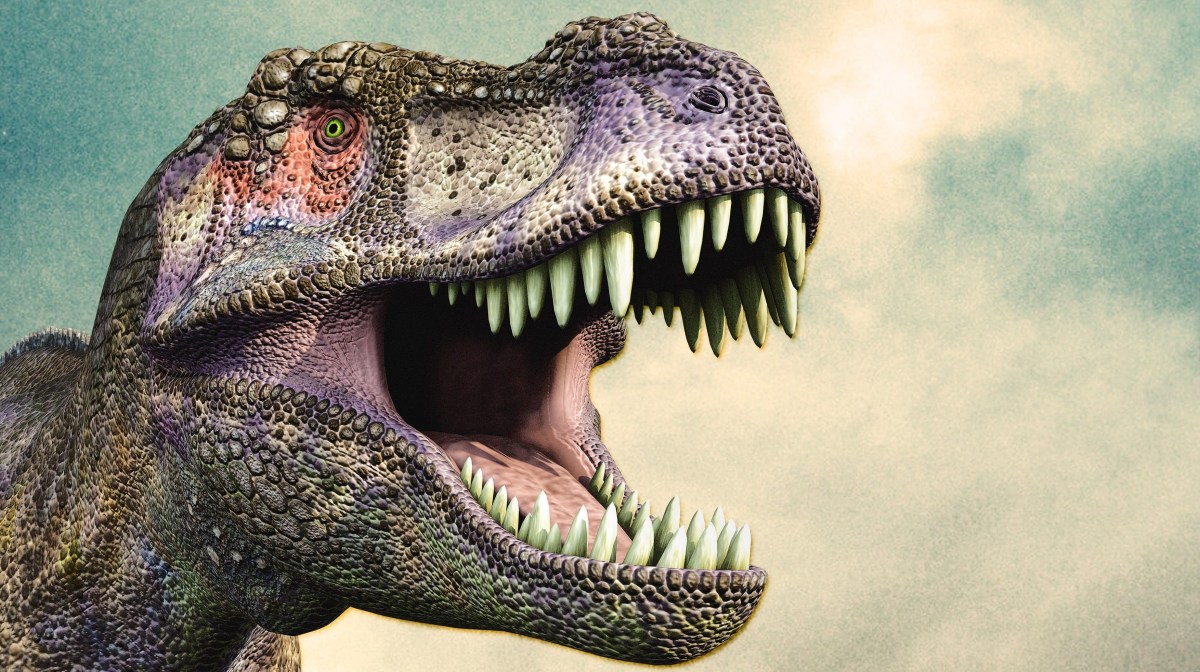
Tyrannosaurus rex, long considered the largest carnivorous dinosaur, faces competition from newer discoveries.
The name Tyrannosaurus rex means “king of the tyrant lizards,” but a number of other giant carnivores would like to steal its crown. Recently some pretty big, fierce dinosaurs have been found.
Tyrannosaurus Nobu Tamura, CC BY-SA 4.0, via Wikimedia Commons
From its discovery in 1902 until the 1990s, Tyrannosaurus rex was regarded as the biggest, most powerful carnivorous dinosaur of all. It was about 40-42 feet long, stood about 12-15 feet tall at the hip, and weighed about 9.7 tons. These days, however, there are at least four other contenders for that crown. Two are from Argentina and two are from Africa. Today, I’m going to write about the two from Argentina, and in two weeks, the two from Africa.
Giganotosaurus (GIG-ah-noh-ta-SAWR-us). was found in Argentina in 1993. Its name comes from Greek words meaning “giant southern lizard.” There’s a lot of confusion about how to pronounce its name. It is definitely not said like gigantic. That leaves out the first “o” in its name. In Greek, the “g” is a hard sound, like get. So that’s what I go with. Lots of Internet sources use a “j” sound, making it JIG-ah-noh-ta-SAWR-us. But I have to go with the Greek sound: GIG-ah-noh-ta-SAWR-us.
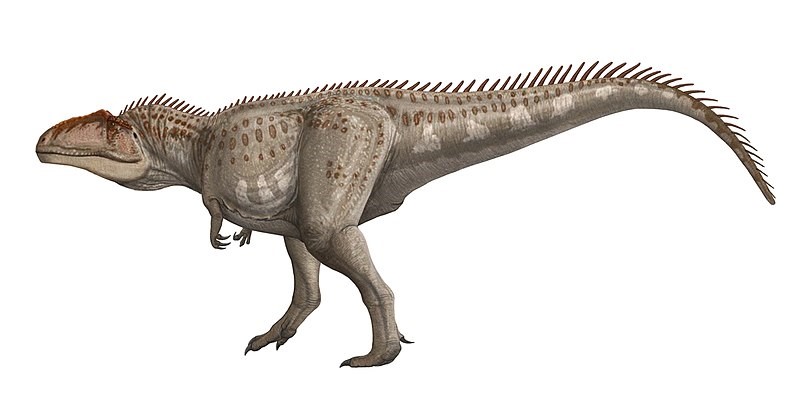
When it was first discovered, paleontologists thought Giganotosaurus was an impressive eight feet bigger than T-rex. Now most think they were similar in size, though Giganotosaurus was probably a little longer, about 40-423 feet long. Their heights and weights also seem to have been similar, with Giganotosaurus having just a slight edge.
T-rex did have some advantages. Its teeth, which were likely used as weapons, could reach 12 inches long, but those of Giganotosaurus were only 8 inches (as if eight-inch teeth were small!). Even more importantly, T-rex had a bigger brain, with well-developed optical lobes, helping it see better. Giganotosaurus had smaller optical lobes, but bigger lobes devoted to smell. Which do you think is more important to a hunter: sight or smell?
These two certainly would have had a huge battle if they ever met. But that never happened. Giganotosaurus lived about 99.5 to 95 million years ago in the area that is now Argentina in South America. Tyrannosaurus lived 72.7 to 66 million years ago in what is now the western United States.
Giganotosaurus ДиБгд, Public domain, via Wikimedia Commons
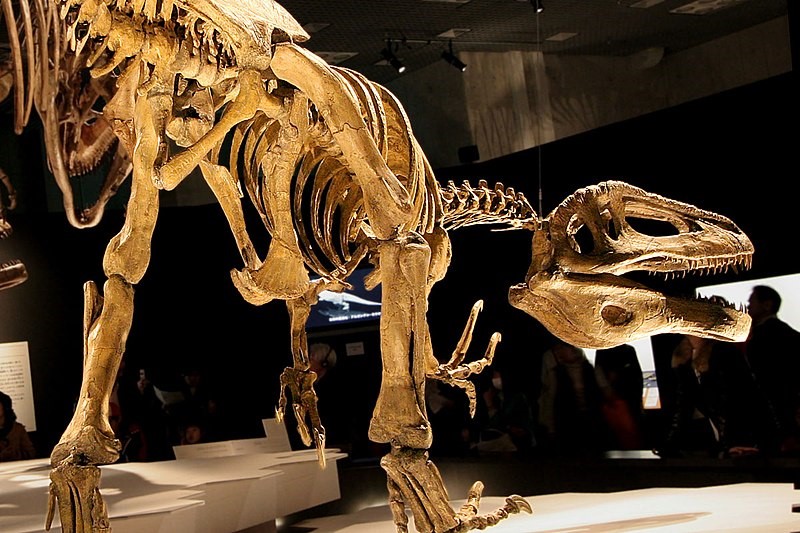
The other contender from Argentina is Megaraptor (MEG-uh-rap-tor). Its name means “large thief.” Megaraptor is known from just a few partial skeletons found in Argentina and Australia in 1997. It lived about 75 to 92 million years ago. Scientists think it might have been about the same height as T-rex. Megaraptor was about 13 feet tall at the hip, but it was not nearly as long, only about 25 to 33 feet, 7-9 feet shorter than Tyrannosaurus.
Megaraptor skeleton Kabacchi, CC BY 2.0, via Wikimedia Commons
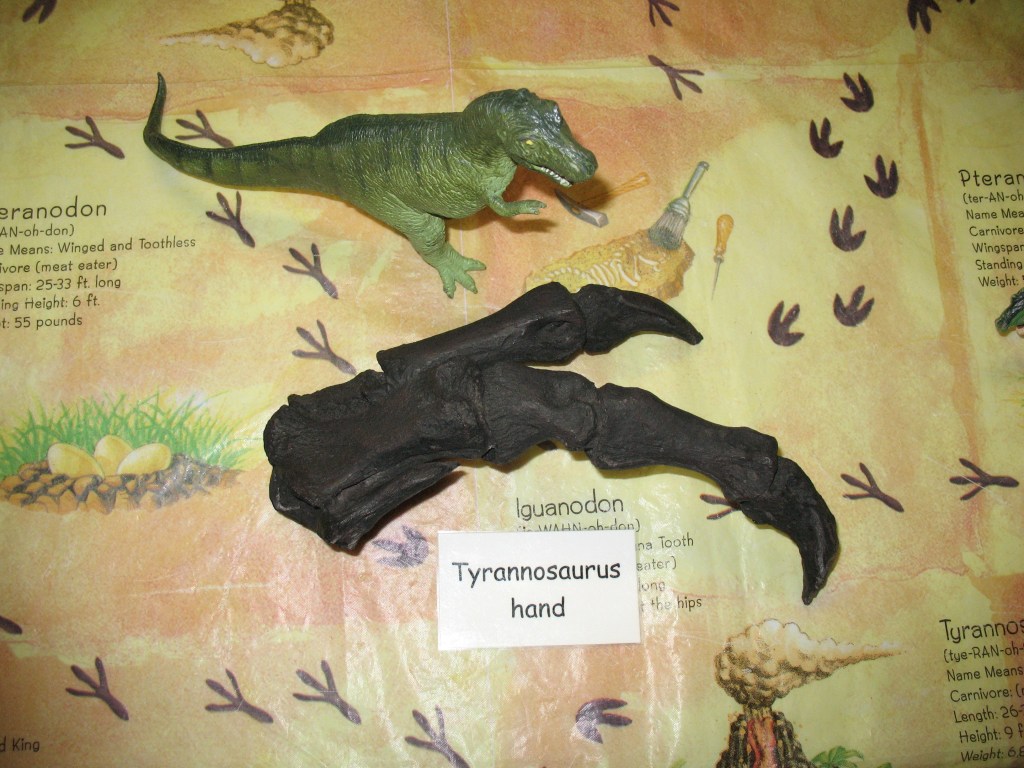
It would seem that Tyrannosaurus’ larger size and probably greater strength would scare Megaraptor off before the fight even began, but that’s not the whole story. What Megaraptor did have was a 15-inch claw on the first finger of each of its hands – and its other claws were pretty big, too. That first claw, though, is almost twice the length of the longest T-rex claw. Tyrannosaurus’s tiny arms were pretty useless in a fight. Megaraptor could use its longer, muscular arms and huge hands to reach in and slash its prey. Also, Megaraptor’s lighter build probably made it faster than T-rex and more agile. It could dart in and out quickly to avoid Tyrannosaurus.
So, it would be an epic battle. Who do you think would win? Could either of these two take Tyrannosaurus’ crown? Or does that crown belong to a dinosaur from Africa? Come back in two weeks to find out.
Sources (Click Me!)
Calvo, Jorge Orlando and Rodolfo Coria. “New Specimen of GiganotosaurusCarolini (Coria & Salgado, 1995), Supports it as the Largest Theropod Ever Found.” GAIA, Lisbon, December 1998.
Currie, Philip J and Colleayn O. Mastin. The Newest and Coolest Dinosaurs. Grasshopper Books Publishing, 1998.
Frachtenberg, Fabio, and Jorge Calvo, Oscar A. Frachtenberg. Dinosaurios Argentinos: Giants of Patagonia. Aurora, IL: SciTech Hands-On Museum, 2006.
Gasparini, Zulma, Leonardo Salgado, and Rodolfo A. Coria (eds.). Patagonian Mesozoic Reptiles. Indiana University Press, 2007.
Larson, Peter and Kenneth Carpenter. Tyrannosaurus Rex: The Tyrant King. Indianapolis: Indiana University Press, 2008.
Mazzetta, Gerardo V., Per Christiansen, and Richard Farina. “Giants and Bizarres: Body Size of Some Southern South American Cretaceous Dinosaurs.” Historical Biology, June – December 2004, Vol. 16 (2-4) pp. 71-83.
Miller, Erin. “T-Rex’s older, tougher cousin – Giganotosaurus skeleton will go on national tour.”Daily Telegraph, The (Sydney) (n.d.). Newspaper Source_. EBSCO. Judson University Library, Elgin, IL 15 JJuly 2009. <http://www.judsonu.edu:2048/login? url=http://<http://www.judsonu.edu:2048/login?url=http://search.ebscohost.com/login.aspx?direct=true&db=nfh&AN=200312221022639124&site=ehost-live>.
Novas, Fernando, E., Diego Pol Juan I. Canale; Juan D. Porfiri; Jorge O. Calvo. “A Bizarre Cretaceous Theropod Dinosaur from Patagonia and the Evolution of Gondwanan Deomaeosaurids. Proceedings: Biological Sciences, Mar2009, Vol. 276, Issue 1659, p1101-1107.
Porfiri, Juan D., Domenica Dos Santos, and Jorge O. Calvo. “New Information on Megaraptornamunhuaiquii (Theropoda: Tetanurae), Patagonia: Considerations on Paleoecological Aspects.” Arquivos do Museu Nacional, Rio de Janeiro, 2007, Vol. 65, n. 4, pp. 545-550.
Richardson, Hazel. Smithsonian Handbooks: Dinosaurs and Prehistoric Life. Dorling Kindersley, 2003.
Smith, Nathan D., Peter J. Makovicky1, Federico L. Agnolin, Martin D. Ezcurra, Diego F. Pais3 and Steven W. Salisbury. “A Megaraptor-like theropod (Dinosauria: Tetanurae) in Australia: Support for Faunal Exchange across Eastern and Western Gondwana in the Mid-Cretaceous.” Proceedings of the Royal Society. 20 May 2008.
Spotts, Peter N. “Giant Dinosaur Fossil Forces Scientists to Question Theories.” Christian Science Monitor 03 Dec. 1997: 3. Academic Search Premier. EBSCO. Judson University Library, Elgin, IL. 15 July 2009. <http://www.judsonu.edu:2048/login?url=http://search. ebscohost. com/login.aspx?direct=true&db=aph&AN=9712050418&site=ehost-live>.
University of Queensland. “Australian Dinosaur Found to Have South American Heritage.” ScienceDaily. 15 June 2008. <http://www.sciencedaily.com/releases/ 2008/06/080613111410.htm>.

























 Dinosaur Lady


.jpg)


.png)


.png)


