Stegosaurus

Stegosaurus is one of the most iconic herbivores, but is also one of the most peculiar…

            Many dinosaurs are strange. But one of the strangest is Stegosaurus. Imagine what you would look like if you walked on your feet and your elbows! Well, that’s sort of what Stegosaurus looked like. Its back legs were twice as long as its front legs. That meant its hips were stuck way up in the air – 9-13 feet! Its head and shoulders were close to the ground, and its back curved like a slide down to its tail.  From front to back it was about 24-30 feet long, and it weighed about 5 ½ tons. In a bowling alley, it would take just two stegosaurs to stretch from the beginning of the alley all the way down to the bowling pins.
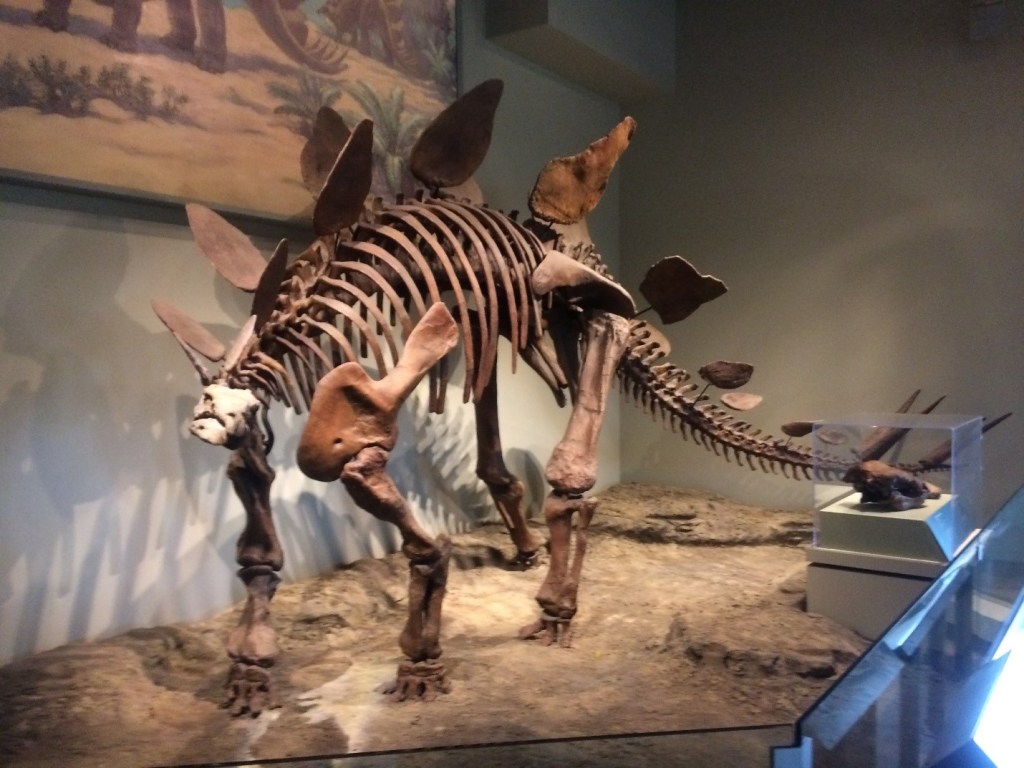
Stegosaurus skeleton at the Field Museum of Natural History in Chicago

            That was certainly a strange shape, but Stegosaurus had an even stranger mouth. The front of its mouth was a beak, like that of a parrot or turtle. Most plant eaters have strong teeth that can grind up food, but not Stegosaurus. In the back of its mouth, it had rows of small, weak teeth. Its jaws could only move up and down, not to the side, which made chewing hard. As you can imagine, all this made it hard for Stegosaurus to eat. It could break off a mouthful of plants, but it couldn’t really chew them up very well before swallowing them. So, most things went down whole. There’s no evidence to indicate that it ate rocks (called gastroliths) as did other dinosaurs that couldn’t chew. The rocks helped break up the food in a special sac called a gizzard. But Stegosaurus didn’t do this. So, scientists have no idea how this strange creature managed to digest its food.

Frederick Berger, Public domain, via Wikimedia Commons

            Stegosaurus not only had trouble eating – it also had trouble thinking. The Stegosaurus had a tiny head and probably the smallest brain compared to its size of any dinosaur. It was only about as big as a golf ball or walnut.

            Stegosaurus might not have been very smart, but it knew enough to avoid somebody who tried to take a bite out of it. And there were plenty of creatures that wanted to take a bite out of Stegosaurus.

FabSubeject, CC BY-SA 3.0, via Wikimedia Commons

            The Stegosaurus lived at the same time as the fierce Allosaurus and many other meat eaters. It couldn’t run fast, and it couldn’t think fast. It had to have some way to protect itself – so it grew a very strange weapon. Most dinosaurs that needed to defend themselves grew sharp claws on their feet or horns on their heads. But Stegosaurus did things backwards. It grew four, foot-long spikes on the end of its tail!
Fred Wierum, CC BY-SA 4.0, via Wikimedia Commons

            These spikes were good weapons and helped the Stegosaurus, but they were not good enough to fight off a determined attack. So, Stegosaurus’ best chance for survival was either to hide from meat eaters (and it was too big to do that!) or to stay with a herd of stegosaurs. Like any bully, an Allosaurus would rather attack a Stegosaurus found alone than one with a lot of friends nearby.

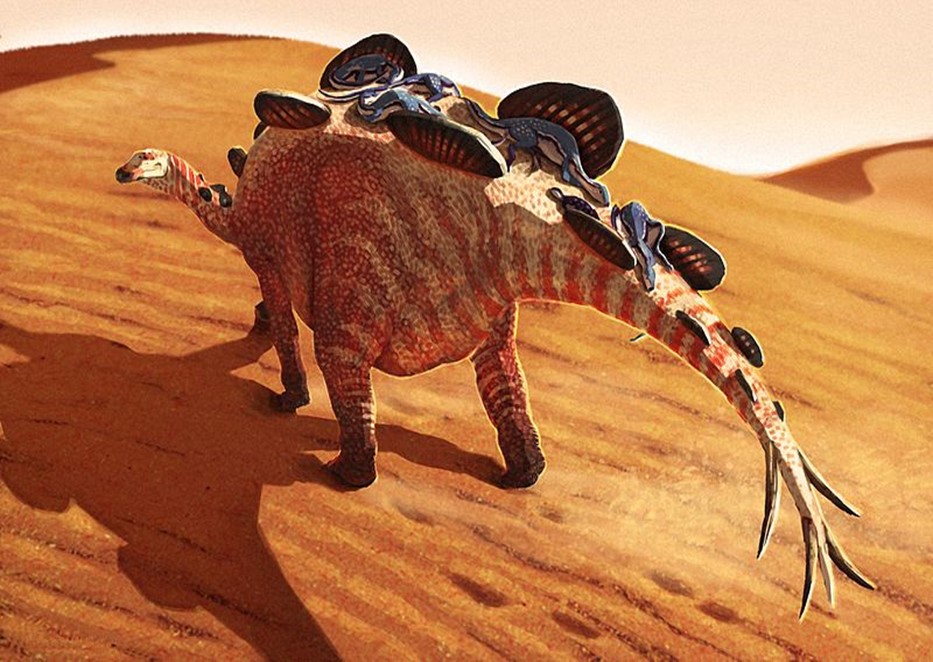
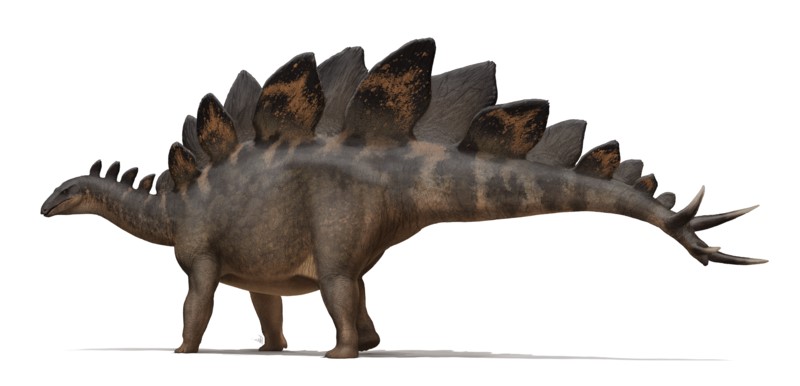
            Probably the weirdest thing about Stegosaurus was the plates on its back. Scientists have wondered whether there was one row of plates or two, whether they stood up straight or lay down flat, and whether they were arranged in pairs or alternated. They have also wondered what the plates were for.

©Diana Magnuson

            They weren’t dinner plates – but they may have helped keep Stegosaurus from becoming someone else’s dinner, serving as defense. This isn’t too likely because their whole sides had no covering. Just protecting the top wasn’t very effective.

            Or the plates may have worked to keep the Stegosaurus from becoming too hot. Their position and shape seem designed to pull heat from the body of Stegosaurus and let the wind carry it away. But dinosaur species similar to Stegosaurus, such as Kentrosaurus, have spikes instead of plates, which wouldn’t work as heat dispersers. Most likely, the plates may have been just for display, to help Stegosaurus attract a mate. Scientists have considered all of these ideas, but they have not been able to agree. They continue to study the plates, but they may never know for sure why Stegosaurus had them.

Kentrosaurus
Connor Ashbridge, CC BY-SA 4.0, via Wikimedia Commons

            Scientists also don’t know much about the kind of life Stegosaurus led. Scientists have found Stegosaurus footprints which seem to indicate it traveled in herds, living on flat floodplains and in conifer forests bordering rivers. It is likely it ate plants that grew close to the ground, such as mosses or ferns. They think it laid eggs and that it probably left its babies on their own to take care of themselves because they weren’t smart enough to take care of them. Many reptiles, such as sea turtles and snakes, do this. But scientists don’t know for sure. There will always be things we don’t know about Stegosaurus. But that’s part of the fascination of this strange creature.

ABelov2014 (https://abelov2014.deviantart.com/), CC BY-SA 3.0, via Wikimedia Commons
Sources (Click Me!)

Naish, Darren. “The Stegosaurus Plate Controversy.” Scientific American. 11 July 2016.  https://www.scientificamerican.com/blog/tetrapod-zoology/the-stegosaurus-plate-controversy/

Norman, David. The Illustrated Encyclopedia of Dinosaurs. Crescent Books, 1985.

Rafferty, John P. “Stegosaurus.” Britannica. 10 July 2024. https://www.britannica.com/animal/ ornithischian

Riehecky, Janet. Stegosaurus. The Child’s World, 1988.

Title Image from https://wallpaperaccess.com/stegosaurus
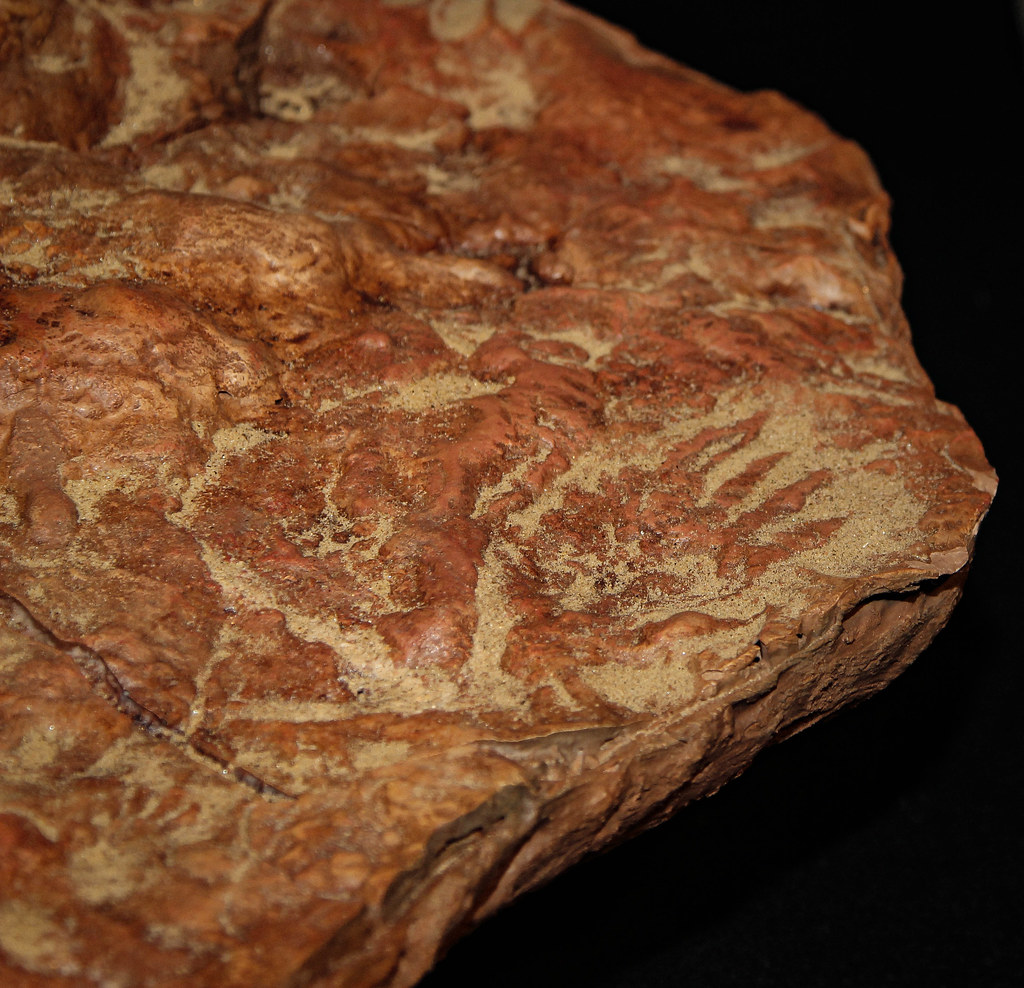
Dinosaur Mummies

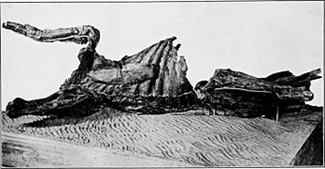
            Everybody knows where you find mummies – in pyramids in Egypt. But not always. People made the Egyptian mummies, but under just the right conditions, Mother Nature can make them, too. A few, very rare dinosaur mummies have been found. Not just a skeleton but a fossil with skin and soft tissue preserved.

AntoninJury, CC BY-SA 4.0, via Wikimedia Commons

            To become a mummy, a dinosaur that died would first need to be protected somehow from predators, so they couldn’t tear it apart. That could happen in a number of ways. The dinosaur could die in a place away from predators or be covered over with water from a flood or a giant mudslide. Some could be covered by the collapse of a sand dune.

            Being away from predators isn’t enough. Minerals need to soak into the skin and soft tissue before they have a chance to decay. It helps if the dinosaur is covered with something that slows down the microbes that cause that decay, such as certain kinds of mud. It also helps to have the right kind of skin. Some scientists have suggested that the reason most of the dinosaur mummies that have been found are duckbilled dinosaurs is that there was something in their skin that slowed down decay, giving the skin time to fossilize.

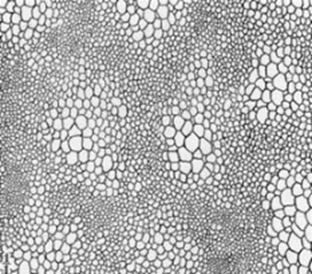
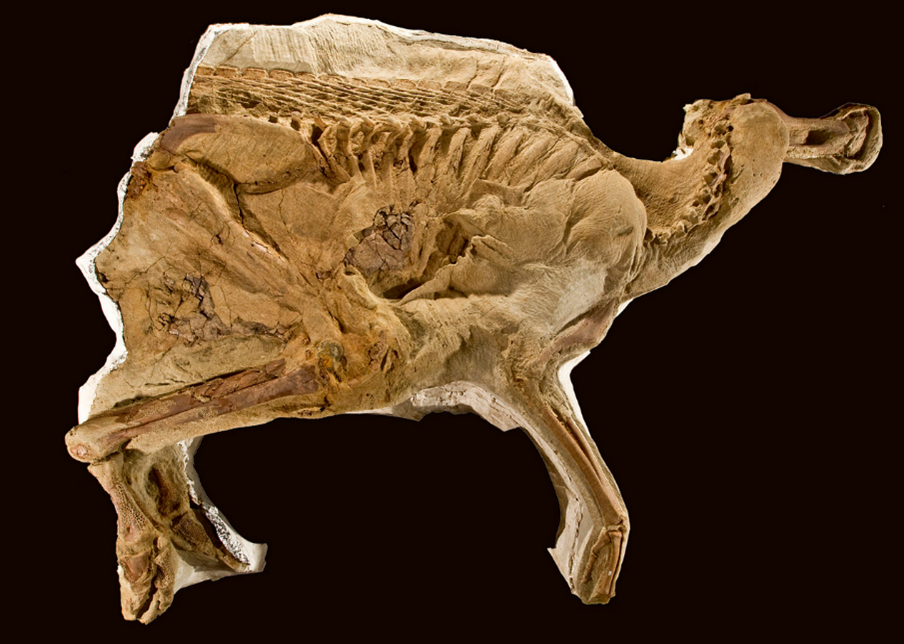
            The first dinosaur mummy was found in Wyoming in 1908. It was an Edmontosaurus (ed-MON-to-SAWR-us), a duckbill dinosaur common in the late Cretaceous. Though it’s hard to see in this picture, almost 2/3 of the body is still covered with skin. The skin consists of very small scales, less than two tenths of an inch in diameter. Unlike those of many reptiles, the scales are more like separate bumps than overlapping scales.

The Children’s Museum of Indianapolis, CC BY-SA 3.0, via Wikimedia Commons
Henry Fairfield Osborn, Public domain, via Wikimedia Commons

            Different sizes are clustered together. The scales on the upper side of the body are larger than those on the lower side. Soft tissue between the claws on its hands suggests that it had padded feet, and tissue above the spine suggests it had a soft ridge along the back of the neck and spine.

The Children’s Museum of Indianapolis, CC BY-SA 3.0, via Wikimedia Commons

            Several other duckbill dinosaur mummies were found during the 1900s, but they didn’t have as much preserved soft tissue or skin. The next dinosaur mummy of any importance was not found until 2000 when scientists in Montana unearthed a Brachylophosaurus (BRACK-uh-LOF-o-SAWR-us), which is another type of duckbilled dinosaur. They named it Leonardo (nearby graffiti from 1916 said that Leonard loved Geneva). This mummy was 90% complete and revealed that the neck had unusually strong muscles and that its skin was scaly, similar to Edmontosaurus. Scientists were able to examine the contents of its stomach. It ate leaves, conifers, ferns, and flowering plants like magnolias. Its stomach also revealed parasites – small bristly worms.

ケラトプスユウタ, CC BY-SA 4.0, via Wikimedia Commons

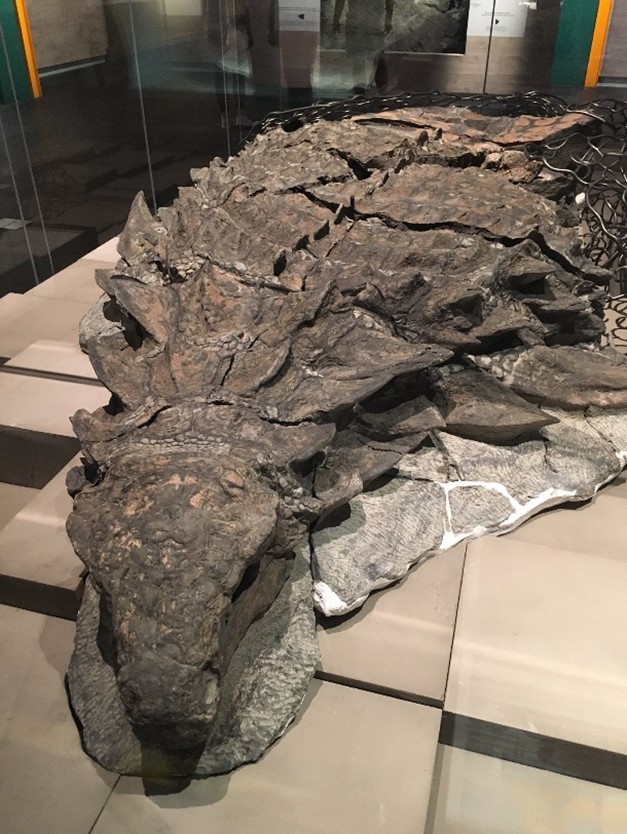
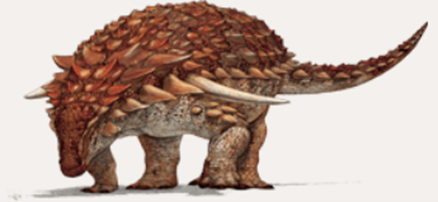
            Probably the most spectacular dinosaur mummy of all was discovered in 2011 in Alberta, Canada. It is Borealopelta (BORE-e-AL-o-PEL-ta), not a duckbilled dinosaur but a nodosaur, an armored dinosaur. In life it was 18 feet long and weighed about 3000 pounds. The back legs and tail are missing, but what is there is amazing. The skin was so well preserved that scientists were able to use a mass spectrometer to find out what the color of the dinosaur was.

© Royal Tyrrell Museum of Palaeontology, illustration by Julius Csotonyi

            The back and sides of the dinosaur were a dark reddish brown, while the belly was a lighter reddish brown. We see that pattern of coloring, ark on top and light underneath, in many animals today. It helps those animals hide from predators. Not only was the skin well preserved, but also the armor itself. Usually, the armor falls off armored dinosaurs before they fossilize. Sometimes pieces of armor are found nearby, but often they aren’t. This mummy shows exactly where and how every piece of armor was attached. In addition, scientists have learned that the spikes were covered with keratin, the same stuff that fingernails are made of. This made the armor look bigger: the better to scare away predators – or perhaps to attract a mate.  

            No doubt additional exciting dinosaur mummies will be found in the future. A potential one, discovered in Montana in 2014, still lies encased in a 35,000-pound block of stone, waiting to be dug out. Each mummy helps fill in gaps in our knowledge of how dinosaurs looked and behaved.

            Which do you like better? Egyptian mummies or dinosaur mummies? Let me know in the comment section below.

Sources (Click Me)

Brachylophosaurus. Wikipedia. 22 March 2021, https://en.wikipedia.org/wiki/ Brachylophosaurus#cite_note-MTT06-7

“Dinosaur Mummies.” Fossil Wiki. Fandom. n.d. https://fossil.fandom.com/wiki/ Dinosaur_mummies#Discovery_and_analysis

“Fossil ‘Mummy’ Shows Glimpse of Dinosaur Skin.” American Museum of Natural History.

            28 April, 2017, https://www.amnh.org/explore/news-blogs/news-posts/fossil-mummy-shows-glimpse-of-dinosaur-skin.

Greshko, Michael. “The Amazing Dinosaur Found (Accidentally) by Miners in Canada.” National Geographic. June 2017. https://www.nationalgeographic.com/magazine/ article/dinosaur-nodosaur-fossil-discovery

“Nodosaur Dinosaur ‘Mummy’ Unveiled with Skin and Guts Intact.” All That’s Interesting. 19 June 2020, https://allthatsinteresting.com/nodosaur-dinosaur-mummy.

“Spectacularly Detailed Armored Dinosaur “Mummy” Makes Its Debut.” Smart News. Smithsonian Magazine. 2021. https://www.smithsonianmag.com/smart-news/mummified-armored-dinosaur-makes-its-debut-1-180963311/