Parasaurolophus

            Dinosaurs left behind skeletons, eggs, footprints, even fossilized poop. All these things help us imagine what the world of the dinosaurs looked like. But we really don’t have much of an idea what it sounded like. We can be pretty sure that the dinosaurs’ world echoed with the thud of gigantic feet, the splash of water, and the buzz of insects. But did dinosaurs bark, howl, grunt or growl? We don’t know.

Leandra Walters, Phil Senter, James H. Robins, CC BY 2.5, via Wikimedia Commons

            However, scientists do think that one dinosaur “played a horn.” That dinosaur was Parasaurolophus (par-uh-sore-oh-loaf-us). Scientists have made models of the long, hollow crest on its head, and when they blew air through it, it made a deep, low tone, like a musical instrument.

            This link https://www.youtube.com/watch?v=QtpSOpUDCb8 will help showcase what Parasaurolophus might have sounded like.

            The crest of Parasaurolophus was a very long, thin tube of bone. It began at the dinosaur’s nose and stretched up way above its head. On some Parasaurolophus the crest reached six feet long – longer than most people! This crest was hollow inside. A tube for air went up from each nostril to the tip of the crest and then curved back down like a trombone. All the air it breathed had to make that long journey. Not even Pinocchio had a nose that long!
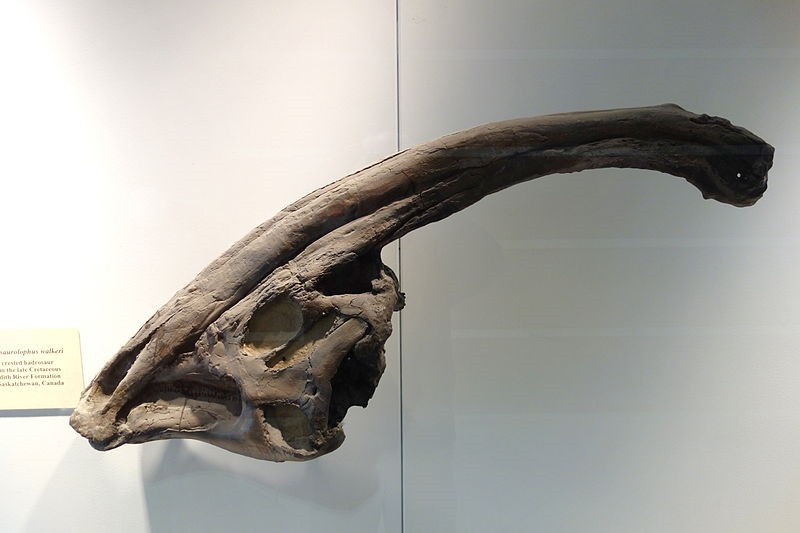
Daderot, CC0, via Wikimedia Commons

            In every other way Parasaurolophus was ordinary. It was one of the plant eaters nicknamed “duckbilled” because its mouth was long and flat like a duck’s bill. It stood on two strong back legs, with shorter front legs that it could also walk on or use as arms. It was about 30 feet long and 16 feet tall, and it probably weighed 3 or 4 tons. This was about the size of a bus – or an average dinosaur.

Size comparison of person and Parasaurolophus walkeri

            Parasaurolophus might have used the sounds it could make with its crest to communicate different messages, such as danger or food ahead. A herd might have honked at a Tyrannosaurus to go away. A special kind of honk might have attracted a mate.

            Parasaurolophus also might have used its crest to push away branches in a thick forest. The cassowary, a large flightless Australian bird, uses its crest for that today. Another idea is that the crest brought cool air close to the Parasaurolophus’ brain to keep it from getting too hot. And it might have been able to smell through it, so it could seek out its favorite plants or tell when a meat eater was close by.

            Scientists don’t know for sure if the Parasaurolophus used its crest in any of these ways. They continue to look for clues and ideas.
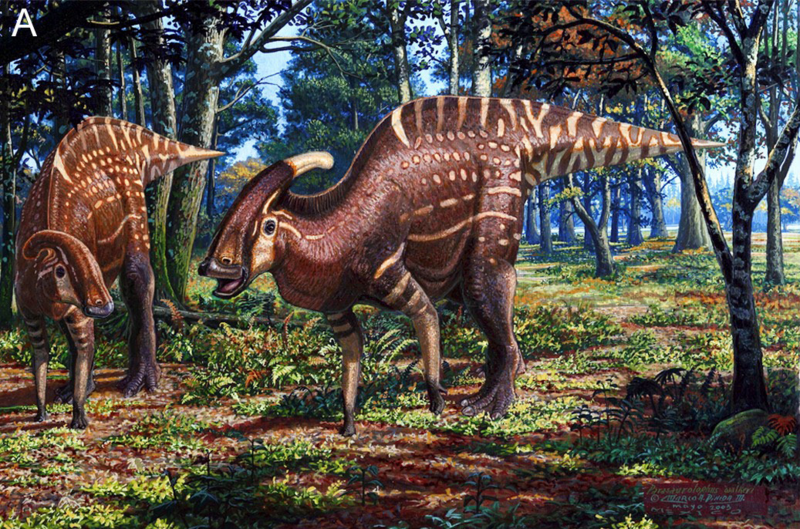
Marco Antonio Pineda, CC BY-SA 4.0, via Wikimedia Commons

            Scientists do know that Parasaurolophus had strong jaws which would be good for eating tough plants, such as pine needles, leaves, and different fruits and seeds. Its cheeks were loaded with good teeth for grinding things up. It even had three or four extra teeth above the ones that showed. That way if any of its teeth broke or wore out, new ones moved down. A Parasaurolophus may have grown more than 10,000 teeth during its lifetime.

            Parasaurolophus lived right up to the end of the age of dinosaurs, outliving the other known duckbilled dinosaurs. But sixty-six million years ago, the last dinosaurs on earth died, including Parasaurolophus. Never again will the world echo with the sound of those gigantic feet or the honk of a Parasaurolophus calling to its friends.

Sources (Click Me!)

Norman, David. The Illustrated Encyclopedia of Dinosaurs. Crescent Books, 1985.

Parasaurolophus.” Natural History Museum of London. https://www.nhm.ac.uk/discover/dino-directory/parasaurolophus.html

“The Real Parasaurolophus.” Philip J. Currie Dinosaur Museum. 2024. https://dinomuseum.ca/2021/01/the-real-parasaurolophus

Riehecky, Janet. Parasaurolophus. The Child’s World, 1990.
When Did the Dinosaurs Live?

This blog is the first in a series that will explore the timeline of Earth’s history, from the formation of the planet to the dominance and eventual extinction of dinosaurs.

           This blog is about dinosaurs in time; that is, dinosaurs in the timeline of Earth’s history. Not dinosaurs on time, because dinosaurs were hardly ever on time seeing they didn’t have clocks.

           Scientists say the Earth was formed 4.6 billion years ago. At first it was just molten lava, hundreds of miles deep. Over millions of years the Earth cooled and a crust appeared.

Artist’s impression of the Hadean Eon.
Tim Bertelink, CC BY-SA 4.0, via Wikimedia Commons

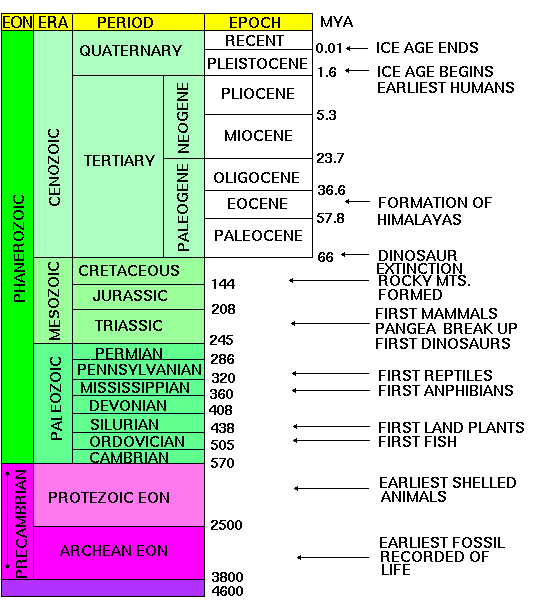
            The first lifeform that existed was a sort of blue-green algae. Then other lifeforms appeared, including shellfish. That whole time period of more than four billion years is called the Precambrian Eon. From 542 million years ago to the present age is the Phanerozoic Eon. It’s divided into three eras, the Paleozoic, the Mesozoic, and the Cenozoic. During the Paleozoic (from 541 to 252 million years ago) life began to bloom. The first fish, first amphibians, and the first reptiles appeared. The first plants also began to grow. But then a massive extinction wiped out 90% of life on Earth. Its cause is not known, but it ended the Paleozoic Era making way for the Mesozoic Era (from 252 to 66 million years ago).

           That’s when we get to the good stuff: Dinosaurs! The Mesozoic is divided into three time periods: the Triassic, the Jurassic, and the Cretaceous. And about halfway through the Triassic Period a new kind of animal evolved: a dinosaur.

Timeline of Earth (MYA means millions years ago))
Thanaben, CC BY-SA 3.0, via Wikimedia Commons

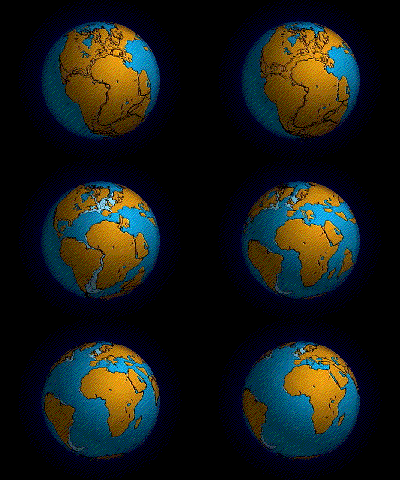
           During the Triassic the Earth was warm and fairly dry, with ice at the north and south poles. (Although Santa Claus hadn’t moved in yet.) Most of the large island masses gathered together in a supercontinent called Pangaea. Conifers, cycads (which looked like mutant pineapples), and ferns were the most common plants, and reptiles ruled the planet. It was about 240 million years ago that the first dinosaurs appeared. They were small and walked on two legs. Over millions of years, they began to change, and many varieties of dinosaurs appeared. Some were meat eaters; others, plant eaters. Some grew to large sizes. These included Riojasaurus and Lessemsaurus. But then 201 million years ago, another mass extinction took place, probably caused by volcanic action in the Atlantic Ocean, rising sea levels, and climate change.

Pangaea breaking up
Public Domain U.S. Dept. of the Interior

           Some dinosaurs survived and moved into the Jurassic Period. Pangaea broke apart and, over millions of years, formed the continents we know today. Their environment ranged from arid deserts to lush tropical forests. Conifers and ferns were the main plants. Most importantly, dinosaurs dominated each new continent. Some of the largest of all dinosaurs evolved during this time, including Alamosaurus, Argentinosaurus, and Dreadnaughtus. The fierce predator Allosaurus also lived in this time period. And the earliest known bird, Archaeopteryx, emerged in the late Jurassic.

USGS; Diarama by Masato Hattori. Map courtesy of Colorado Plateau Geosystems Inc., Public domain, via Wikimedia Commons

           About 140 million years ago, life on Earth began to change dramatically. Many new life forms emerged while others went extinct. There doesn’t seem to have been any big extinction event, but scientists date this as the beginning of the Cretaceous Period (my favorite time period!). Flowering plants appeared, but there were still a lot of the familiar conifers and ferns. Many new, strange-looking dinosaurs dominated the environment. Tyrannosaurus became an apex predator and weird dinosaurs, such as Parasaurolophus, Ankylosaurus, Triceratops and Pachycephalosaurus roamed around.

           Dinosaurs were so abundant it seemed they would rule Earth forever – but an asteroid colliding with Earth 66 million years ago brought their world to an end. The Cenozoic Era began, with an opening for mammals to dominate the world. The asteroid collision will be the subject of my next blog.

Sources (Click Me!)

Davis, Josh. “The Triassic Period: The Rise of the Dinosaurs.” London Natural History Museum, n.d., https://www.nhm.ac.uk/discover/the-triassic-period-the-rise-of-the-dinosaurs.html

“Hadean Eon: The Formation of Earth (4.6 to 4.0 billion years ago).” EarthHow, 2024. https://earthhow.com/hadean-eon/

“Mesozoic.” U.S. Dept. of the Interior. https://www.usgs.gov/youth-and-education-in-science/mesozoic

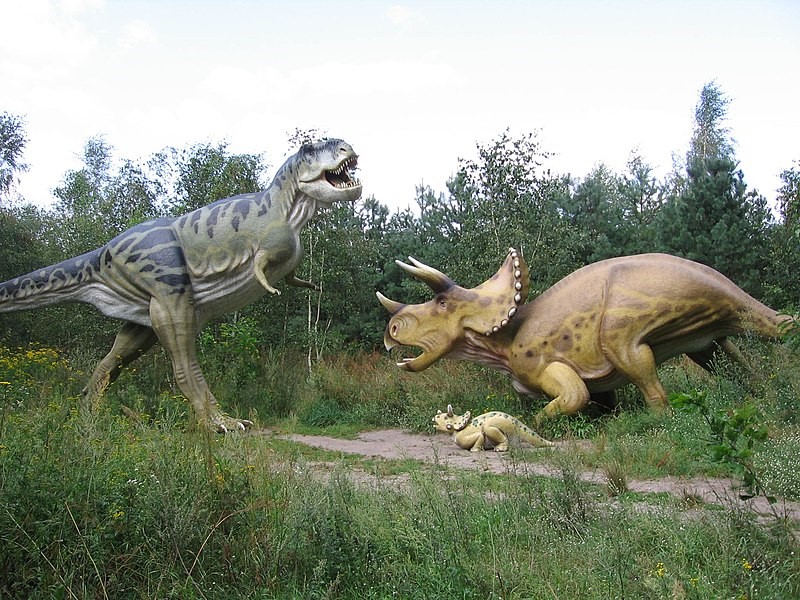
Title Image of Triceratops facing Tyrannosaurus
Marcin Chady, CC BY 2.0, via Wikimedia Commons