When Did the Dinosaurs Live?

This blog is the first in a series that will explore the timeline of Earth’s history, from the formation of the planet to the dominance and eventual extinction of dinosaurs.

           This blog is about dinosaurs in time; that is, dinosaurs in the timeline of Earth’s history. Not dinosaurs on time, because dinosaurs were hardly ever on time seeing they didn’t have clocks.

           Scientists say the Earth was formed 4.6 billion years ago. At first it was just molten lava, hundreds of miles deep. Over millions of years the Earth cooled and a crust appeared.

Artist’s impression of the Hadean Eon.
Tim Bertelink, CC BY-SA 4.0, via Wikimedia Commons

            The first lifeform that existed was a sort of blue-green algae. Then other lifeforms appeared, including shellfish. That whole time period of more than four billion years is called the Precambrian Eon. From 542 million years ago to the present age is the Phanerozoic Eon. It’s divided into three eras, the Paleozoic, the Mesozoic, and the Cenozoic. During the Paleozoic (from 541 to 252 million years ago) life began to bloom. The first fish, first amphibians, and the first reptiles appeared. The first plants also began to grow. But then a massive extinction wiped out 90% of life on Earth. Its cause is not known, but it ended the Paleozoic Era making way for the Mesozoic Era (from 252 to 66 million years ago).

           That’s when we get to the good stuff: Dinosaurs! The Mesozoic is divided into three time periods: the Triassic, the Jurassic, and the Cretaceous. And about halfway through the Triassic Period a new kind of animal evolved: a dinosaur.
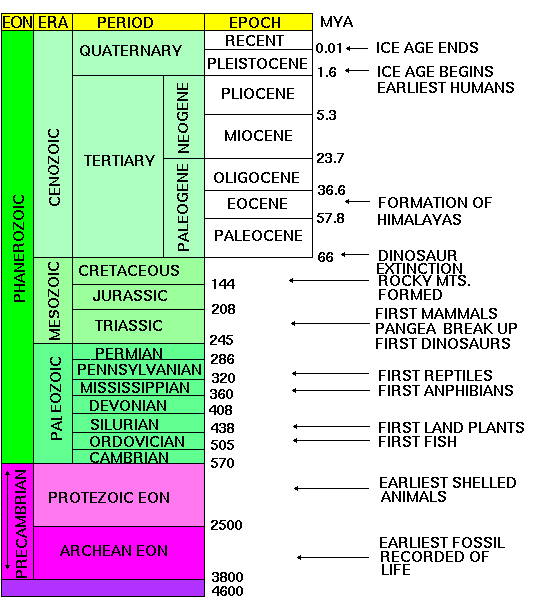
Timeline of Earth (MYA means millions years ago))
Thanaben, CC BY-SA 3.0, via Wikimedia Commons

           During the Triassic the Earth was warm and fairly dry, with ice at the north and south poles. (Although Santa Claus hadn’t moved in yet.) Most of the large island masses gathered together in a supercontinent called Pangaea. Conifers, cycads (which looked like mutant pineapples), and ferns were the most common plants, and reptiles ruled the planet. It was about 240 million years ago that the first dinosaurs appeared. They were small and walked on two legs. Over millions of years, they began to change, and many varieties of dinosaurs appeared. Some were meat eaters; others, plant eaters. Some grew to large sizes. These included Riojasaurus and Lessemsaurus. But then 201 million years ago, another mass extinction took place, probably caused by volcanic action in the Atlantic Ocean, rising sea levels, and climate change.
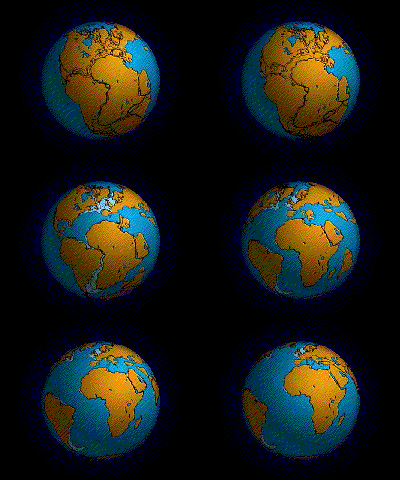
Pangaea breaking up
Public Domain U.S. Dept. of the Interior

           Some dinosaurs survived and moved into the Jurassic Period. Pangaea broke apart and, over millions of years, formed the continents we know today. Their environment ranged from arid deserts to lush tropical forests. Conifers and ferns were the main plants. Most importantly, dinosaurs dominated each new continent. Some of the largest of all dinosaurs evolved during this time, including Alamosaurus, Argentinosaurus, and Dreadnaughtus. The fierce predator Allosaurus also lived in this time period. And the earliest known bird, Archaeopteryx, emerged in the late Jurassic.

USGS; Diarama by Masato Hattori. Map courtesy of Colorado Plateau Geosystems Inc., Public domain, via Wikimedia Commons

           About 140 million years ago, life on Earth began to change dramatically. Many new life forms emerged while others went extinct. There doesn’t seem to have been any big extinction event, but scientists date this as the beginning of the Cretaceous Period (my favorite time period!). Flowering plants appeared, but there were still a lot of the familiar conifers and ferns. Many new, strange-looking dinosaurs dominated the environment. Tyrannosaurus became an apex predator and weird dinosaurs, such as Parasaurolophus, Ankylosaurus, Triceratops and Pachycephalosaurus roamed around.

           Dinosaurs were so abundant it seemed they would rule Earth forever – but an asteroid colliding with Earth 66 million years ago brought their world to an end. The Cenozoic Era began, with an opening for mammals to dominate the world. The asteroid collision will be the subject of my next blog.

Sources (Click Me!)

Davis, Josh. “The Triassic Period: The Rise of the Dinosaurs.” London Natural History Museum, n.d., https://www.nhm.ac.uk/discover/the-triassic-period-the-rise-of-the-dinosaurs.html

“Hadean Eon: The Formation of Earth (4.6 to 4.0 billion years ago).” EarthHow, 2024. https://earthhow.com/hadean-eon/

“Mesozoic.” U.S. Dept. of the Interior. https://www.usgs.gov/youth-and-education-in-science/mesozoic

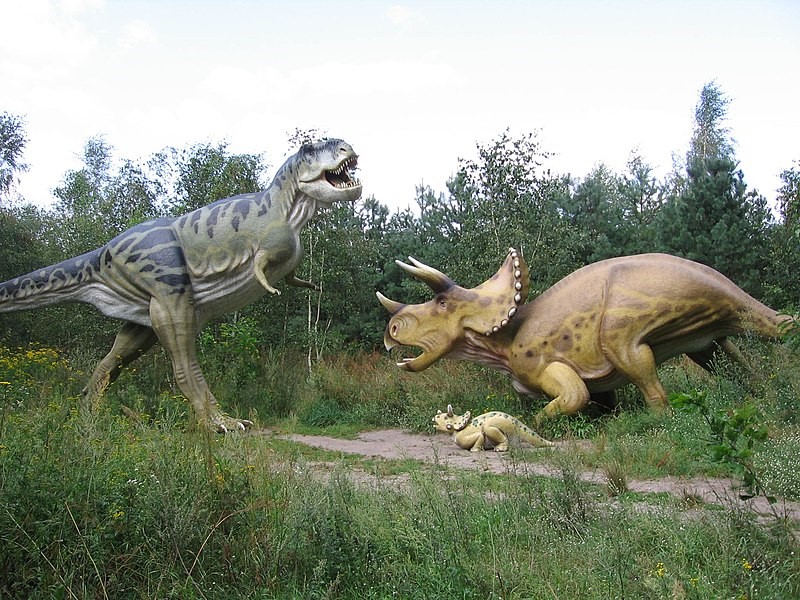
Title Image of Triceratops facing Tyrannosaurus
Marcin Chady, CC BY 2.0, via Wikimedia Commons
Ask Me Anything

Happy Tuesday Friends! Over the last few weeks we have covered a lot of Dino-related info, from the T-Rex to the Pachycephalosaurus. I appreciate the interest you all have shown in the world of dinosaurs!

Many of you have have left thought provoking and intriguing comments and I have enjoyed reading and responding to all of them. Because of this, I thought we should have an experiment this week.

For the next week, feel free to ask me about anything, or respond to other threads or messages. The hope is that we can have fun and share interesting facts about dinosaurs!

If this goes well, maybe we have more group discussions like this in the future 🙂

Thank you all for taking the time to read my little blog. Enjoy the rest of your week and don’t forget to comment below!

Leave a comment

4 responses to “Ask Me Anything”

  1. jcpunk Avatar
    jcpunk

    What is your favorite dinosaur from each geologic period?

    Liked by 1 person

    1. Janet Riehecky Avatar

      Triassic Period: Coelophysis– I have a lifesize figure of one in my living room.
      Jurassic Period: Apatosaurus — I have 5′ 7″ femur from one in my living room, a gift from my husband
      Cretaceous Period: Triceratops — All I have from it is a horn from its brow, but I’ve always like it best.

      Like

  2. hungerwinter Avatar
    hungerwinter

    If you were being hunted by a dinosaur (pick any meat eater) how would you use your knowledge of dinosaurs to evade the predator and possibly even knock it in the noggin?

    If you could have a dinosaur as a pet, which one would you choose and why?

    Does it bother you when someone accuses another person of being out of date and says, “You are such a dinosaur”? Is that kind of a slam on dinosaurs?

    You needn’t reply to all my questions. Pick the one(s) you like.

    Liked by 1 person

    1. Janet Riehecky Avatar

      Thanks for your questions!
      To avoid T-rex, the last thing you want to do is stand still. If you’re a good runner, you can out-distance it. It takes very large steps, but it was probably too heavy to run for an extended period of time.
      I would like a Triceratops. They’ve always been my favorite.
      Telling someone they’re a dinosaur is actually a compliment and not just because they’re awesome. They managed to live on Earth for 120 million years — not bad survival skills. People wouldn’t have managed any better in the face of that asteroid.

      Liked by 1 person

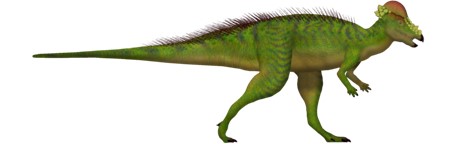
Pachycephalosaurus: The Bone-Head

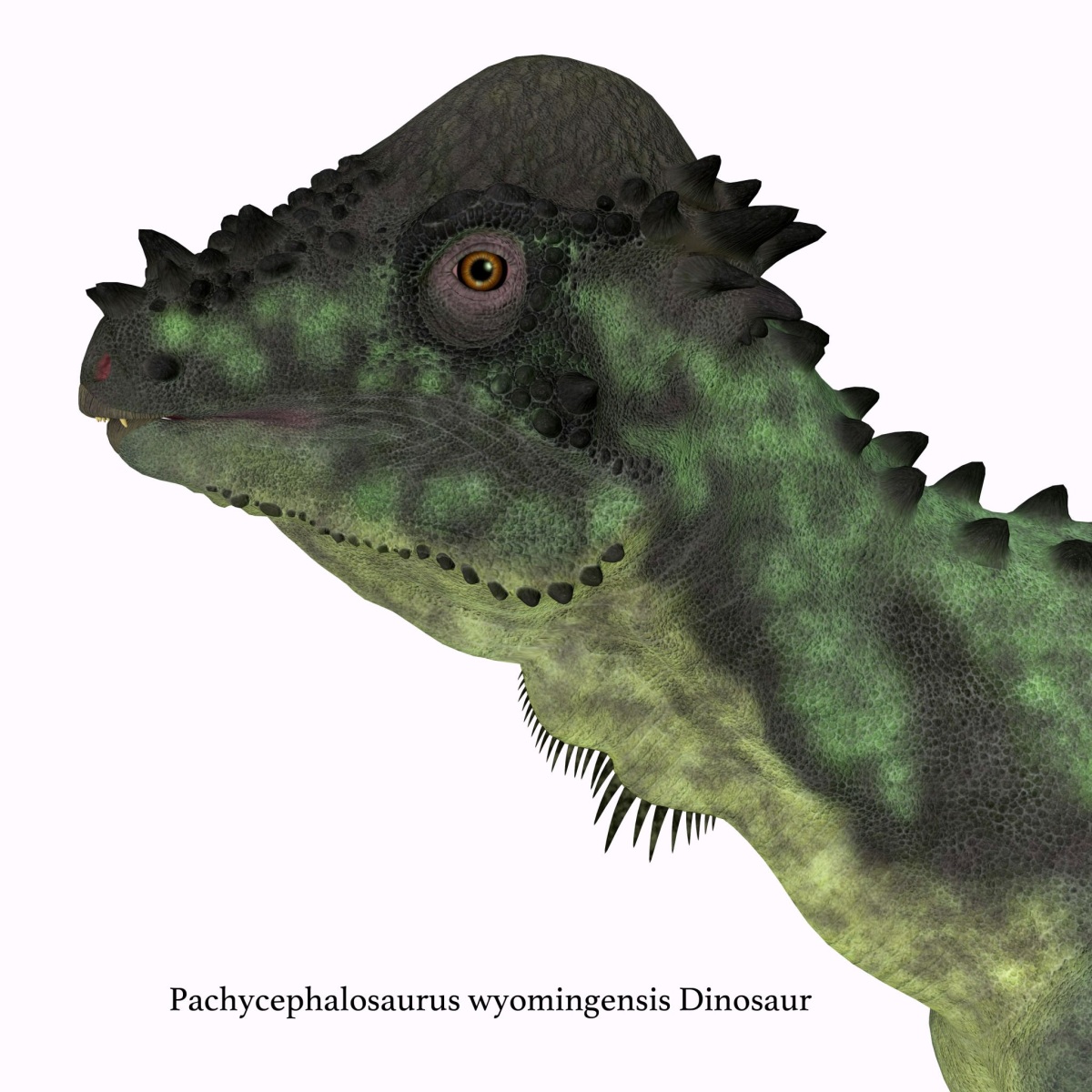
One of the reasons I like dinosaurs so much is that some of them are just plain weird. And, for me, one of the weirdest is Pachycephalosaurus
(pa-KEE-seh·fuh·luh-SORE-us).

            Pachycephalosaurus lived in the late Cretaceous Period, 72 – 66 million years ago, in what is now the western United States and Canada. This was the same time and place that Tyrannosaurus and Triceratops lived. Pachycephalosaurus probably walked on two legs with its tail stretched out behind it and its head leaning forward to balance it. It was about 15 feet long, and weighed almost 1000 pounds. None of that makes it unusual. But when people take a closer look at this dinosaur, it definitely stands out.

            Pachycephalosaurus means “thick-headed lizard.” It is a bizarre creature for several reasons. First, the name is weird, even for a dinosaur, because it has so many syllables. If you ever want to impress someone, just rattle off that name without any pauses.

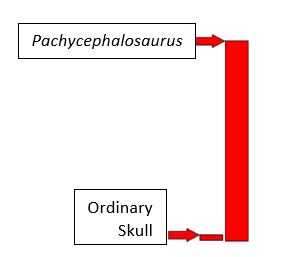
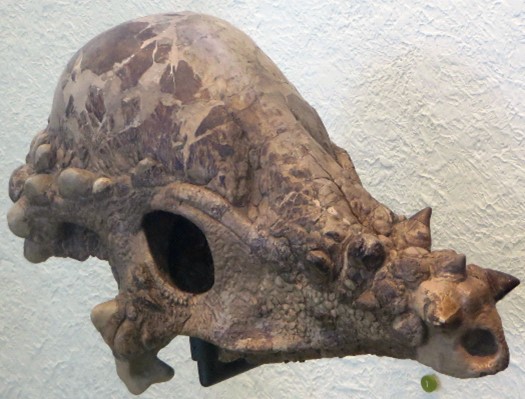
            Second, it had nine to ten inches of solid bone in a dome on top of its skull, twenty times thicker than the skulls of most other dinosaurs. That’s a huge difference!

Eden, Janine and Jim from New York City, CC BY 2.0 https://creativecommons.org/licenses/by/2.0>, via Wikimedia 

            Scientists don’t know for sure why this dinosaur had such a thick skull, but some of them think Pachycephalosaurus liked to butt its head into things, especially other dinosaurs. Head-butting is used by modern animals, such as bighorn sheep or mountain goats, to establish dominance.

            The winner controls a territory and impresses the females. The thick skull of Pachycephalosaurus might have protected its brain when it collided with another dinosaur. Scars on the domes of some skulls also support this idea.

Photo via <a href=” ttps://www.goodfreephotos .com/”>Good Free Photos</a>

            But some scientists doubt head-butting was possible, saying the shape of its neck makes it unlikely its spine could withstand a head-on collision. And, the top of its head is rounded, so not much surface would collide with the other dinosaur. These scientists think that maybe Pachycephalosaurus used glancing blows to the side while fighting others to see who would control a territory. It also might be that Pachycephalosaurus having a big head just helped males to attract females. One thing scientists do agree on is that its thick skull wouldn’t have been much good as defense if it were attacked by Tyrannosaurus because the rest of its body had no defenses.  

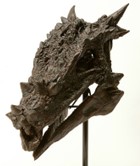
            However, it wasn’t just the thickness of the skull that made this dinosaur weird. Across the back of the dome and on its snout, it had large circular bumps (see skull above). Bumps aren’t all that weird, but scientists think most of the bumps started out as spikes, flattening as the dinosaur grew older. They have found skulls of smaller dome-headed dinosaurs that were thought to be different species of dinosaurs, such as one called Dracorex hogwartsia, which means “the Dragon King of Hogwarts” (named for Harry Potter’s school). They are now thought to be juvenile pachycephalosaurs. It seems odd that spikes would flatten into bumps as the dinosaur grew up, as spikes seem more useful than bumps, but, as I said, this is a weird dinosaur.  

            Another strange thing was its teeth. In the back of its mouth, it had wide, leaf-shaped teeth, similar to those found in many plant-eating dinosaurs. According to paleontologist, Philip Currie, “We have always been somewhat mystified by what these animals were eating, but I think the teeth at the back of the jaws clearly show it’s an herbivore.” But in 2018, paleontologists reported finding a more complete jaw, and they couldn’t believe what it showed. In the front of its mouth, it had sharp, triangular teeth, that were more like a carnivore.

            Paleontologist, Steve Brusatte, said, “It had the combination of a beak with these very sharp, steak knife-like serrated teeth … They must have been eating some kind of meat. Why else would you have steak knives at the front of your mouth?” This combination is very unusual. Scientists have suggested that this means it might be an omnivore, eating both plants and meat. The meat would have been small animals, such as lizards, frogs, or even small mammals; the plants would have been ferns, leaves, and conifer needles.   

            All in all, Pachycephalosaurus certainly qualifies as a strange and weird dinosaur. It’s one of my favorites, and I hope it is now one of yours.

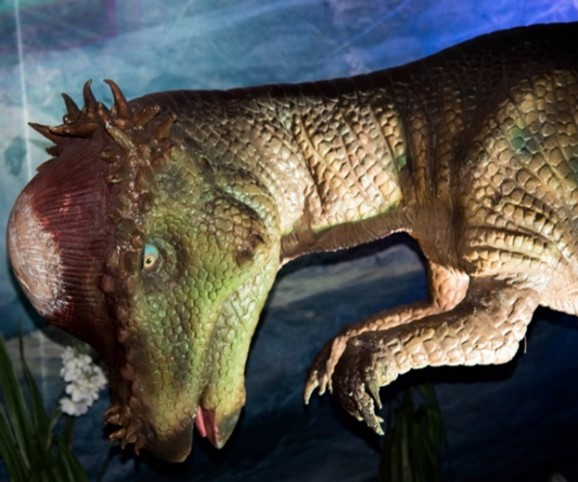
UnexpectedDinoLesson, CC BY-SA 4.0, via Wikimedia Commons

Title Image provided by DKfindout

Sources (Click Me)

Sykes, Ben. “Seventeen Unusual, Bizarre, and Downright Weird Dinosaurs.” BBC Science Focus Magazine. 31 May 2018. https://www.sciencefocus.com/nature/17-of-the-weirdest-dinosaurs-to-walk-the-planet/

“Pachycephalosaurus.” Find Out. Dorling Kindersley Limited. 2022. https://www.dkfindout. com/us/dinosaurs-and-prehistoric-life/dinosaurs/pachycephalosaurus/

Pickrell, John. “Vegetarian Dinosaur May Have Actually Eaten Meat, Skull Suggests.” National Geographic. 24 Oct. 2018. https://www.nationalgeographic.com/science/article/news-vegetarian-dinosaur-ate-meat-pachycephalosaurus-paleontology