The Chicken-Sized Dinosaur

Dinosaurs varied in size, most know the giants, but today we are tackling one of the smallest dinos: Compsognathus

            When most people think of dinosaurs, they think of huge creatures. And many of the dinosaurs were enormous. Supersaurus was longer than a basketball court, and Sauroposeidon (SORE-oh- poe- seye-don) was as tall as a five-story building. But not every dinosaur was huge. During the Jurassic Time Period, when many of the biggest dinosaurs lived, there also lived Compsognathus (KOMP-sog-nath-us)). Compsognathus was a tiny dinosaur, not much bigger than a chicken.

My life-size model of Compsognathus compared to my cat.

            The largest Compsognathus ever found was not quite four feet long – and most of that was just its tail. It stood about 11 inches high at the hip and weighed about 9-12 pounds. There were some advantages to being a tiny dinosaur in a land of giants. Many big meat eaters were likely to overlook such a small animal. They could feast on hundreds of pounds of tasty plant eaters. Why should they bother with one, stringy, little mouthful?

            Of course, it wouldn’t be so great to be caught in the path of one of the giant dinosaurs. Some of the really big ones could step on a Compsognathus and hardly know it – the way you might step on a large bug.

            But Compsognathus wasn’t likely to get stepped on often. Scientists say it was built for speed with hollow bones and a slender, streamlined body. It ran on two long, strong, back legs, and its tail helped keep it balanced as it ran. It could zip along dodging giant dinosaurs with ease.

            It may not have needed to dodge too many other dinosaurs. Only two skeletons of Compsognathus have been found, and both of them seemed to have lived on atolls, islands that have a lagoon in their center. If all Compsognathus lived on these types of islands, they may have been the biggest predator on them.

Satellite picture of the Atafu atoll in TokelauAtafu.jpg: NASA Johnson Space Center derivative work: Talkstosocks, Public domain, via Wikimedia Commons

            Compsognathus still needed to be speedy – to catch its own food. Scientists think Compsognathus ate such things as insects, frogs, and small lizards. It took speed to catch such quick-moving creatures. One skeleton of a Compsognathus was found with a particularly fast lizard in its stomach. The lizard may have been fast, but Compsognathus was faster. 
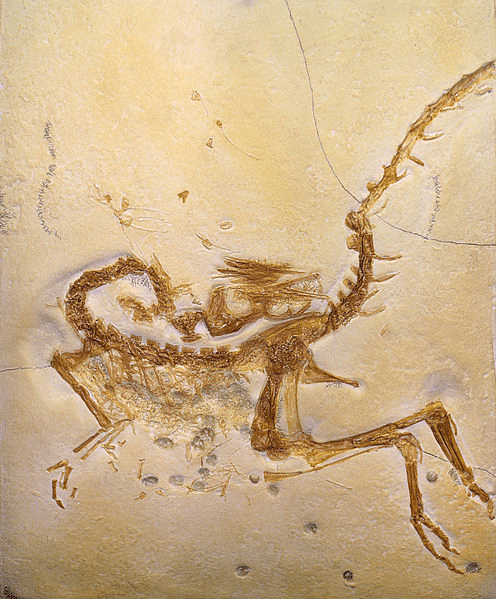
Compsognathus skeletonH. Zell, CC BY-SA 3.0, via Wikimedia Commons

            Compsognathus could grab its lunch with the long fingers on its hands. It had three fingers on each “hand,” but only two of them were usable. Each one of them had a very long claw, good for grabbing food. Once it caught its lunch, Compsognathus could crunch its victim with its many sharp, pointed teeth, though it may have just swallowed it whole. The name Compsognathus means “pretty jaw,” but if you were a pterosaur (TAIR-uh-sore), grounded with a broken wing, you wouldn’t think those jaws were so pretty.

            It’s hard for scientists to learn much about Compsognathus and other little dinosaurs because so few of their skeletons are ever found. Many such dinosaurs were probably gulped down whole by big meat eaters. Even if a tiny dinosaur were fossilized, chances are no one would find it. It’s just much easier to find a six-foot bone than a two-inch one. 

Rigorius, CC BY-SA 4.0, via Wikimedia Commons

            Scientists have found a few dinosaurs that were as small or even smaller than Compsognathus. These include Microraptor which is in the same family as Velociraptor and Utahraptor, except it was only two feet long and weighed about two pounds, and Aquilops, (uh-QUIL-ops) which was a little bigger – 3-5 pounds. Its descendants included the mighty Triceratops. Studying them alongside Compsognathus makes scientists think that any small dinosaur must have been quick and active.

            Scientists want to learn all they can about what made small dinosaurs special. They would like to know whether they lived in packs or by themselves. In the Jurassic Park franchise (where they were called “compis”) a pack of Compsognathus were shown working together to attach someone, but we don’t know if that was true or not. Scientists would also like to know whether or not they took care of their babies or left the babies alone to fend for themselves. And they would like to know whether they lived in fear of the big dinosaurs or simply ignored them. 

            So far, the fossil record hasn’t answered those questions. In the meantime, scientists continue to search for clues. One thing is already known – tiny dinosaurs are just as fascinating as huge ones!
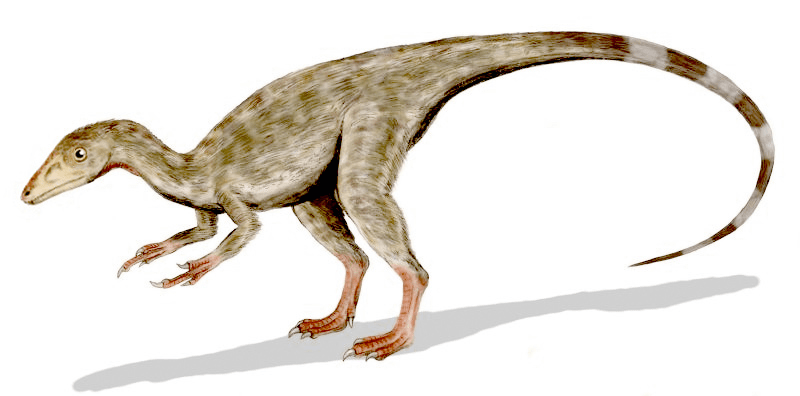
CompsognathusNobu Tamura (http://spinops.blogspot.com), CC BY-SA 3.0, via Wikimedia Commons
Sources (Click Me!)

“Compsognathus.” Dinosaur Facts. DinosaurFacts.net. n.d. http://www.dinosaurfact.net/jurassic/Compsognathus.php

Norman, David. The Illustrated Encyclopedia of Dinosaurs. Crescent Books, 1985.

Riehecky, Janet. Compsognathus. The Child’s World, 1991.

Strauss, Bob. “The 19 Smallest Dinosaurs and Prehistoric Animals.” ThoughtCo. 5 Apr. 2023, thoughtco.com/smallest-dinosaurs-and-prehistoric-animals-1093812.
What Color Were Dinosaurs?

             Not very long ago paleontologists were sure of at least one thing about dinosaurs: nobody would ever know what color they were – unless somebody invented a time machine. Artists had to make up the colors because there were only bones to work with. And you can’t tell the color of anything’s skin from looking at its bones. Even the discovery of several dinosaur “mummies” didn’t help [See my post on dino mummies here]. Though some of these had preserved dinosaur skin, the skin had taken on the color of the minerals that seeped into it to fossilize it. But modern technology has changed this. There are now a couple of ways to determine what color certain dinosaurs were.

Used with permission © Royal Tyrrell Museum of Palaeontology, illustration by Julius Csotonyi

            The first is a rare case. In 2011 an armored dinosaur called Borealopelta (BOH-ree-AH-low-PEL-tuh) was discovered.  Its skin was so well preserved that scientists were able to use a mass spectrometer to discover its color. How does that work? A mass spectrometer is able to tell the chemical substances something is made of, and when you know the exact chemical substances, and where they are, you know what color it is. In the case of Borealopelta, scientists determined the dinosaur was dark reddish brown on the back and neck and lighter reddish brown on the belly and lower parts.

            But finding such well-preserved skin is rare. However, scientists have found another way to determine color. Using an electron microscope they found tiny structures that were smaller than cells. At first these were dismissed as bacteria, but they were, in fact, melanosomes (muh-LAN-uh-sohmz), irregular blobs that contain color pigments. Melanosomes can be found in skin, hair, scales or feathers. The size, shape, thickness, and dispersal of melanosomes found in a fossilized feather can be compared to those found in modern birds to determine a color. Then the trick is finding dinosaur fossils that contain preserved skin, hair, scales, or feathers. So far, feathers have been the main structure to reveal dinosaur color through melanosomes.

Matt Martyniuk, CC BY 3.0, via Wikimedia Commons

            In 2009 scientists found a feathered dinosaur, which they named Anchiornis (ANG-kee-OR-niss). It lived during the late Jurassic Period. The fossil included some preserved feathers, which were examined under an electron microscope. Analysis of the melanosomes indicated this was a black-and-white dinosaur with a patch of red on the back of its head.

Lucas-Attwell, CC BY-SA 4.0, via Wikimedia Commons

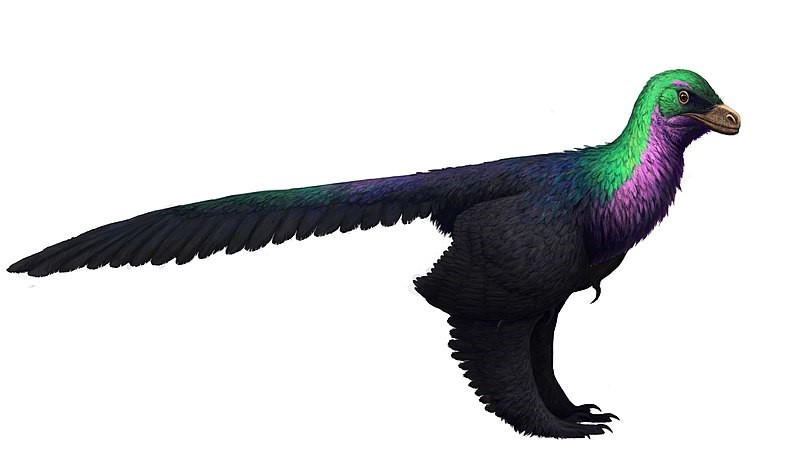
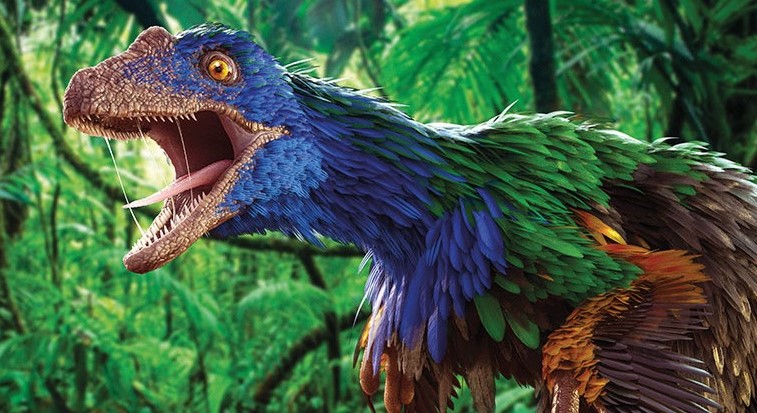
            Other dinosaurs have been colorized by this same process.  A recent discovery in China, Caihong (KAY-hong), was found with remains of actual feathers. When these were analyzed, they showed that most of the dinosaur was iridescent black, a glossy black that subtly changed its hue when looked at from different angles. The head, chest, and the base of the tail contained melanosomes that produce bright iridescent colors in modern birds. These colors could not be specifically identified, but artists have guessed at what they might be. 

Conty, CC BY 3.0, via Wikimedia Commons

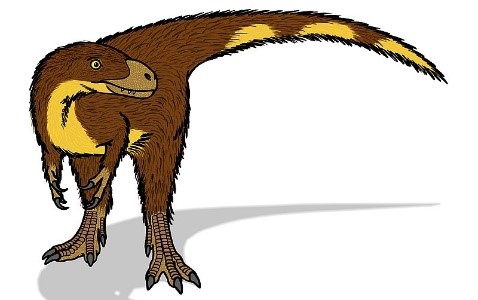
            Other dinosaurs that have been colorized include Sinosauropteryx (SIEN-oh-soh-ROP-tuh-riks) – which lived during the early Cretaceous Period and had bright orangish feathers with a lighter belly and a striped tail.

Entelognathus, CC BY-SA 4.0, via Wikimedia Commons

            And they include Microraptor – a small meat-eating dinosaur that also lived during the early Cretaceous Period and had feathers that gleamed an iridescent blue/black, like ravens or starlings.

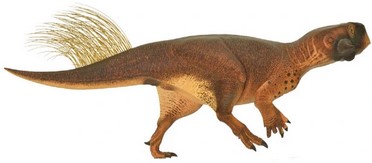
            As stated earlier, melanosomes can also be found in scales. Psittacosaurus (SIT-a-ko-SOR-us) is an early Cretaceous dinosaur distantly related to Triceratops. It does not have feathers, but one of the skeletons found had preserved scales that contained melanosomes. They revealed the dinosaur was dark brown on its back and a paler brown on its underside with its hind legs being striped on the inside and spotted on the outside.

Vinther et al., CC BY 4.0, via Wikimedia Commons

            Melanosomes are not the answer to the color of every dinosaur. There has to be preserved soft tissue to have melanosomes, and most fossils lack that. Additionally, some colors, such as blues and yellows, are not made by melanosomes. Still, even knowing the colors of a few dinosaurs is something most scientists once thought would never happen.

            What color do you think Tyrannosaurus rex was? Put your guesses in the comment section.

Sources (Click Me)

Black, Riley. “The Colors of Dinosaurs Open a Window to Study the Past.” Smithsonian Magazine. 21 May 2019. https://www.smithsonianmag.com/science-nature/colors-dinosaurs-open-new-window-study-past-180972070/

—. “Microraptor was a Glossy Dinosaur.” Smithsonian Magazine. 9 March 2012. https://www.smithsonianmag.com/science-nature/microraptor-was-a-glossy-dinosaur-119691559/

Caihung.” Wikipedia. 18 May 2021. https://en.wikipedia.org/wiki/Caihong

“Dinosaurs – Sinosauropteryx prima.” Australian Museum. 12 Feb. 2020. https://australian.museum/learn/dinosaurs/fact-sheets/sinosauropteryx-prima/

Dunham, Will. “Scientists decipher color of ‘super cute’ bristly dinosaur.” Reuters. 2021. https://www.reuters.com/article/us-science-dinosaur/scientists-decipher-color-of-super-cute-bristly-dinosaur-idUSKCN11L1OI

“Spectacularly Detailed Armored Dinosaur ‘Mummy’ Makes Its Debut.” Smart News. Smithsonian Magazine. 2021. https://www.smithsonianmag.com/smart-news/mummified-armored-dinosaur-makes-its-debut-1-180963311/

Woodford, Chris. “Mass Spectrometers.” Explain That Stuff! 4 Feb., 2021. https://www.explainthatstuff.com/how-mass-spectrometers-work.html

Yong, Ed. “The Renaissance of Technicolour Dinosaurs Continues (And the Gloves Come Off). Not Exactly Rocket Science. National Geographic.com. 4 Feb. 2010. https://www.nationalgeographic.com/science/article/the-renaissance-of-technicolour-dinosaurs-continues-and-the-gloves-come-off

Note: Title Image Sourced from BBC Science Focus Magazine