Baryonyx: The Fishing Dinosaur

            When the dinosaurs lived, they often had just one thing on their minds – FOOD! Whether a dinosaur ate plants or meat, getting food was a full-time job. Scientists have found evidence that at least one type of dinosaur went fishing for its food. That dinosaur was Baryonyx (BAR-ee-ON-ix).

Ballista, CC BY-SA 3.0, via Wikimedia Commons

            Scientists know Baryonyx was a meat eater because it had the sharp curved teeth needed to cut through meat. But in many ways, it was different from other meat-eating dinosaurs.

            Most meat-eating dinosaurs had strong jaws, heavy skulls, and enormous teeth, so they could slice through tough skin and bone. But Baryonyx’s jaws were not very strong, and its head was long and flat, like a crocodile’s. Its teeth were much smaller than most meat eaters’ – and it had almost twice as many of them. Baryonyx was not made for attacking other dinosaurs. It was made for catching fish.

            A lot of animals like the taste of fish, but it takes a very special kind of animal to catch them. Fish dart about very quickly in the water. To catch them, an animal has to be even quicker. Fish are also very slippery. Holding onto them takes special claws or teeth.

            So, how could Baryonyx catch fish? Scientists have suggested several ways.  It might have stood by the edge of a shallow lake, waiting as patiently as a heron. When an unsuspecting fish swam by, it might have snapped it up. Its long mouth and many sharp teeth could have grabbed a quick-moving fish and held onto it no matter how much it wiggled.

            Or the Baryonyx might have played crocodile. Some scientists picture it floating in the water, watching carefully. If a fish swam by, it was scooped up in the long mouth of Baryonyx.

Artwork by Jim Conaway

            Another way it might have fished was with its front feet. It could use its front feet as hands. It had long, slender fingers which may have been used to grab fish. Or if it didn’t feel like grabbing, it might have gone “spear fishing.” The name Baryonyx means “heavy claw.” It got this name because it had a huge claw, one of the biggest dinosaur claws that has ever been found – 12 inches long! Scientists think Baryonyx had one of the super claws on each front foot. It could stand in shallow water, waiting. Then, when a fish swam past, it could stab quickly into the water and catch it.

Artwork by Jim Conaway

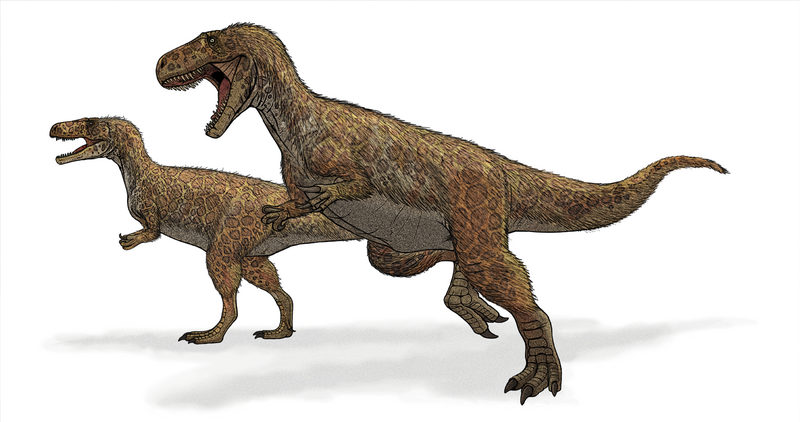
            What makes scientists so sure Baryonyx ate fish? The first skeleton found had fish scales where its stomach would have been. They also found a few bones of a plant-eating dinosaur. How did Baryonyx hunt large plant eaters when it wasn’t a very big or strong dinosaur? Well, many scientists think it let a powerful meat eater like Megalosaurus do all the work. Megalosaurus might kill a plant eater too big for it to eat. Baryonyx could come by when it was done and eat the leftovers. So, the life of Baryonyx was like a vacation – lots of fishing and somebody else prepares the food!

PaleoGeekSquared, CC BY-SA 4.0, via Wikimedia Commons

            Scientists don’t know much about how Baryonyx lived. They don’t know if it traveled in a pack or alone, they don’t know if it took care of its babies or left them on their own, and they don’t know if it had feathers or scaly skin. They can describe its size because the first skeleton found of it was 85% complete. It grew about 30-33 feet long and was about twice as tall as an average person. Its legs were short compared to some dinosaurs and lacked strong muscles, so it wasn’t a runner. It was not very strong in general, but its large claw would have made a great weapon to defend itself. Only a very big and very hungry meat eater would have bothered it.

            Scientists are fascinated by this dinosaur because it’s so different from other dinosaurs. The wide variety of dinosaurs makes them very interesting to study, and each new discovery adds to our picture of what they were like.

Sources (Click me!)

“Baryonyx.” Natural History Museum, London. https://www.nhm.ac.uk/discover/dino-directory/baryonyx.html

Paul, Gregory S. The Princeton Field Guide to Dinosaurs. Princeton University Press, 2010. pp.  87-88.

Riehecky, Janet. Baryonyx. The Child’s World, 1990.
The Discovery of Dinosaurs

Two hundred years ago, the word “dinosaur” didn’t exist. It didn’t need to. No one knew that giant reptiles had once walked the earth.

            Occasionally people found large bones, but they usually thought they belonged to some animal, like an elephant or a giraffe. One piece of bone was thought to have been from a race of giant people. Dinosaur bones may even be responsible for the belief in dragons in ancient China. Then, in England, two gentlemen working separately discovered dinosaurs at about the same time.       

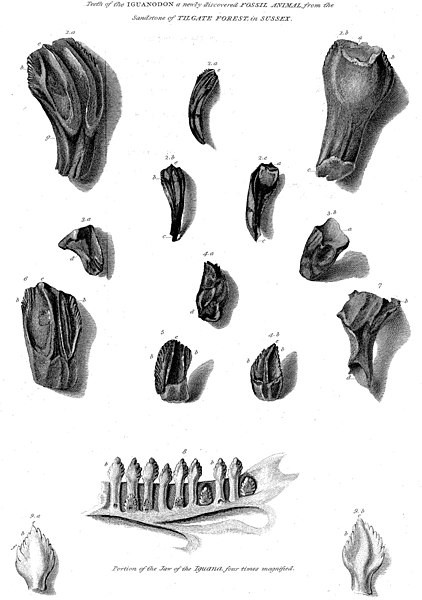
            The first was Dr. Gideon Mantell, a physician and amateur geologist. In 1822 his wife, Mary Ann Mantell, found some very large, unusual teeth in a pile of gravel. Mantell sent the teeth to other experts, but they dismissed them as belonging to a known animal. One paleontologist said they were from a rhinoceros. Mantell didn’t give up. He was sure the teeth were something special. He learned that the pile of gravel his wife had found the fossils in came from a nearby stone quarry. There he found more teeth and some bones. After much study, he determined that the bones and teeth came from a giant reptile. The teeth resembled those of the iguana lizard, but they were twenty times bigger!

Illustration of the original Iguanodon teeth found by Mantell
Gideon Mantell, Public domain, via Wikimedia Commons

            In 1825, Mantell published a description of the creature, describing it as being at least 40 feet long. He named it Iguanodon (eh-GWA-nuh-don), Iguana from the iguana lizard and don, meaning tooth.

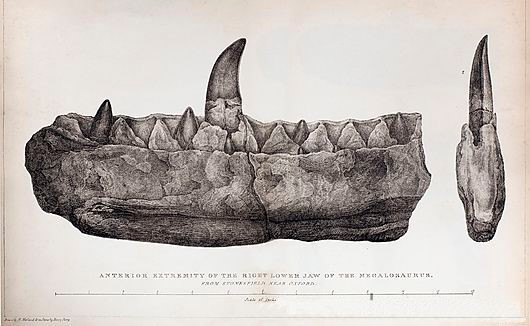
            Meanwhile, in 1824, the Rev. William Buckland of Oxford came into the possession of some bones, including part of a jaw with teeth.

Mary Buckland, née Morland (1797-1857), Public domain, via Wikimedia Commons

            These teeth were clearly those of a giant reptile. Buckland named it Megalosaurus (MEH·guh·luh·sore·us), which means “great lizard.” He published a description of it that same year, which means it was the first dinosaur described scientifically. Mantell was still struggling with skeptics, and, as I said above, he didn’t publish until 1825. But, in 1833, Mantell discovered another giant reptile, Hylaeosaurus (hy-LEE-oh-sore-us). Hylaeosaurus was an armored, plant-eating dinosaur that grew about 16 feet long. So he discovered two of the first three dinosaurs.

            A scientist named Sir Richard Owen was the one who put it all together. He studied the bones and teeth of all three creatures. He found them to share some characteristics, such as fused vertebrae at the base of the spine. But he found them quite unlike modern reptiles. He determined that these three animals deserved their own category. In 1842, he invented the name dinosaurs, which means “terrible lizards,” to describe them.

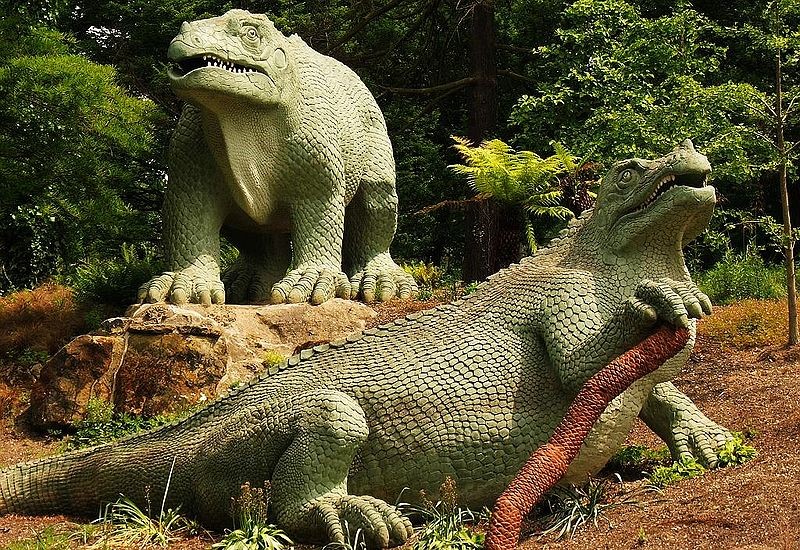
            People were excited about these huge creatures and wanted to know what they looked like. Scientists tried to figure out how to put together the bones that had been found. But it was like trying to put together a jigsaw puzzle with only half the pieces. They thought Iguanodon looked something like a fat rhinoceros. In 1852, a sculptor named Waterhouse Hawkins made life-sized models of what scientists thought Iguanodon and Megalosaurus looked like.

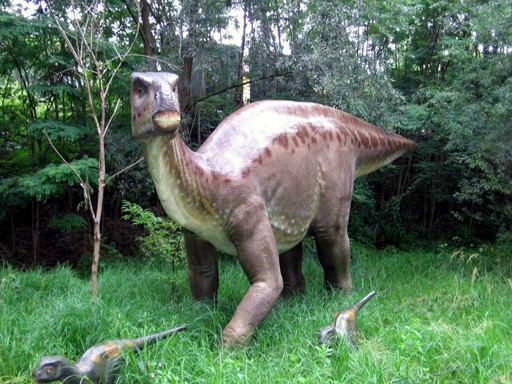
Statues of Iguanadon and Megalodon Jes from Melbourne, Australia, CC BY-SA 2.0, via Wikimedia Commons

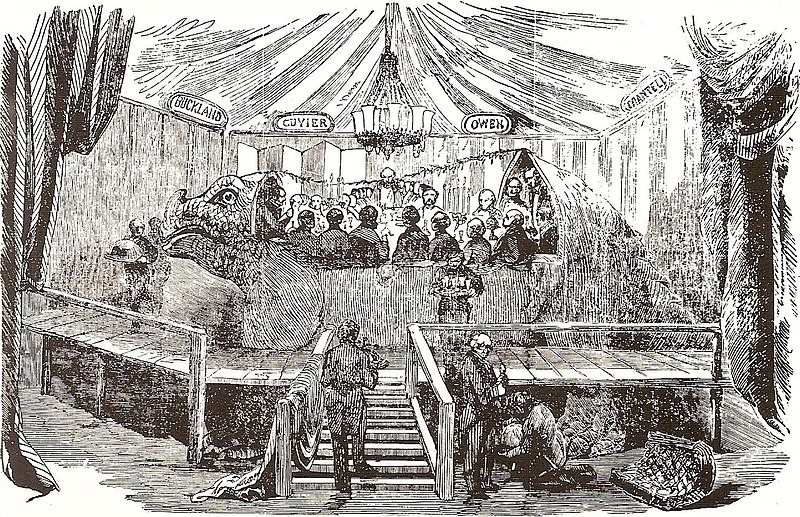
            He and the scientists made a lot of mistakes. For example, when they found a spike from the Iguanodon, they put it on its nose. It was really the creature’s thumb. But they didn’t know they’d made so many mistakes. In fact, they were anxious to show the world their dinosaurs. When the model was half done, they decided to have a dinner party – in the dinosaur!

Public domain, via Wikimedia Commons

            Many important scientists were invited. The seating area was a bit crowded, but everyone had a wonderful time. This was probably the only time in history that a dinner was inside a dinosaur without being the dinosaur’s dinner!

            Since that time, we’ve learned so much more about dinosaurs, including more about how Iguanodon and Megalosaurus looked. They stood with all four legs directly under their bodies and didn’t drag their tails. They were active, not slow, sluggish creatures. But the excitement people felt then is the same excitement people still feel today.

Sources (Click Me!)

Andrei, Mihai. “The Fearsome Megalosaurus: A Glimpse into the Jurassic World.” ZME Science.  9 August, 2023. https://www.zmescience.com/feature-post/natural-sciences/geology-and-paleontology/dinosaurs/megalosaurus/

Norman, David. The Illustrated Encyclopedia of Dinosaurs. Crescent Books, 1985.

Osterloff, Emily. “Dinosauria: How the ‘terrible lizards’ got their name.” London Natural History Museum. https://www.nhm.ac.uk/discover/how-dinosaurs-got-their-name.html

Walker, Bob. “Gideon Mantell: The Forgotten Man Who Discovered Dinosaurs.” The Guardian. 2020. https://www.theguardian.com/science/2019/feb/03/gideon-mantell-play-fight-over-first-dinosaur