Sixty-six million years ago, life on Earth was very different from today. Trees, ferns, and flowering plants covered the land. There wasn’t any grass (despite what the picture below shows. I couldn’t find a free Cretaceous scene anywhere without green ground). Grass hadn’t evolved yet.

The only mammals were small creatures, no bigger than about three feet long. Dinosaurs dominated the planet. There were small dinosaurs, medium-sized dinosaurs and BIG dinosaurs. They lived in every part of the world. They lived in valleys and on mountains. They lived in dry places and wet places. They lived in forests and on open plains. They had ruled the Earth for 180 million years, and it seemed they would continue to do so indefinitely.
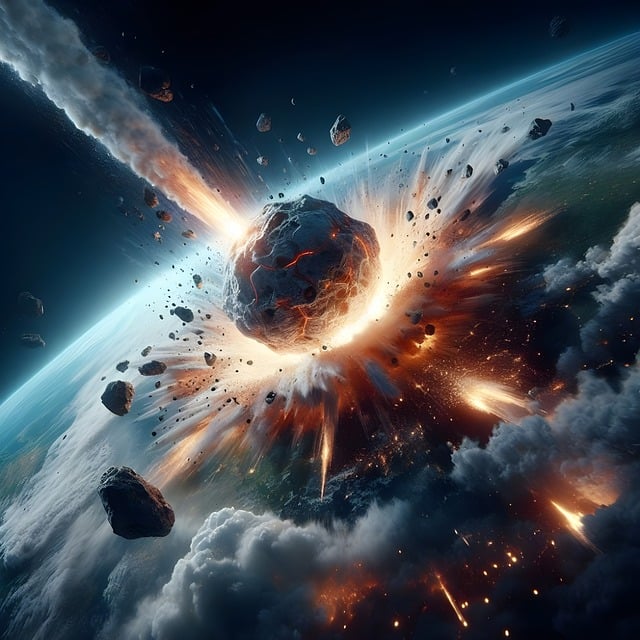
But out in space an asteroid was plunging toward Earth. It was about six miles wide and the height of Mt. Everest. When it reached the Earth’s atmosphere, it would have looked like a fireball brighter than the sun. It was seen, though, for only a few seconds before it hit the Earth because it was hurtling through the air at about 45,000 mph! It hit in the Yucatan Peninsula in Mexico, forming a crater that covers a large portion of the Gulf of Mexico. The crater has been named Chicxulub (CHICKS-ih-lube) Crater.
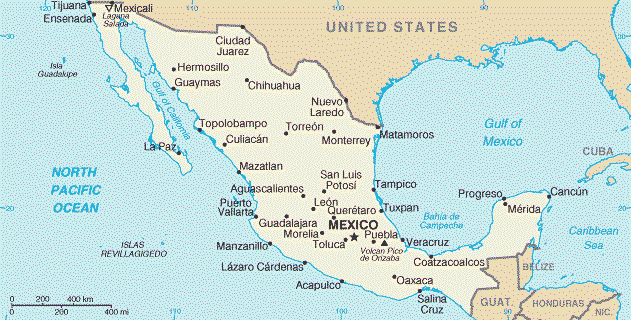

The asteroid hit with a force 10 billion times larger than the atomic bomb detonated on Hiroshima, blowing a hole in the ground 120 miles wide and 18 miles deep. Imagine how loud that explosion must have been! In an instant, the intense heat of the explosion vaporized the asteroid and turned thousands of cubic miles of rock into liquid and spewed it into the air, like a colossal volcano erupting. Anything within 600 miles or more would have been instantly incinerated by the fireball. A combination of soot, sulfuric gases, and extremely fine dust was flung into the atmosphere. For the next several hours, titanic winds blew this debris around the whole Earth. They ignited a world-wide firestorm that probably killed most of life on Earth. In addition, a mega-earthquake shook all of Mexico and Central America, the southern United States, and as far south as far as Argentina. The earthquake (magnitude 13 – likely the biggest earthquake the Earth has ever felt) triggered giant tsunamis and mudslides. One-thousand-foot-high waves of water hit the coast where now Texas, Alabama, Mississippi, northern Mexico, and Cuba lie. Secondary waves traveled as far as what is now North Dakota.
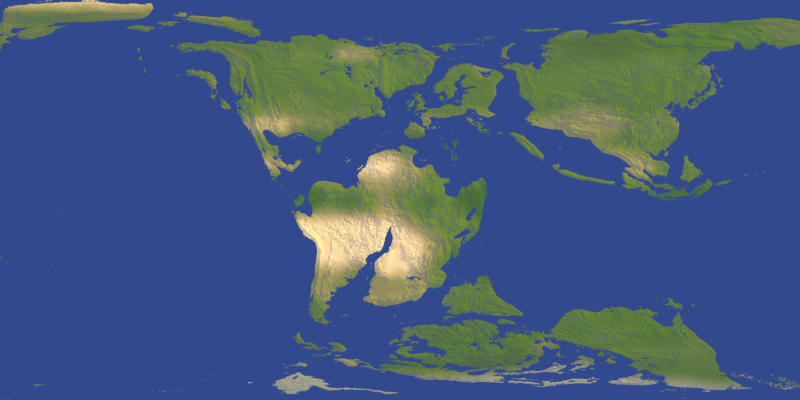
Merikanto, CC BY-SA 4.0, via Wikimedia Commons
Life that somehow survived this, now faced another horror. Dust and soot lingered in the atmosphere blocking most of the sunlight for at least a year. Without sunlight plants couldn’t grow and thrive. Plant eaters lost their food source and died. Meat eaters lost their food source and died. In addition, the lack of sunlight lowered the temperature on Earth by about 80° Fahrenheit.
As if this weren’t bad enough, volcanos in India had been erupting at this same time, with lava flows covering 190,000 square miles of land, killing all life in that area. The eruptions also added more toxic fumes and debris to the atmosphere.
Scientists disagree about how long it took, but about 75% of all life on earth, plant and animal, died because of the asteroid hit and the volcanos, including all the dinosaurs (except birds which most scientists believe are direct descendants of dinosaurs). Some small animals survived, including the ancestors of today’s frogs, snakes, lizards, alligators, crocodiles, a variety of insects, birds, and mammals.
How do we know all this happened? I’ll explain in my next blog.
Death of the Dinosaurs: Part 2
Death of the Dinosaurs: Part 3
Sources (Click Me!)
“Asteroid as Powerful as 10 Billion WWII Atomic Bombs May Have Wiped Out the Dinosaurs.” CNN. 10 September 2019. https://wtop.com/gallery/science/asteroid-as-powerful-as-10-billion-wwii-atomic-bombs-may-have-wiped-out-the-dinosaurs/
“Asteroid Impact that Killed Dinosaurs Triggered ‘Mega-Earthquake’ that Lasted Months.” Press Release Montclair State University. 19 October 2022. https://www.montclair.edu/newscenter/2022/10/19/asteroid-impact-killed-dinosaurs-triggered-mega-earthquake-lasted-months/
Black, Riley. “What Happened in the Seconds, Hours, Weeks After the Dino-Killing Asteroid Hit Earth?” Smithsonian Magazine. 9 August 2016. https://www.smithsonianmag.com/science-nature/what-happened-seconds-hours-weeks-after-dino-killing-asteroid-hit-earth-180960032/
Cornell, Sean, et al. “The Tsunami that Killed Dinosaurs!” InTeGrate. Pennsylvania State. n.d. https://www.e-education.psu.edu/earth107/node/1623
Kaufman, Mark. “Scientists Reveal Deadly Earth just after the Dinosaur Asteroid Hit.” 4 November 2023. Mashable. https://mashable.com/article/dinosaur-extinction-asteroid-cause
Lea, Robert. An Asteroid and Volcano ‘Double Punch’ Doomed the Dinosaurs, Study Suggests. Space.com. 21 Sept. 2022. https://www.space.com/dinosaur-extinction-volcanoes-aided-asteroid-impact
Osterloff, Emily. “How an Asteroid Ended the Age of the Dinosaurs.” Natural History Museum of London. n.d. https://www.nhm.ac.uk/discover/how-an-asteroid-caused-extinction-of-dinosaurs.html
Roden, Nathan. “How Did We Find Out that an Asteroid Killed the Dinosaurs?” ScIU Indiana University Bloomington. 8 April 2023. https://blogs.iu.edu/sciu/2023/04/08/an-asteroid-killed-the-dinosaurs/
Smith, Roff. “Here’s What Happened the Day the Dinosaurs Died.” National Geographic. 111 June 2016. https://www.nationalgeographic.com/animals/article/what-happened-day-dinosaurs-died-chicxulub-drilling-asteroid-science
 Dinosaur Lady