The Chicken-Sized Dinosaur

Dinosaurs varied in size, most know the giants, but today we are tackling one of the smallest dinos: Compsognathus

            When most people think of dinosaurs, they think of huge creatures. And many of the dinosaurs were enormous. Supersaurus was longer than a basketball court, and Sauroposeidon (SORE-oh- poe- seye-don) was as tall as a five-story building. But not every dinosaur was huge. During the Jurassic Time Period, when many of the biggest dinosaurs lived, there also lived Compsognathus (KOMP-sog-nath-us)). Compsognathus was a tiny dinosaur, not much bigger than a chicken.

My life-size model of Compsognathus compared to my cat.

            The largest Compsognathus ever found was not quite four feet long – and most of that was just its tail. It stood about 11 inches high at the hip and weighed about 9-12 pounds. There were some advantages to being a tiny dinosaur in a land of giants. Many big meat eaters were likely to overlook such a small animal. They could feast on hundreds of pounds of tasty plant eaters. Why should they bother with one, stringy, little mouthful?

            Of course, it wouldn’t be so great to be caught in the path of one of the giant dinosaurs. Some of the really big ones could step on a Compsognathus and hardly know it – the way you might step on a large bug.

            But Compsognathus wasn’t likely to get stepped on often. Scientists say it was built for speed with hollow bones and a slender, streamlined body. It ran on two long, strong, back legs, and its tail helped keep it balanced as it ran. It could zip along dodging giant dinosaurs with ease.

            It may not have needed to dodge too many other dinosaurs. Only two skeletons of Compsognathus have been found, and both of them seemed to have lived on atolls, islands that have a lagoon in their center. If all Compsognathus lived on these types of islands, they may have been the biggest predator on them.

Satellite picture of the Atafu atoll in TokelauAtafu.jpg: NASA Johnson Space Center derivative work: Talkstosocks, Public domain, via Wikimedia Commons

            Compsognathus still needed to be speedy – to catch its own food. Scientists think Compsognathus ate such things as insects, frogs, and small lizards. It took speed to catch such quick-moving creatures. One skeleton of a Compsognathus was found with a particularly fast lizard in its stomach. The lizard may have been fast, but Compsognathus was faster. 
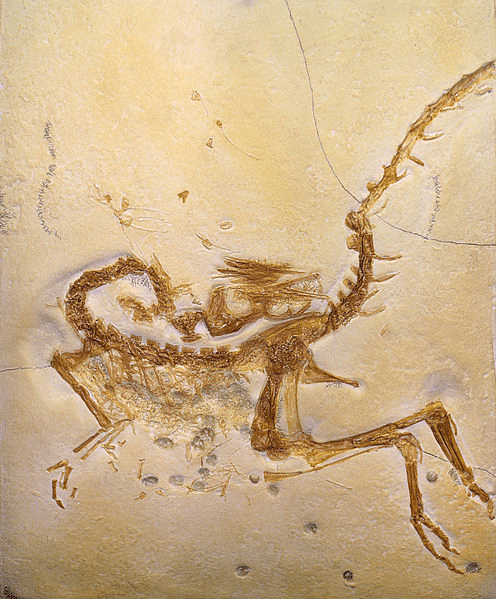
Compsognathus skeletonH. Zell, CC BY-SA 3.0, via Wikimedia Commons

            Compsognathus could grab its lunch with the long fingers on its hands. It had three fingers on each “hand,” but only two of them were usable. Each one of them had a very long claw, good for grabbing food. Once it caught its lunch, Compsognathus could crunch its victim with its many sharp, pointed teeth, though it may have just swallowed it whole. The name Compsognathus means “pretty jaw,” but if you were a pterosaur (TAIR-uh-sore), grounded with a broken wing, you wouldn’t think those jaws were so pretty.

            It’s hard for scientists to learn much about Compsognathus and other little dinosaurs because so few of their skeletons are ever found. Many such dinosaurs were probably gulped down whole by big meat eaters. Even if a tiny dinosaur were fossilized, chances are no one would find it. It’s just much easier to find a six-foot bone than a two-inch one. 

Rigorius, CC BY-SA 4.0, via Wikimedia Commons

            Scientists have found a few dinosaurs that were as small or even smaller than Compsognathus. These include Microraptor which is in the same family as Velociraptor and Utahraptor, except it was only two feet long and weighed about two pounds, and Aquilops, (uh-QUIL-ops) which was a little bigger – 3-5 pounds. Its descendants included the mighty Triceratops. Studying them alongside Compsognathus makes scientists think that any small dinosaur must have been quick and active.

            Scientists want to learn all they can about what made small dinosaurs special. They would like to know whether they lived in packs or by themselves. In the Jurassic Park franchise (where they were called “compis”) a pack of Compsognathus were shown working together to attach someone, but we don’t know if that was true or not. Scientists would also like to know whether or not they took care of their babies or left the babies alone to fend for themselves. And they would like to know whether they lived in fear of the big dinosaurs or simply ignored them. 

            So far, the fossil record hasn’t answered those questions. In the meantime, scientists continue to search for clues. One thing is already known – tiny dinosaurs are just as fascinating as huge ones!
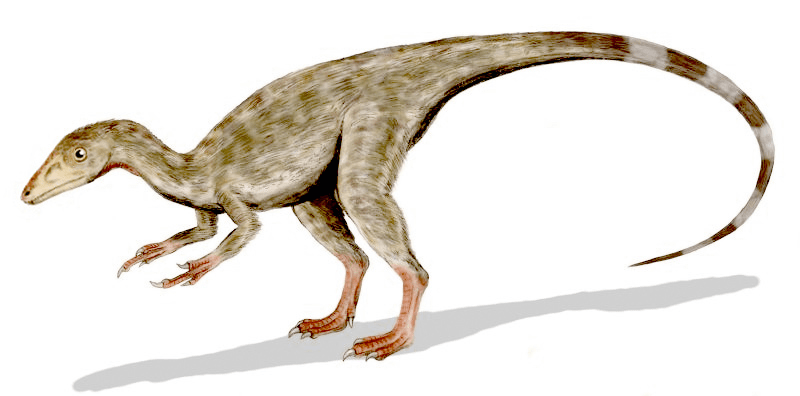
CompsognathusNobu Tamura (http://spinops.blogspot.com), CC BY-SA 3.0, via Wikimedia Commons
Sources (Click Me!)

“Compsognathus.” Dinosaur Facts. DinosaurFacts.net. n.d. http://www.dinosaurfact.net/jurassic/Compsognathus.php

Norman, David. The Illustrated Encyclopedia of Dinosaurs. Crescent Books, 1985.

Riehecky, Janet. Compsognathus. The Child’s World, 1991.

Strauss, Bob. “The 19 Smallest Dinosaurs and Prehistoric Animals.” ThoughtCo. 5 Apr. 2023, thoughtco.com/smallest-dinosaurs-and-prehistoric-animals-1093812.
Velociraptor or Not

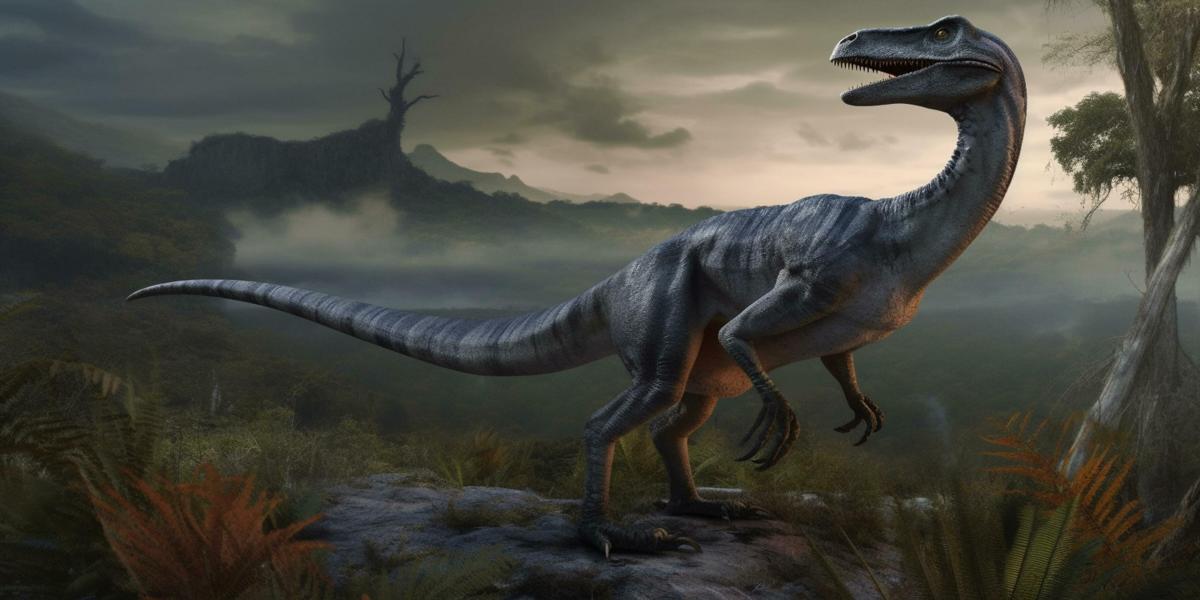
How accurate is Jurassic Park?

            In the first movie of the Jurassic Park series, the second scariest dinosaur was Velociraptor. (Scariest? T-rex, of course.) The movie showed a creature that was about six feet tall, with a huge foot claw that it held upright. Its body was thick, like a tyrannosaur, it was highly intelligent, and it hunted in a pack during the day. Given that most of us like watching movies with scary creatures, a star was born. Overnight Velociraptor became famous.

            But like many movies, Jurassic Park got it wrong. In fact, pretty much all of it was wrong. To start with, Velociraptor was little: only about three feet tall (one meter) measured at the hip. From the tip of its nose to the end of its tail, it measured about six feet (2 meters), but almost half of that length was its long, stiff tail. When Velociraptor was fully grown, it weighed only about 33 pounds (15 kg). A Great Dane, which is about the same height, can weigh up to 140 pounds (64 kg.).

Why is the height of a dinosaur measured at its hip? (Click Me)

Dinosaurs that walked on two legs didn’t stand upright. They leaned forward (sometimes a little, sometimes a lot) and used their tail to balance their head. This means that the head wouldn’t always be at the same height. It could go up and down. But the legs of dinosaurs are directly under their bodies, so the measurement of height at the hip would always be the same.

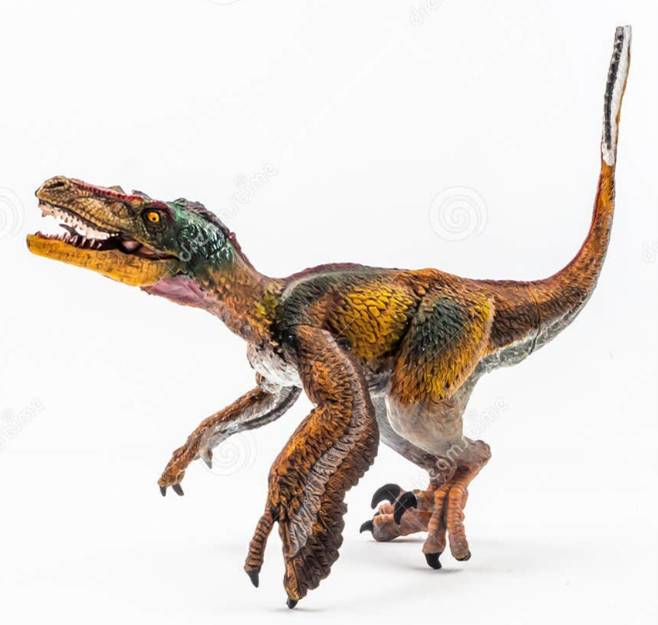
            The movie showed Velociraptor covered with scales, but scientists have found marks on the arm and tail bones of this dinosaur that show feathers were attached there. In fact, it’s likely their whole bodies were covered with feathers. However, though their arms may have looked like wings, Velociraptors weren’t capable of flight. Their arms were too short, and their bodies were too long. Instead, they walked on two legs.

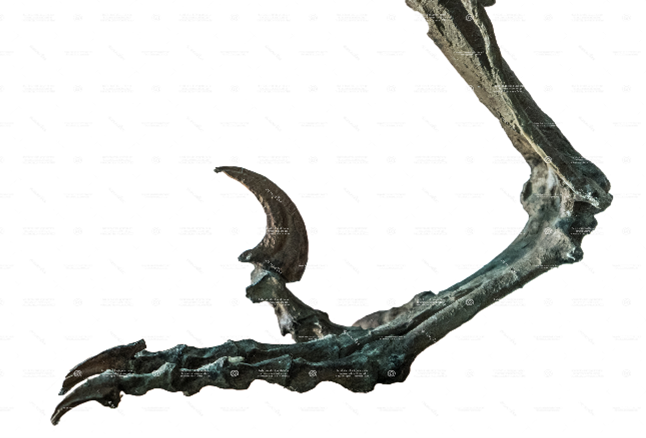
            If you’re now picturing a fluffy, cute, little dinosaur, think again. It would not make a good pet. It may have been only about the size of a Great Dane, but it was a fierce hunter. Its upright, sickle (curved in an arc) claw was about 2½ inches (6.5 cm.) long, measured around the outer edge. That’s not very big compared to that claw in the movies, but an eagle’s talons are only two inches long, and think of the damage it can do with those!

            The movie did get it right that Velociraptor was a carnivore, a meat eater. It had a mouth full of very sharp, serrated (having a jagged edge , like a steak knife) teeth.  Its head was flat with large eyes that enabled it to see very clearly. It also had great senses of smell and hearing. The three claws on each hand were very sharp. Each foot had sharp claws, too, including that famous sickle claw. This claw was held up off the ground, which kept it very sharp. Claws that scrape along the ground become dull.

            The movie showed a highly intelligent, coordinated attack by a pack of Velociraptors in the daytime. However, none of that is true. First, Velociraptor was not that smart. Its brain was large compared to its body, but it’s a small body and a small brain. It was about as smart as a bird of prey, such as a hawk. Many modern mammals could have outthought it.

            Next, it probably wasn’t a pack hunter. Strangely, it is their teeth that make some scientists think this. Scientists have analyzed the teeth of young Velociraptors and compared them to adult Velociraptors. They’ve found that the chemicals in each set of teeth are different. This is important information because in pack animals the chemical makeup of the teeth is usually the same because old and young share the same food.

Dragos Andrei, CC BY-SA 4.0 <https://creativecommons.org/licenses/by-sa/4.0&gt;, via Wikimedia Commons

            Young animals which are not taken care of by their parents or the pack usually have different chemicals in their teeth than adults because they eat different food. They would eat lizards and insects, small creatures that a little dinosaur could catch. As an adult they’d eat bigger things. Young animals that have not been taken care of by their parents also tend not to hang out with others of their kind. And, dinosaurs are more closely related to reptiles and birds which generally do not hunt in packs. So, at least for right now, these facts have caused scientists to lean toward the theory that Velociraptor did not hunt in packs.  

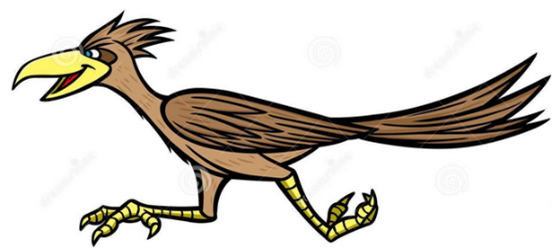
            But whichever way it goes, it is certain that Velociraptor’s slim body and long legs made it a fast runner. It could run as fast as a roadrunner, maybe as fast as 25 mph (40 kph). Small prey, with their short legs, didn’t stand a chance of outrunning it. Their only chance of escaping lay in having a big head start because Velociraptor’s leg muscles weren’t strong enough to run really fast over a long distance.

            Sometimes Velociraptor is shown in books and movies using its sickle claw to rip open its prey, but that isn’t likely. The claw could break through the skin of a dinosaur, but tests show it wasn’t strong enough or long enough to kill another animal. Most likely that claw was used to hold onto its prey while Velociraptor used its other claws and its teeth to kill. Hawks and various other birds of prey use their talons in this way.

            Velociraptors also probably hunted at night, not in the day as in Jurassic Park. Scientists have noted that all birds and many reptiles alive today have a ring of bone around the eye. In those animals that hunt at night, the opening in the ring is large, to let in as much light as possible. Those that hunt in the day have a much smaller opening. Velociraptor has a large opening in its ring of bone. This makes it almost certain that it hunted at night. And that makes sense as the area Velociraptor lived in was mostly desert. It would want to hunt at night when it would be cooler. Its body wouldn’t overheat, and small creatures would be more likely to come out.

            All in all, Velociraptor is not much like the creature in the movie that made it famous, but the real Velociraptor was still a deadly predator.

            Which do you like better? The real Velociraptor or the one in the movie? Please let me know in the comments below.

Sources (Click Me)

“Dinosaurs: Where Jurassic Park Got It Wrong.” The Guardian. Theguardian.com. 8 Feb. 2009. https://www.theguardian.com/science/2009/feb/08/jurassic-park-dinosaur-inaccuracies

Hendry, Lisa. “Vicious Velociraptor: Tales of a Turkey-sized Dinosaur.” Natural History Museum London. https://www.nhm.ac.uk/discover/velociraptor-facts.html.

Maxwell, W. Desmond, and John H. Ostrom. “Taphonomy and Paleobiological Implications of Tenontosaurus-Deinonychus Associations.” Journal of Vertebrate Paleontology, vol. 15, no. 4, [Society of Vertebrate Paleontology, Taylor & Francis, Ltd.], 1995, pp. 707–12, http://www.jstor.org/stable/4523664.

Osterloff, Emily. “Were Dinosaurs Good Parents?” Natural History Museum London. n.d. https://www.nhm.ac.uk/discover/were-dinosaurs-good-parents.html

Switek, Brian. “Dinosaurs Behaving Badly: Did Velociraptors Hunt in Packs?” 29 March 2011. The Guardian. https://www.theguardian.com/science/blog/2011/mar/29/dinosaurs-behaviour-raptors-pack-hunters

Taylor, Ian. “The Scary Truth about Velociraptors.”  Science Focus. BBC Focus Magazine. 30 May 2021. https://www.sciencefocus.com/nature/the-scary-truth-about-velociraptors/

Velociraptor Had Feathers, Scientists Say.” CBS News. 20 Sept. 2007. https://www.cbc.ca/news/science/velociraptor-had-feathers-scientists-say-1.686873

Yong, Ed. “How We Know Velociraptor Hunted by Night.” National Geographic. 14 April 2021. https://www.nationalgeographic.com/science/article/dinosaurs-around-the-clock-or-how-we-know-velociraptor-hunted-by-night

First feathered dinosaur from Dreamstime, paid for July 15, 2023