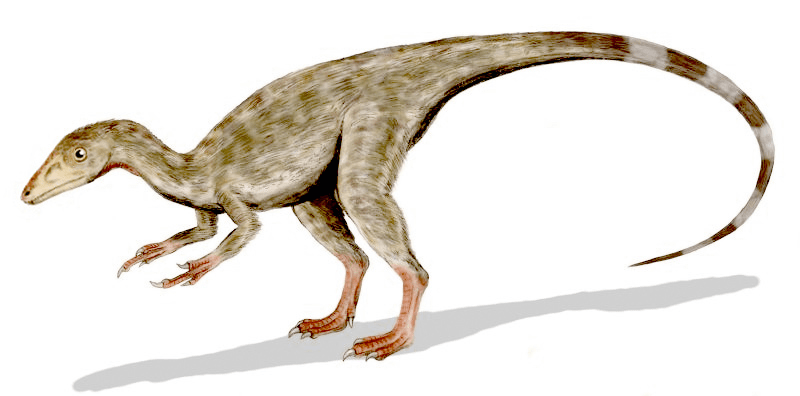
When most people think of dinosaurs, they think of huge creatures. And many of the dinosaurs were enormous. Supersaurus was longer than a basketball court, and Sauroposeidon (SORE-oh- poe- seye-don) was as tall as a five-story building. But not every dinosaur was huge. During the Jurassic Time Period, when many of the biggest dinosaurs lived, there also lived Compsognathus (KOMP-sog-nath-us)). Compsognathus was a tiny dinosaur, not much bigger than a chicken.

The largest Compsognathus ever found was not quite four feet long – and most of that was just its tail. It stood about 11 inches high at the hip and weighed about 9-12 pounds. There were some advantages to being a tiny dinosaur in a land of giants. Many big meat eaters were likely to overlook such a small animal. They could feast on hundreds of pounds of tasty plant eaters. Why should they bother with one, stringy, little mouthful?
Of course, it wouldn’t be so great to be caught in the path of one of the giant dinosaurs. Some of the really big ones could step on a Compsognathus and hardly know it – the way you might step on a large bug.
But Compsognathus wasn’t likely to get stepped on often. Scientists say it was built for speed with hollow bones and a slender, streamlined body. It ran on two long, strong, back legs, and its tail helped keep it balanced as it ran. It could zip along dodging giant dinosaurs with ease.
It may not have needed to dodge too many other dinosaurs. Only two skeletons of Compsognathus have been found, and both of them seemed to have lived on atolls, islands that have a lagoon in their center. If all Compsognathus lived on these types of islands, they may have been the biggest predator on them.

Compsognathus still needed to be speedy – to catch its own food. Scientists think Compsognathus ate such things as insects, frogs, and small lizards. It took speed to catch such quick-moving creatures. One skeleton of a Compsognathus was found with a particularly fast lizard in its stomach. The lizard may have been fast, but Compsognathus was faster.
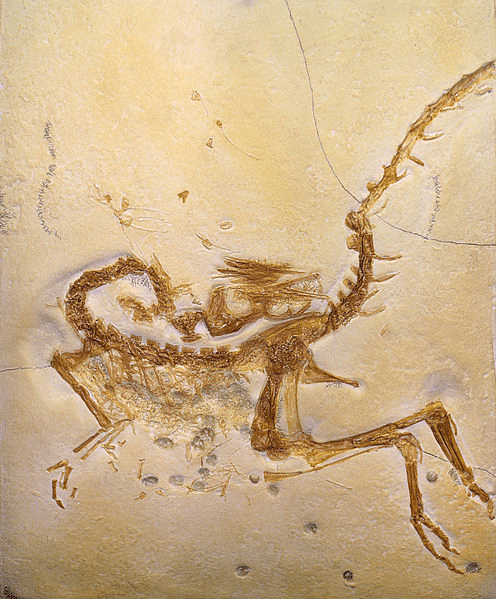
Compsognathus could grab its lunch with the long fingers on its hands. It had three fingers on each “hand,” but only two of them were usable. Each one of them had a very long claw, good for grabbing food. Once it caught its lunch, Compsognathus could crunch its victim with its many sharp, pointed teeth, though it may have just swallowed it whole. The name Compsognathus means “pretty jaw,” but if you were a pterosaur (TAIR-uh-sore), grounded with a broken wing, you wouldn’t think those jaws were so pretty.
It’s hard for scientists to learn much about Compsognathus and other little dinosaurs because so few of their skeletons are ever found. Many such dinosaurs were probably gulped down whole by big meat eaters. Even if a tiny dinosaur were fossilized, chances are no one would find it. It’s just much easier to find a six-foot bone than a two-inch one.

Scientists have found a few dinosaurs that were as small or even smaller than Compsognathus. These include Microraptor which is in the same family as Velociraptor and Utahraptor, except it was only two feet long and weighed about two pounds, and Aquilops, (uh-QUIL-ops) which was a little bigger – 3-5 pounds. Its descendants included the mighty Triceratops. Studying them alongside Compsognathus makes scientists think that any small dinosaur must have been quick and active.
Scientists want to learn all they can about what made small dinosaurs special. They would like to know whether they lived in packs or by themselves. In the Jurassic Park franchise (where they were called “compis”) a pack of Compsognathus were shown working together to attach someone, but we don’t know if that was true or not. Scientists would also like to know whether or not they took care of their babies or left the babies alone to fend for themselves. And they would like to know whether they lived in fear of the big dinosaurs or simply ignored them.
So far, the fossil record hasn’t answered those questions. In the meantime, scientists continue to search for clues. One thing is already known – tiny dinosaurs are just as fascinating as huge ones!
Sources (Click Me!)
“Compsognathus.” Dinosaur Facts. DinosaurFacts.net. n.d. http://www.dinosaurfact.net/jurassic/Compsognathus.php
Norman, David. The Illustrated Encyclopedia of Dinosaurs. Crescent Books, 1985.
Riehecky, Janet. Compsognathus. The Child’s World, 1991.
Strauss, Bob. “The 19 Smallest Dinosaurs and Prehistoric Animals.” ThoughtCo. 5 Apr. 2023, thoughtco.com/smallest-dinosaurs-and-prehistoric-animals-1093812.
 Dinosaur Lady