
One of the most basic things geologists study are layers of rock. You’ve probably seen them.

These layers are laid down by sand, river silt, lava, and other inorganic ground cover. Some are formed quickly; others take thousands of years. Earthquakes can shove some layers up and others down. Each layer represents an era of time.
Scientists can determine the age of layers of rock by looking at fossils and elements found in the rock. Some elements are especially helpful in this because they change over time. For example, some forms of potassium change into argon. Scientists know how long it takes for this to happen (millions of years), so by measuring how much of a sample is still potassium and how much argon, they can tell how old the rock is. They can also do this with some uranium, which changes into lead. It’s more complicated than that, but that’s the basic idea.
Scientists have known for a long time that there is a layer of rock that marks the end of the dinosaurs. It’s called the K-Pg boundary and it dates to 66 million years ago, (K stands for the German word for Cretaceous and the Pg for Paleogene, the next time period.) Below that layer dinosaur fossils are found. No dinosaur fossils have ever been found above it.
At first, scientists believed that this extinction happened gradually. Dinosaurs died out because they were replaced by “superior” mammals. But in the mid-1970s, while studying layers of rock in Italy, geologists Walter Alvarez and Bill Lowrie, noted that the layer of rock below the K-Pg boundary had loads of microfossils of sea creatures in it, but a thin layer of clay just above it had almost none. It looked like nearly all these creatures had died suddenly. Alvarez realized that their near extinction occurred at the same time with a much bigger extinction – the dinosaurs!
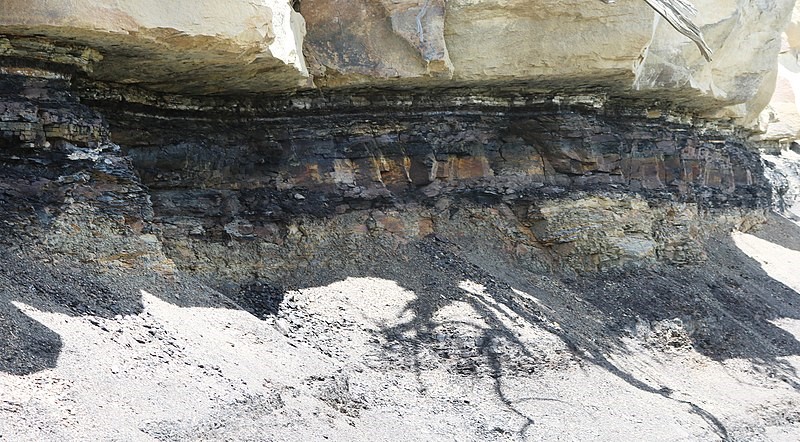
Jeffrey Beall, CC BY 4.0, via Wikimedia Commons
Alvarez talked to his father, Luis Alvarez, a Nobel prize winning physicist, about the problem. His father had the idea of trying to look for the element iridium in order to tell if the layer of clay was deposited quickly (which could mean a catastrophe killed the dinosaurs) or gradually (which would mean scientists were right about dinosaurs dying off slowly). Iridium comes from asteroids. It’s very, very rarely found on Earth. But dust from asteroids drifts down through the atmosphere in tiny amounts at a consistent rate. If there was a lot of iridium dust, that would mean the extinction happened gradually. If a small amount, then it happened quickly.
But father and son were not prepared for what they found: a lot of iridium. That should have meant that the layer was laid down gradually, but it was too much iridium, nine times more than just dust could account for. They decided to look in another location of the K-Pg boundary to see if they found the same thing. They found a site in Denmark. It also had lots of iridium. Later a site in Spain got the same result.
Father and son discussed the idea that the iridium could have come from an asteroid hitting the Earth, but they couldn’t figure out how one impact could cause worldwide extinction. Walter presented the iridium data at a conference and met with lots of resistance. Scientists did not want to let go of the idea that dinosaurs had died out gradually.
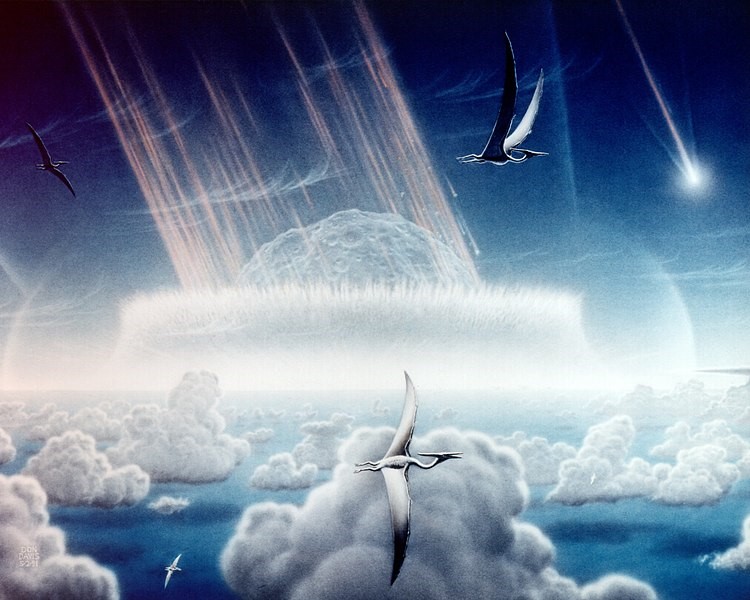
Donald E. Davis, Public domain, via Wikimedia Commons
Luis then had the idea that a large enough impact would cast so much debris into the air that sunlight would be blocked. With no sunlight, plants wouldn’t grow. Plant eaters would have nothing to eat and would die. Then meat eaters would have nothing to eat. This could cause mass extinction. Meanwhile, reports came in from all over the world showing lots of iridium in the K-Pg boundary. But nearly all scientists still rejected the idea of an asteroid impact leading to mass extinction.
Over the next decade other evidence of an impact was found in rocks. Scientists found shocked quartz in the K-Pg boundary. Shocked quartz is formed from a powerful shock wave (like an earthquake) passing through rock and deforming the structure inside regular quartz. An asteroid impact would have sent a shock wave like that through the ground. They also found tektites, which are made when rock is heated so hot it becomes liquid (usually by a volcano). Bits of liquid rock are flung into the air. When they get high enough, the rock solidifies, and it falls to Earth in a distinctive tear-drop shape. An asteroid hitting the Earth would have made an explosion so hot it would have melted the rock and produced tektites. Scientists also found sand deposits that indicated a tsunami had occurred and soot from the worldwide firestorm there would have been.
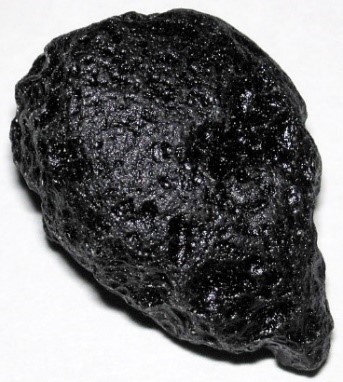
James St. John, CC BY 2.0, via Wikimedia Commons
All this was great, but skeptics still held out. They asked, “If an asteroid hit the Earth, where is the crater that it would have formed?” It wasn’t until 1990 that scientists found that the Gulf of Mexico had been hiding the crater. The Chicxulub Crater in the Yucatan Peninsula became the smoking gun that confirmed that a huge asteroid had indeed struck the Earth. Scientists were able to date the crater to about 66 million years ago – the end of the Cretaceous Period and the end of the dinosaurs. This finally convinced most scientists.

The original uploader was David Fuchs at English Wikipedia., CC BY 3.0, via Wikimedia Commons
Further research has strengthened the asteroid theory. The Chicxulub Crater is the largest impact crater on Earth, about 120 miles wide and 18 miles deep. The asteroid that hit it was about six miles wide and moving about 45,000 mph. As I said in my last blog, it hit with so much power that it blew a huge hole in the Earth and melted thousands of cubic miles of rock, throwing massive debris into the air. We now know that the rock bed of the impact site was limestone and anhydrite. These rocks would have released vast amounts of carbon dioxide, carbon monoxide, and sulfur into the air when they exploded. The sulfur would have combined with water to form acid rain. All this would have contributed to the extinction event by contaminating the air and reducing oxygen.
Imagine the horror of that day – an explosion 10 billion times bigger than the WWII atomic bomb, a tsunami with one-thousand-foot-high waves of water covering what is now Mexico and the southern United States, a magnitude 10 earthquake, a worldwide firestorm, and billions of tons of debris, ash, and acid rain polluting the atmosphere. And don’t forget, as I mentioned last week, there were huge volcanoes erupting in what is now India. We don’t know if the asteroid had anything to do with those eruptions or not, but they certainly contributed to the extinction event. About 75% of life on Earth became extinct.
It’s hard to picture it all, but a recent discovery in North Dakota gives us a freezeframe of that day. That site will be the subject of next week’s blog.
Death of the Dinosaurs: Part 1
Death of the Dinosaurs: Part 3
Sources (Click Me!)
Alvarez, Walter. T.rex and the Crater of Doom. Princeton University Press. 1997.
“Asteroid as Powerful as 10 Billion WWII Atomic Bombs May Have Wiped Out the Dinosaurs.” CNN. 10 September 2019. https://wtop.com/gallery/science/asteroid-as-powerful-as-10-billion-wwii-atomic-bombs-may-have-wiped-out-the-dinosaurs/
“Asteroid Impact that Killed Dinosaurs Triggered ‘Mega-Earthquake’ that Lasted Months.” Press Release Montclair State University. 19 October 2022. https://www.montclair.edu/newscenter/2022/10/19/asteroid-impact-killed-dinosaurs-triggered-mega-earthquake-lasted-months/
Black, Riley. “What Happened in the Seconds, Hours, Weeks After the Dino-Killing Asteroid Hit Earth?” Smithsonian Magazine. 9 August 2016. https://www.smithsonianmag.com/science-nature/what-happened-seconds-hours-weeks-after-dino-killing-asteroid-hit-earth-180960032/
Cornell, Sean, et al. “The Tsunami that Killed Dinosaurs!” InTeGrate. Pennsylvania State. n.d. https://www.e-education.psu.edu/earth107/node/1623
Kaufman, Mark. “Scientists Reveal Deadly Earth just after the Dinosaur Asteroid Hit.” 4 November 2023. Mashable. https://mashable.com/article/dinosaur-extinction-asteroid-cause
Lea, Robert. An Asteroid and Volcano ‘Double Punch’ Doomed the Dinosaurs, Study Suggests. Space.com. 21 Sept. 2022. https://www.space.com/dinosaur-extinction-volcanoes-aided-asteroid-impact
Osterloff, Emily. “How an Asteroid Ended the Age of the Dinosaurs.” Natural History Museum of London. n.d. https://www.nhm.ac.uk/discover/how-an-asteroid-caused-extinction-of-dinosaurs.html
Roden, Nathan. “How Did We Find Out that an Asteroid Killed the Dinosaurs?” ScIU Indiana University Bloomington. 8 April 2023. https://blogs.iu.edu/sciu/2023/04/08/an-asteroid-killed-the-dinosaurs/
Smith, Roff. “Here’s What Happened the Day the Dinosaurs Died.” National Geographic. 111 June 2016. https://www.nationalgeographic.com/animals/article/what-happened-day-dinosaurs-died-chicxulub-drilling-asteroid-science
 Dinosaur Lady

_23.jpg)