Ankylosaurus: The Walking Tank

Most of the dinosaurs that lived millions of years ago were peaceful plant eaters. But, every now and then, into this peaceful life came meat eaters!

            If a plant eater didn’t want to become dinner, it had to be able to defend itself. Some plant eaters were very good at this. They had sharp claws or horns of their own. But one type of dinosaur didn’t need to fight back. All it had to do was squat down. This was the Ankylosaurus (an-KI-luh-sawr-us). The Ankylosaurus had thick, bony armor over almost all of its body.
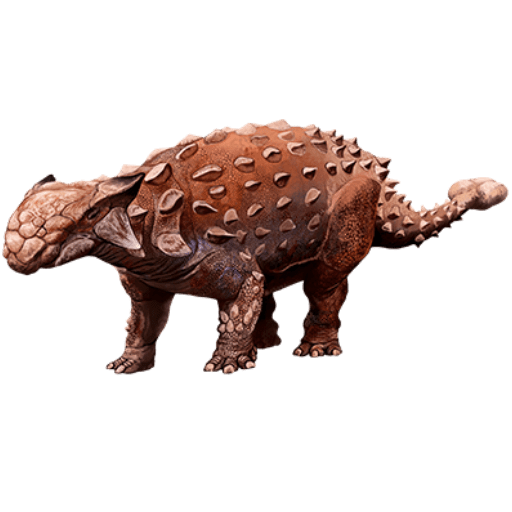
            The Ankylosaurus was a huge dinosaur. That alone would have been enough to discourage most meat eaters. It was just a little smaller than a bus – about 26 feet long and 7 feet tall, weighing as much as five tons. But it didn’t look like a bus – it looked like a tank.

            Tanks are covered with metal armor. The Ankylosaurus’ armor was made from thick bands or plates of bone. Spikes and knobs were scattered across the back and over the head. The armor covered its back, neck, and head – even its eyelids!

Ankylosaurus head cast
Tim Evanson, CC BY-SA 2.0, via Wikimedia Commons

            The armor was probably very frustrating to a hungry meat eater. Even if a meat eater could dodge the knobs and spikes, all it would get was a mouthful of bony armor – and maybe a few broken teeth.

            A meat eater had only one chance. The belly of the Ankylosaurus didn’t have any armor. If the meat eater could get to that soft spot, it could still have an Ankylosaurus snack. But all the Ankylosaurus had to do was crouch to the ground, folding its legs underneath. That way the only parts a meat eater could get to were covered with armor.

Illustration by Diana Magnuson

            Some meat eaters probably tried to flip it on it back. If it were flipped over, the weight of its armor would prevent it from flipping back, much like a turtle. It would be completely helpless. However, trying to flip an Ankylosaurus was like trying to flip a tank. Most ankylosaurs were much too heavy for even the strongest meat eater to budge. And, of course, it was hard to find a place to grab on, with all those spikes and knobs in the way.

            If a meat eater kept on bothering an Ankylosaurus, it ran the risk of provoking the creature into an attack. At the end of its tail, the Ankylosaurus had a huge, bony club. The club was about 16 inches wide and made of solid bone. The muscles in the tail were very strong. If an Ankylosaurus swung its club hard enough, it could probably have knocked down any other dinosaur, even a Tyrannosaurus. It might have been able to break a meat eater’s leg – or its skull – with that club. It certainly would have made that meat eater very sorry it ever wanted an Ankylosaurus for dinner!
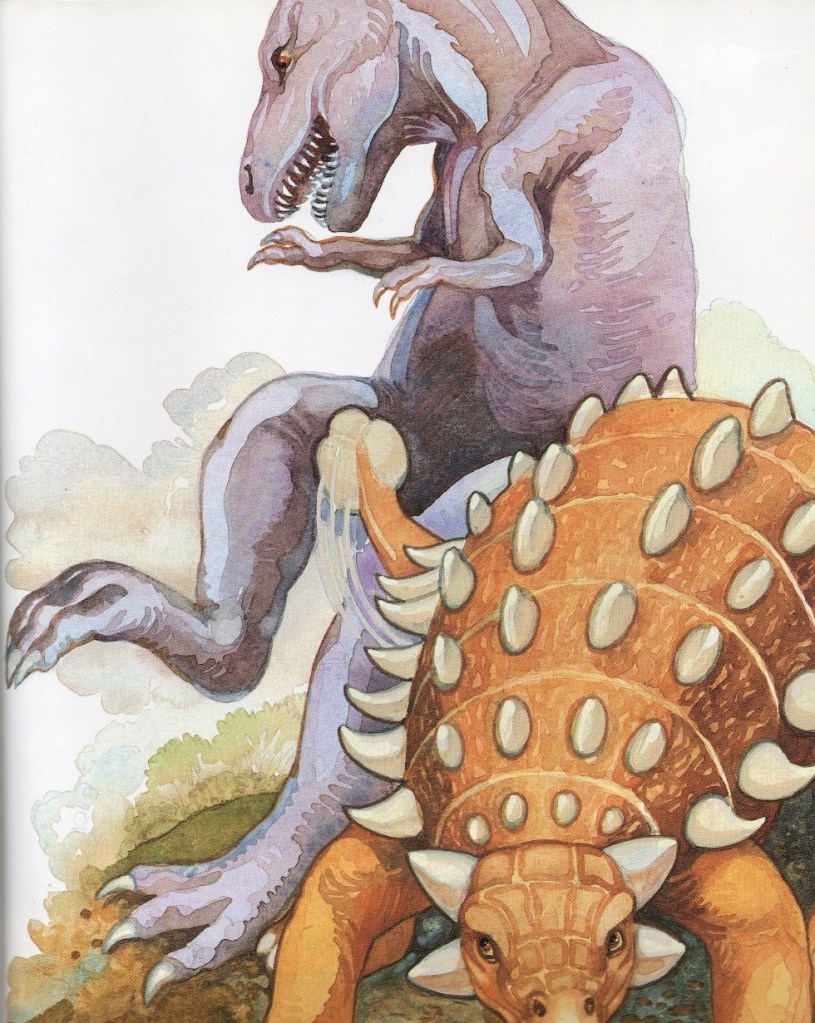
Illustration by Diana Magnuson

            Ankylosaurus had some trouble finding its own dinner. It was hard for it to move its head and neck because of all that armor. And it certainly couldn’t rear up on its back legs with all that heavy bone to lift. That meant that it could only feed on plants that grew close to the ground. Maybe that wasn’t all bad, though. Every now and then it might scoop up some ants or a few beetles for a tasty dessert.

            You might think that the Ankylosaurus with its heavy armor was a slow-moving dinosaur, but it was more like a rhinoceros than a turtle. A rhinoceros is very large and heavy, but it can run fast. Ankylosaurus wasn’t as fast as a rhino, but it could run as fast as 6 mph, which is about as fast as most people can run. The powerful leg muscles of Ankylosaurus helped it to move quickly if it needed to.

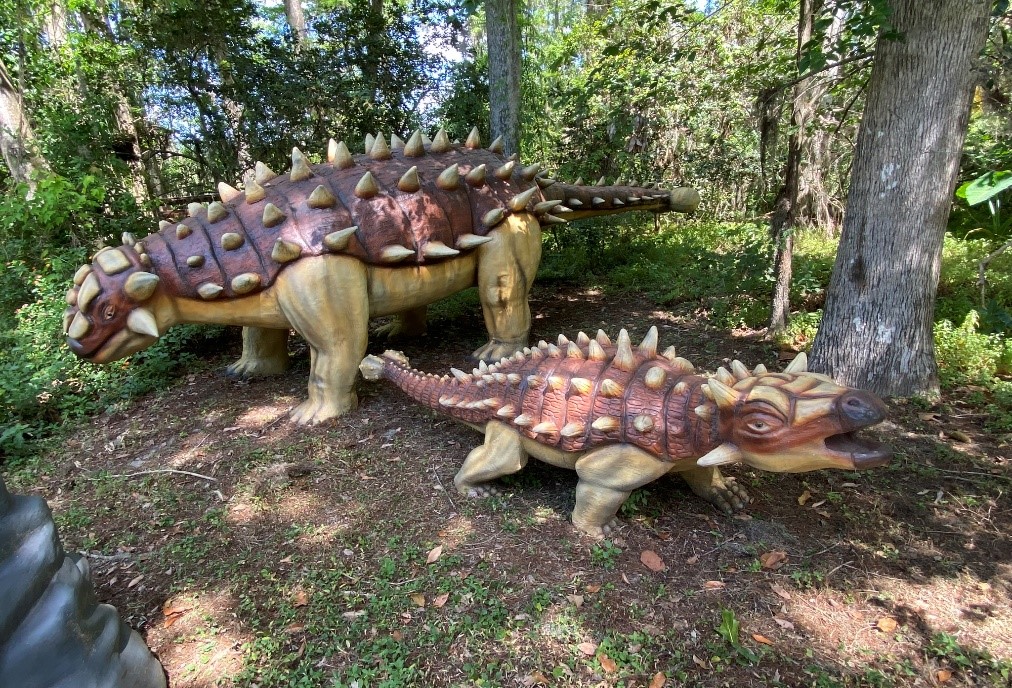
            Ankylosaurus was the biggest armored dinosaur that we know, but it was not the only one. It had many relatives. Some had more spikes. Some had few or none at all. Some had tail clubs. Some did not.
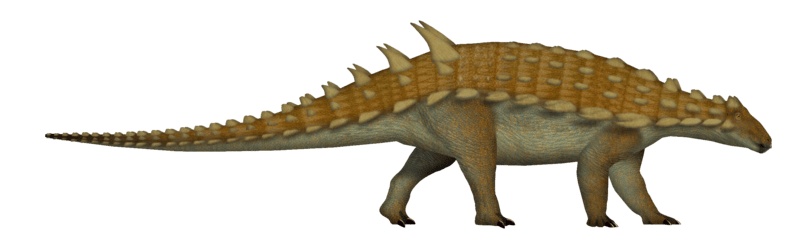
Hylaeosaurus
UnexpectedDinoLesson, CC BY-SA 4.0, via Wikimedia Commons
Yuxisaurus
Xi Yao, Paul M Barrett, Lei Yang, Xing Xu, Shundong Bi, CC BY 4.0, via Wikimedia Commons

            But most of them were good at surviving. Many of the armored dinosaurs lived until the very end of the age of dinosaurs. It wasn’t easy living in the same world as Tyrannosaurus, but it could be done – by a walking tank!

Sources (Click Me!)

“Ankylosaurus.” Natural History Museum of London. n.d. https://www.nhm.ac.uk/ discover/dino-directory/ankylosaurus.html

“Cretaceous Insects.” Western Australian Museum. n.d. https://museum.wa.gov.au/ explore/dinosaur-discovery/cretaceous-insects

Norman, David. The Illustrated Encyclopedia of Dinosaurs. Crescent Books, 1985.

Rasmussen, Patty and Talon Homer. “Ankylosaurus: A Tank-like Herbivore With a Killer Club Tail.” How Stuff Works. 10 July 2024. https://animals.howstuffworks.com/ dinosaurs/ankylosaurus.htm?utm_source=facebook&utm_medium=social&utm_campaign=hsw-owned&utm_content=animals&fbclid=IwY2xjawFYdItleHRuA2Flb QIxMQABHSJZrzMY8s_ckpGF7a0h_hX_66x-bgLwyX_Zqb-4gJSO4DdqauNWL6RUmA_aem_vUroiI23KZyLQ6TE2xysxw

Riehecky, Janet. Ankylosaurus. The Child’s World, 1991.
When Did the Dinosaurs Live?

This blog is the first in a series that will explore the timeline of Earth’s history, from the formation of the planet to the dominance and eventual extinction of dinosaurs.

           This blog is about dinosaurs in time; that is, dinosaurs in the timeline of Earth’s history. Not dinosaurs on time, because dinosaurs were hardly ever on time seeing they didn’t have clocks.

           Scientists say the Earth was formed 4.6 billion years ago. At first it was just molten lava, hundreds of miles deep. Over millions of years the Earth cooled and a crust appeared.

Artist’s impression of the Hadean Eon.
Tim Bertelink, CC BY-SA 4.0, via Wikimedia Commons

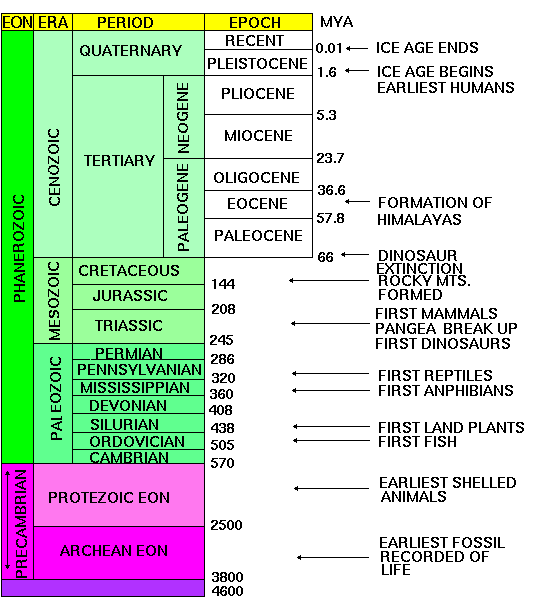
            The first lifeform that existed was a sort of blue-green algae. Then other lifeforms appeared, including shellfish. That whole time period of more than four billion years is called the Precambrian Eon. From 542 million years ago to the present age is the Phanerozoic Eon. It’s divided into three eras, the Paleozoic, the Mesozoic, and the Cenozoic. During the Paleozoic (from 541 to 252 million years ago) life began to bloom. The first fish, first amphibians, and the first reptiles appeared. The first plants also began to grow. But then a massive extinction wiped out 90% of life on Earth. Its cause is not known, but it ended the Paleozoic Era making way for the Mesozoic Era (from 252 to 66 million years ago).

           That’s when we get to the good stuff: Dinosaurs! The Mesozoic is divided into three time periods: the Triassic, the Jurassic, and the Cretaceous. And about halfway through the Triassic Period a new kind of animal evolved: a dinosaur.

Timeline of Earth (MYA means millions years ago))
Thanaben, CC BY-SA 3.0, via Wikimedia Commons

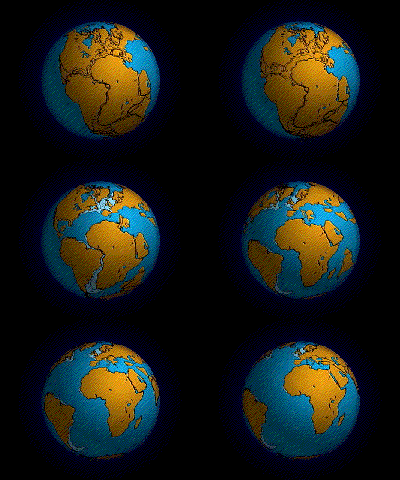
           During the Triassic the Earth was warm and fairly dry, with ice at the north and south poles. (Although Santa Claus hadn’t moved in yet.) Most of the large island masses gathered together in a supercontinent called Pangaea. Conifers, cycads (which looked like mutant pineapples), and ferns were the most common plants, and reptiles ruled the planet. It was about 240 million years ago that the first dinosaurs appeared. They were small and walked on two legs. Over millions of years, they began to change, and many varieties of dinosaurs appeared. Some were meat eaters; others, plant eaters. Some grew to large sizes. These included Riojasaurus and Lessemsaurus. But then 201 million years ago, another mass extinction took place, probably caused by volcanic action in the Atlantic Ocean, rising sea levels, and climate change.

Pangaea breaking up
Public Domain U.S. Dept. of the Interior

           Some dinosaurs survived and moved into the Jurassic Period. Pangaea broke apart and, over millions of years, formed the continents we know today. Their environment ranged from arid deserts to lush tropical forests. Conifers and ferns were the main plants. Most importantly, dinosaurs dominated each new continent. Some of the largest of all dinosaurs evolved during this time, including Alamosaurus, Argentinosaurus, and Dreadnaughtus. The fierce predator Allosaurus also lived in this time period. And the earliest known bird, Archaeopteryx, emerged in the late Jurassic.

USGS; Diarama by Masato Hattori. Map courtesy of Colorado Plateau Geosystems Inc., Public domain, via Wikimedia Commons

           About 140 million years ago, life on Earth began to change dramatically. Many new life forms emerged while others went extinct. There doesn’t seem to have been any big extinction event, but scientists date this as the beginning of the Cretaceous Period (my favorite time period!). Flowering plants appeared, but there were still a lot of the familiar conifers and ferns. Many new, strange-looking dinosaurs dominated the environment. Tyrannosaurus became an apex predator and weird dinosaurs, such as Parasaurolophus, Ankylosaurus, Triceratops and Pachycephalosaurus roamed around.

           Dinosaurs were so abundant it seemed they would rule Earth forever – but an asteroid colliding with Earth 66 million years ago brought their world to an end. The Cenozoic Era began, with an opening for mammals to dominate the world. The asteroid collision will be the subject of my next blog.

Sources (Click Me!)

Davis, Josh. “The Triassic Period: The Rise of the Dinosaurs.” London Natural History Museum, n.d., https://www.nhm.ac.uk/discover/the-triassic-period-the-rise-of-the-dinosaurs.html

“Hadean Eon: The Formation of Earth (4.6 to 4.0 billion years ago).” EarthHow, 2024. https://earthhow.com/hadean-eon/

“Mesozoic.” U.S. Dept. of the Interior. https://www.usgs.gov/youth-and-education-in-science/mesozoic

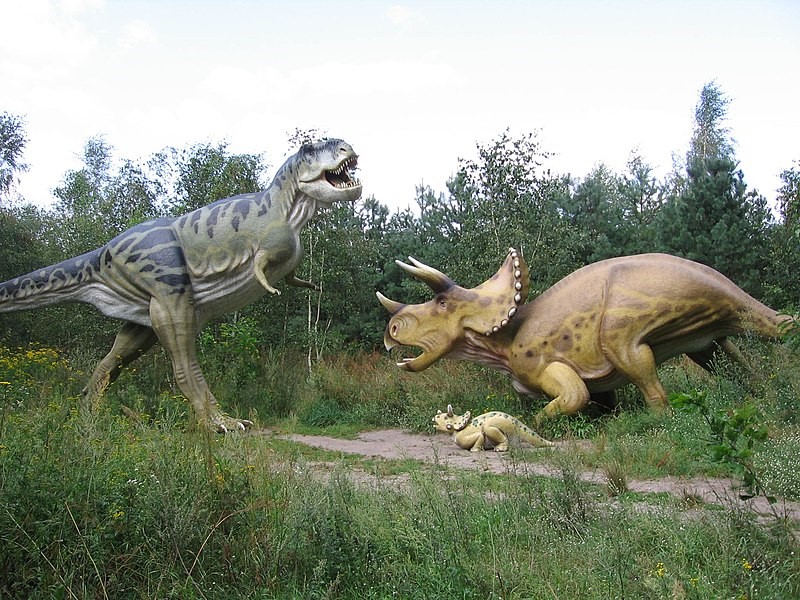
Title Image of Triceratops facing Tyrannosaurus
Marcin Chady, CC BY 2.0, via Wikimedia Commons